Fuquan Xianqiao roses given to poor households bloom into flowers of prosperity
In the course of carrying out targeted poverty alleviation, the Party committee and government of Xianqiao Township, Fuquan City, took local conditions into account and introduced the planting of Damask roses, helping people escape poverty through industrial poverty alleviation, striving to achieve simultaneous development of rural tourism and increased farmers' incomes, and cultivating "flowers of prosperity."
According to reports, the project area involves 58 farming households with 286 people, including 32 poor households with 125 people, on a land area of 170 mu. Routine management of the project can provide nearby employment for surrounding farmers, with wages of 70 yuan per day, and 30-40 people at peak times. This year is the first year the roses bloomed; 1,600 jin were harvested, at a market price of 8 yuan per jin, for total sales of 12,800 yuan. Seeing the benefits, the farmers' enthusiasm greatly increased, and having achieved increased income and prosperity right at their doorsteps, they have all said they want to continue planting roses.
The rose planting project in Dahuashui Village, Xianqiao Township, adopts a "cooperative + base + poor households" operating model, implemented by the Fuquan City Minwang Farmers' Planting Cooperative as entrusted by the Xianqiao Township People's Government. Poor households contribute their financial poverty-alleviation funds as shares; after the project generates benefits, the dividend ratio guarantees a baseline dividend of 5% of the poverty-alleviation funds and increases year by year, with an annual increase of 1%, in a 5-year increase cycle. After the 5-year period ends (when the poor households escape poverty), the poor households are replaced, and the assets formed by the poverty-alleviation funds belong to the village collective, managed uniformly by the cooperative. Growers contribute land as shares, the cooperative invests technology and labor, and after the roses are harvested, the cooperative organizes sales uniformly, with a 30-70 split (30% to the cooperative, 70% to the farmers), forming a "win-win" mechanism.
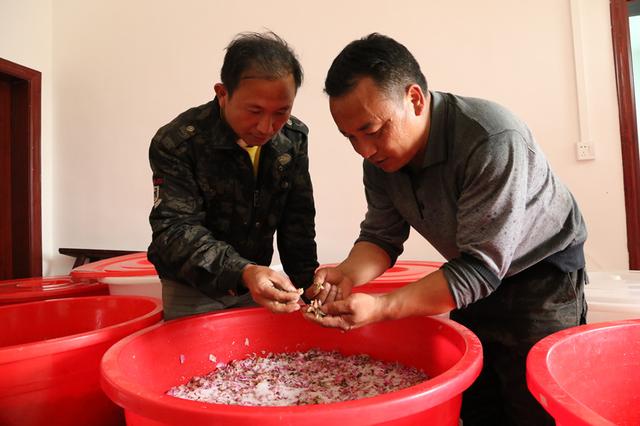
Farmers inspecting the pickling of roses
Roses in full bloom