Detailed Explanation of Key Technical Points for Apple Tree Cultivation and Management in Gansu Province
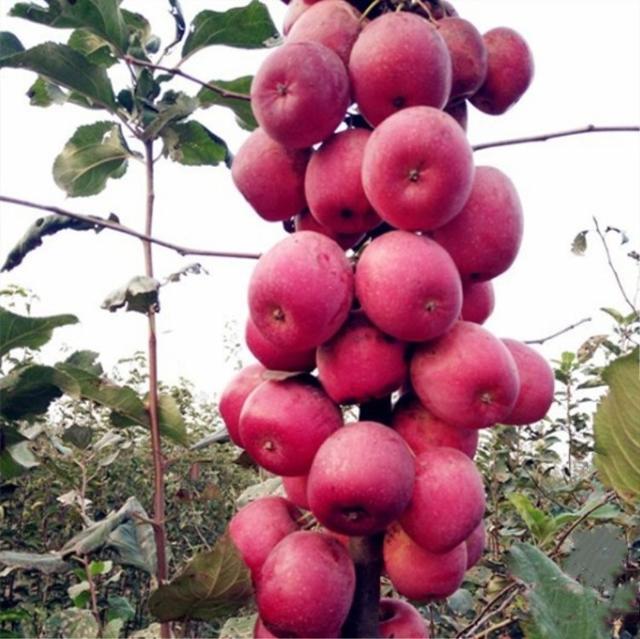
Apple Tree Cultivation and Management Techniques in Gansu Province
During the cultivation and management of apple trees, reasonable fertilization, pruning, and pest and disease control should be carried out according to the actual growth conditions of the fruit trees and local planting conditions, so as to promote the continuous improvement of fruit yield and quality.
1 Raising Large Seedlings
Raising large seedlings can promote increased apple tree yield. The spacing between large seedlings should be controlled at 1-1.5 m, while ensuring appropriate row spacing. Transplanting after successful seedling cultivation can prevent problems such as uneven fruit size and fruit that is too small [Jishan Huayao]. Nutritional pots can be used for raising large seedlings. When the seedlings emerge, they are moved into containers with a diameter of 40 cm, and a nutrient substrate containing rooting powder and organic
matter is added. The abundant nutrients in the nutrient substrate can accelerate the growth and development of the seedlings. After one year of cultivation, the seedlings are already robust enough. At this point, the nutritional pot containers can be removed and the seedlings can be planted directly in the field.
2 Improving Fertility
Fertilizer plays an extremely important role in the growth process of fruit trees, but the soil's own fertility can hardly meet the growth needs of apple trees, so diversified methods are needed to improve fertility.
2.1 Applying Base Fertilizer Well
Base fertilizer mainly consists of farmyard manure, such as pig, cattle, and sheep manure. The effect of using base fertilizer together with chemical fertilizer is relatively good, as it can promote flowering and early fruiting. Methods such as topdressing animal manure and covering the ground under trees with grass can solve the problem of fertility deficiency in some soils.
2.2 Reasonable Topdressing
The timing and amount of topdressing should be reasonably determined according to the growth conditions of the fruit trees. Before flowering, mainly nitrogen fertilizer should be applied; after flower bud formation, while applying nitrogen fertilizer, potassium fertilizer and phosphorus fertilizer should also be applied to reduce fruit drop and promote the growth of branches and leaves; in the middle and late stages, potassium fertilizer and phosphorus fertilizer should be mainly applied, and the amount of nitrogen fertilizer applied should be reduced.
2.3 Precautions
For young fruit trees, circular trenches should be the main method, combined with radial trenches for fertilization. In the process of circular trench fertilization, using the outer edge of the tree canopy shadow as the boundary, strip trenches or circular trenches should be continuously dug outward, and a mixture of fertilizer and soil should be scattered into them. If fertilizer is insufficient or circular trenches are not needed, the radial trench method can be used for fertilization. Mature orchards are more complex. Fertilizer can be scattered throughout the orchard and then deeply dug in. After fertilization is completed, watering is required. When fertilizing and watering, the order must be clear and the procedures standardised. If roots are exposed to the air, they must be buried back into the soil immediately to prevent root damage.
3 Shaping and Pruning
In different growth periods, the methods of pruning fruit trees differ. In the young tree period, shaping is the main focus. When pruning fruit trees in early spring, all branches below 50 cm from the ground should be removed, and the growth direction of the branches should be reasonably allocated. Every 20 cm, 1 branch with a length of more than 70 cm should be retained. After being leveled and notched, appropriate pruning should be carried out. The central trunk should not be cut short. Every 20 cm, 1 circle of branches should be retained to make their growth more uniform. In May-June, shoot twisting and pinching should be carried out. For robust branches, ring cutting of the main branches should be carried out, and the ring cutting method is the same as for the trunk. Trees bearing fruit for the first time should focus on cultivating the tree framework, promoting uniform growth of branches at all levels, and at the same time using notching, peeling, and direction changing methods to build branches, so as to promote bud break in the fruit trees. In the full fruit period, in order not to affect the growth of the fruit trees, while ensuring the fruit-setting rate, the ratio of leaf buds to flower buds should be reasonably adjusted, the retained amount of flowers and fruits should be well controlled, and fruit quality should be ensured. At the same time, the growth of scaffold branches should also be reasonably controlled. Every year, the scaffold branches should be appropriately shortened to ensure the fruiting capacity of the fruit trees, reasonably disperse flower buds, and prevent the occurrence of alternate bearing.
4 Flower and Fruit Thinning
Flower and fruit thinning has the effects of improving fruit quality, ensuring robust growth of fruit trees, and preventing fruit from being too small. The amount of fruit thinning should be determined according to the growth state of the fruit trees. For fruit trees in good growth condition, 1 fruit should be retained for every 4 terminal buds; for fruit trees lacking nutrients, 1 fruit should be retained for every 5 or 6 terminal buds. Flower thinning should be carried out within 30 d after flower drop.
5 Dwarfing
Problems such as insufficient light and ventilation caused by overly dense planting should be avoided. Dwarfing treatment of fruit trees ensures good ventilation and promotes healthy growth of the fruit trees, thereby improving the quality and yield of apple trees and increasing the economic income of fruit growers. Dwarfing and dense planting technology can be used to maximize the number of fruit trees by reasonably increasing fruit tree density, thereby effectively increasing yield.
6 Pest and Disease Control
Aphids, red spiders, anthracnose, and ring rot are the main pests and diseases of apple trees.
6.1 Ring Rot
A 50-fold dilution of 5% Ansol JunDuQing or a 50-fold dilution of 50% carbendazim wettable powder can be used, or 35-fold Pingfu Sukeling can be directly applied to the diseased tumors, or eradication agents can be sprayed before apple trees sprout (200-fold Pingfu Sukeling, 50-fold Fubiqing, 100-fold 35% ring rot eradication agent, 100-fold 50% carbendazim wettable powder, etc.).
6.2 Anthracnose
80% Punuo, 70% Meiqi Jie, 64% Shadufan, 10% Shigao water-dispersible granules (difenoconazole), 75% Daconil (chlorothalonil), etc. can be used.
6.3 Red Spiders and Aphids
A 3000-fold dilution of 75% propargite oil, or a 1000-2000-fold dilution of 5% hexythiazox emulsifiable concentrate, or a 200-fold dilution of 4096 isocarbophos emulsion, or an 800-fold dilution of 40% Yunle emulsifiable concentrate, or a 2000-fold dilution of 3% acetamiprid (Jinshiji) emulsifiable concentrate, or a 3500-fold dilution of 25% imidacloprid wettable powder can be used.