Star jasmine is more worth planting than creeping fig; in just a few years it can grow into a wall of flowers
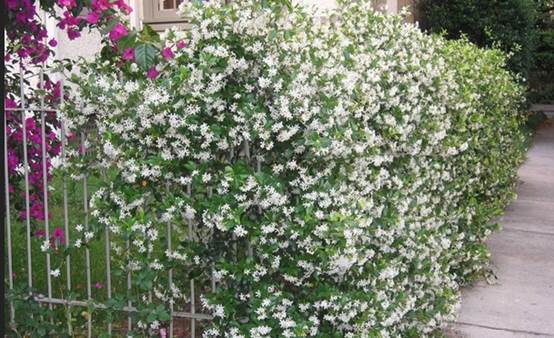
Star jasmine is native to the subtropical regions of southern China and northern Southeast Asia, and it is widely cultivated and associated with the southern United States, which is why it is called "star jasmine." Its glossy dark green leaves are mostly evergreen, but they drop in very cold temperatures. Its fragrant white star-shaped flowers make it a striking but aggressive plant that can grow on fences, walls, tree trunks or telephone poles.
Growth rate
Star jasmine grows 0.9 to 1.8 m in length per year. When first planted, this vine seems to sit dormant through its first summer, adding almost no new stem length. At this time it is not growing leaves but rather an extensive root system. In the second year after planting, its growth rate increases slightly, and by the third spring after planting, star jasmine shows its vigorous and rapid growth rate. By the end of summer, star jasmine will have covered a vast area of the garden, prompting you to prune it back.
Cultivation insights
Star jasmine cultivars such as 'Variegata' and 'Tricolor' do not grow as fast as the fully green-leaved form of this vine. Compared with an increase of 0.9 to 1.8 m per year, variegated cultivars add only 0.3 to 0.6 m per year. The presence of non-green pigments in the leaves reduces the amount of food produced by the green chlorophyll pigments, thereby reducing the growth rate. If you do not want to grow a vine in your garden, you can choose a hybrid star jasmine, which is easier to prune and manage.
Pruning
The southern jasmine vine with green leaves reaches a mature length of between 7.6 m and 10.7 m. If there is no vertical surface to climb, the stems will spread over anything in order to bask in the sun. Pruning can control the shape of southern jasmine, but regrowth is also very rapid and aggressive. The best time to prune this vine is from late spring to early summer, after the main flowering period has ended. In regions with a longer growing season and no frost, such as USDA Zone 9 and warmer, prune in winter. When pruning, a lot of white milky sap will flow from the star jasmine stems. Flowers open only on mature stems at least 6 months old.
Growing considerations
All star jasmine vines, regardless of cultivar, grow best and fastest in non-alkaline soil that is rich in organic matter, moist and well-drained. Planting this star jasmine in hot, dry sand or compacted, unirrigated clay will hinder growth and make the plant look somewhat sickly. Too little light will also hinder growth and inhibit flowering. For best results, give it full sun exposure - 6 to 12 hours per day.