Detailed Explanation of Key Points for High-Yield Cultivation Techniques of Kyoho Grapes
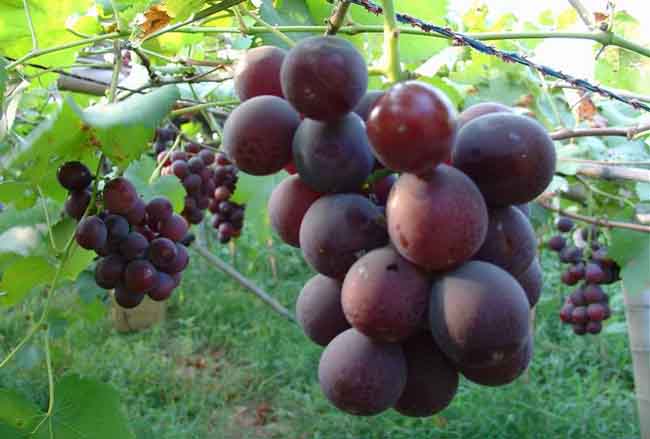
The Kyoho grape variety is a European-American hybrid. In the autumn of 1954, a visiting delegation from Okayama University of Japan to China gifted 4 cuttings, which were propagated by Beijing Agricultural University and began to spread nationwide in the 1960s. Currently, among commercially available table grape varieties, Kyoho grapes are favored by consumers for their large clusters, large berries, vivid color, thick flesh, and balanced sweet-tart flavor. The following key technical points should be well managed in its cultivation:
Main Characteristics of Kyoho Grapes
1. Buds break in early to mid-March, blooms in early May, approximately 138 days from bud break to maturity, with active accumulated temperature of 3132°C——3412°C.
2. Good flower bud differentiation, stable yield.
3. Leaves: medium-sized leaves, average leaf area 138.9 sq cm, maximum leaf area at the pinch point 230 sq cm.
4. Stress resistance: susceptible to black spot disease, gray mold, rachis brown blight, and downy mildew.
Poor Fruit Set: Symptoms and Causes
Poor fruit set has two situations: one is low fruit set rate with severe flower and fruit drop; the other is relatively good fruit set but severe berry size unevenness in the cluster, with normal seeded large berries accounting for a small proportion while abnormal seedless small berries are numerous.
The main causes of poor fruit set in Kyoho grapes are:
1. Abnormal floral organs. The ovule abnormality rate in female organs reaches 76.8%, with only 23.5% able to undergo normal ovule pollination.
2. Long fertilization time. Completing the entire pollination process requires about 120 hours. If adverse nutrition or environmental conditions are encountered, fertilization aborts midway, causing fruit drop.
3. Hormonal imbalance in the plant. In flowers with poor fruit set, gibberellin (GA3) and cytokinin levels are relatively high, which can accelerate ovule maturation, while pollen tube germination remains relatively slow. As a result, the maturation processes of male and female organs are not synchronized, and most ovules miss the fertilization opportunity, leading to flower and fruit drop.
4. Excessive tree vigor imbalance. Overly vigorous new shoots not only promote increased GA3 and other hormone levels in floral organs but also compete for nutrients from the flower pistils, weakening reproductive growth, causing mid-stage abortion of fertilized embryos, and increasing ovary abscission and seedless small berries.
5. Environmental factors. When daytime temperatures during flowering are below 20°C, the proportion of seedless berries increases; rainfall washes away the secretion fluid on the stigma, causing pollen to detach.
Key Cultivation Techniques
Goal: Improve fruit set rate, reduce fruit drop, stabilize yield
1. Control nitrogen fertilizer before flowering, control tree vigor. Before flowering, new shoots should be controlled below 70 cm, which is favorable for fruit set; if new shoot length reaches above 80 cm before flowering, fruit set will be low. The main measures to control new shoot growth are pre-flowering nitrogen control and water control. For vineyards with medium fertility, apply less base fertilizer: 0.5 tons of chicken manure and 100 jin of phosphate fertilizer per mu, without pre-bud fertilizer. After fruit set, apply 100 jin of compound fertilizer + 40 jin of potassium sulfate per mu, split into 2 applications with a 10-day interval. At the hard pit stage, apply 40 jin of potassium sulfate per mu; for vineyards with heavy fruit load, apply 20 jin of compound fertilizer per mu. Apply appropriate potassium fertilizer again at the coloring stage.
2. Pinching before flowering. Pinch 3—5 days before flowering up to the visible flowering stage. For weak shoots, pinch leaving 5—6 leaves above the cluster; for vigorous shoots, pinch leaving 3—5 leaves above the cluster. After pinching (5 days), the plant enters the flowering and fruit set stage, with abundant nutrients concentrated in the clusters, which is favorable for fruit set.
3. Foliar spray of mepiquat chloride before flowering
Mepiquat chloride aqueous solution (auxin) produced by Jiangsu Nantong Shizhuang Chemical Co., Ltd., with 25% active ingredient. Each 15 mg bottle is diluted with 15 jin of water; for vigorous growth, the concentration can be increased to each bottle diluted with 12 jin of water, sprayed 5—7 days before flowering.
4. Yield-controlled cultivation
For high-quality fruit entering supermarkets, yield is controlled at 2500 jin per mu, with 3400 clusters per mu. Generally, yield should be controlled at around 3500 jin per mu, with a vine-to-fruit ratio of 1:0.8—1:1. Each cluster should retain 20—25 effective leaves; the 3—5 leaves above the cluster should not retain lateral shoot leaves; starting from the 5th leaf above the cluster, lateral shoot leaves may be retained. Each cluster should retain 40 berries. Currently, many vineyards in production exceed 4000 jin in yield; the concept of high yield with low-price sales should gradually change.