What causes black-skinned fruit? Detailed explanation of prevention measures
Many farmers who have grown citrus, lemons, and pomelos have experienced this: in summer and autumn, these fruits develop blackened peel, commonly known as “black-skinned fruit”. Some orchards can even be overrun by this black-skinned fruit, with black fruits hanging all over the branches. These fruits are small, sour, and black-skinned, completely losing their value as a commodity. All of this is caused by a pest called the citrus rust mite. This citrus rust mite can be called a killer of citrus appearance. It not only affects the fruit's market appearance, but more seriously affects the taste, leading to a decline in growers' income. What is even more frightening is that this pest can also cause damage for many consecutive years, hence the saying “one year of copper, three years of poverty”. Below, taking citrus as an example, let us understand the causes of this “black-skinned fruit” and the control measures.
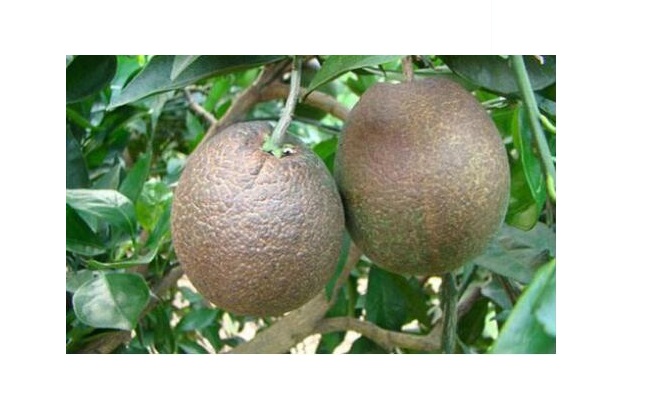
I. Causes
Citrus black-skinned fruit is caused by damage from the citrus rust mite (also known as citrus rust spider, rust mite, or prickly leaf gall mite). The adult mites, nymphs, and larvae of the citrus rust mite use piercing-sucking mouthparts to pierce into fruits and leaves to suck sap. After the oil cells are destroyed, the overflowing oil is oxidized and turns brown to dirty black, which growers call “oil-skin lump” or “oil-skin citrus”. On damaged leaves, the underside is dark brown, as if smoked, and the dirty color cannot be wiped off (the mold layer of sooty mold infection can be wiped off). Once citrus fruits (or leaf undersides) turn dark brown, the best time for control has already been missed. When the rust mite damages citrus trees, it also causes a large number of leaves to turn yellow and fall off, weakening tree vigor and seriously affecting the next year's yield.
II. Development characteristics
The host range of the citrus rust mite is limited to citrus fruit trees. During peak occurrence, larvae, nymphs, and adult mites can be seen at the same time. Adults overwinter on summer and autumn shoots, and the following year move to spring shoots and fruits to cause damage. Generally starting in May, they damage the undersides of tender spring leaves, and the backs of damaged leaves show dark brown net-like patterns, triggering a large amount of leaf drop. From late May to early to mid-June, they begin to damage fruits. July to September is the peak period of rust mite damage, with fruit damage being the most severe. During this period, if there is high temperature and high humidity weather, it is unfavorable for rust mite reproduction; if there is high temperature and drought, rust mite damage worsens, and damage can still occur in October.
III. Control measures
Having understood the causes and development characteristics of this “black-skinned fruit”, next we introduce the control measures that growers are most concerned about. Because rust mites are very small, initially white and later turning pale yellow, and during severe outbreaks insects and eggs appear in patches on leaves and fruits, early observation requires using a magnifying glass to inspect leaves and fruit surfaces, with special attention to leaf undersides. If dust-like mite bodies are found on the surface of individual fruits, chemical control should be carried out immediately. For chemical control of rust mites, first spray the inner and lower parts of the canopy, then the outer and upper parts of the canopy, focusing on leaf undersides and the shaded sides of fruits. The best spraying times are before 10 a.m. and after 5 p.m. Spraying should be careful and thorough. The spray volume should be such that leaves and fruits are moist but no liquid drips off. Generally, spray 2 to 3 times consecutively, with an interval of 7 to 10 days each time.
When it comes to effective chemicals for controlling rust mites, here we introduce a preparation called lime sulfur mixture. Different concentrations can be used according to different seasons: generally 0.2 to 0.3 degrees Baume in spring, 0.1 degrees Baume in summer, 0.2 to 0.4 degrees Baume in autumn, and 0.6 to 0.7 degrees Baume in winter. In high-temperature seasons, the concentration used must be chosen carefully. Other effective chemicals include 75% propargite, 50% cyhexatin, 20% fenpropathrin, 50% fenbutatin oxide, 20% deltamethrin, 40% omethoate, 1.8% abamectin emulsifiable concentrate, 63% zineb wettable powder, and Hirsutella thompsonii powder (70,000 colonies per gram), etc. At present, citrus growers in Yuanjiang City, Hunan Province, use Dacotech (80% mancozeb wettable powder) to control citrus rust mites, with good results and a long residual period. Spraying once with a 600-fold Dacotech solution gives a residual period of 30 to 60 days. In ordinary years, continuous control 1 to 2 times, and in severe outbreak years continuous control 2 to 3 times, can also concurrently control citrus sooty mold and other diseases and pests that easily infect and affect the appearance and color of fruits.
The above is a brief introduction to the occurrence of citrus “black-skinned fruit” and its control methods. During the control process, biological control methods can also be used, utilizing the natural enemies of rust mites, mainly including predatory ladybeetles that feed on mites, predatory mites, long-haired snout mites with tubercles, thrips, and Hirsutella thompsonii, etc., which can also play a certain inhibitory role against rust mites.