How much does a pistachio sapling cost? Detailed planting methods
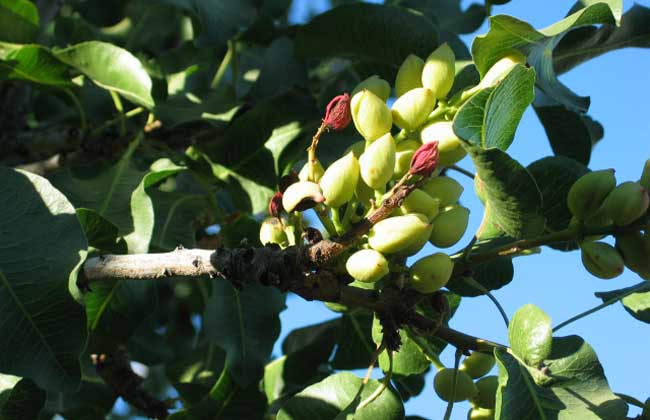
Pistachio is also known as bisi da, green kernel fruit, nameless seed, etc. It is a shrub plant of the genus Pistacia in the Anacardiaceae family, produced in Syria, Iraq, Iran, the southwestern part of the former Soviet Union and southern Europe, and is also cultivated in ** in China with good economic benefits, and can also serve as an excellent tree species for soil and water conservation. Let's take a look at pistachio sapling prices and planting methods below!
Pistachio sapling reference price list
Specification and age Reference price Specification and age Reference price 1-year sapling 2-3 yuan/plant 2-year sapling 6-7 yuan/plant 3-year sapling 10-12 yuan/plant 4-year sapling 18-20 yuan/plant 5-year sapling 24-26 yuan/plant 6-year sapling 35-38 yuan/plant 8-year sapling 50-58 yuan/plant 10-year sapling 70-80 yuan/plantNote: Pistachio trees in China are concentrated in the Kashgar, Hotan and Aksu areas south of the ** Tianshan Mountains, with more planting in Shufu County and Shule County. Sapling prices vary with specification, place of origin and market, so the above is for reference only. Please refer to actual prices.
Planting conditions for pistachio trees
1. Soil: Pistachio trees can grow in almost all types of soil, especially preferring deep, thick, light or dry calcareous sandy loam and yellow loam. They can also grow on gravelly barren mountain land and semi-desert land, but cannot grow in places that are too damp and waterlogged.
2. Water: Suitable planting areas for pistachio trees generally have annual precipitation of 200-400 mm. In areas with annual precipitation below 80 mm, they can still grow, flower and bear fruit tenaciously, but lack of water during the water-sensitive period in summer will result in no fruit at all.
3. Temperature: Pistachio has strong adaptability to temperature, but needs a sufficiently cool winter to break bud dormancy and a long, hot, dry summer to ripen the fruit. During the fruiting period it requires a large day-night temperature difference, and grows well within the range of a maximum of 43.8°C and a minimum of minus 32.8°C.
Planting methods for pistachio trees
1. Orchard site selection: Although pistachio has extremely strong adaptability, it is best to choose loam and sandy loam plots with deep soil layers and good aeration. Pay attention to choosing the middle of hillsides, open flat land, valley land and south-facing slopes sheltered from wind and facing the sun to build the orchard. Do not build the orchard on the windward side of the prevailing wind direction.
2. Seedling planting: The planting spacing for pistachio is preferably 3×4 m or 4×5 m, with 33-55 plants per mu, and in dense planting orchards 83-111 plants per mu. When planting, keep the roots level with the ground, firm the soil while planting, then irrigate thoroughly.
3. Scientific fertilization: Pistachio is generally fertilized 3 times a year. The first time is in early spring or autumn and winter, mainly with quick-acting nitrogen fertilizer; the second time is during the fruit expansion period, mainly with nitrogen and potassium fertilizer; the third time is after fruit harvest, mainly with organic fertilizers such as compost and barnyard manure.
4. Training and pruning: Pistachio likes light and has strong apical dominance. In high-density orchards, the free spindle shape is often mainly used, while in low-density orchards, the natural open-center shape is mainly used.
① Free spindle shape: It features a central trunk, with 10-15 main branches staggered on different parts of the central trunk. The main branches maintain 80-90 degrees with the trunk, and small and medium-sized fruiting branch groups are directly borne on the main branches.
② Natural open-center shape: It features good ventilation and light penetration, with a trunk height of about 40-50 cm. Select and retain 3-4 main branches on the trunk with a basal angle of 45-75 degrees, and 2-4 side branches, with branch groups arranged on the side branches.
5. Flower and fruit management: Pistachio planting should strengthen comprehensive orchard management to enhance tree vigor and promote flower bud differentiation, and apply more organic fertilizer. Because it is self-unfruitful, arranging 1 row of pollinator varieties for every 2 rows of the main cultivated variety helps increase the fruit-setting rate.
Pest and disease control of pistachio trees
1. Gummosis
[Damage characteristics] Gummosis mainly occurs on branches and fruit. On branches with severe gummosis, the bark cracks and is covered with gummy masses, causing the tree vigor to weaken until it dries up and dies.
[Control method] Scrape off the gum in time, clean up the scraped gum thoroughly and burn it in a concentrated manner. After scraping, apply 0.2% gentian violet solution to the diseased spots, and spray lime sulfur mixture before the tree buds.
2. Leaf spot disease
[Damage characteristics] Leaf spot disease begins to harm parts of the leaves and fruit each year when the rainy season starts, turning them brown, causing premature leaf fall, and affecting pistachio fruit development, resulting in serious yield reduction or crop failure.
[Control method] Sweep up fallen pistachio leaves, cut off diseased leaves, burn them in a concentrated manner, and promptly spray the whole plant with Bordeaux mixture during the disease period.
3. Root rot
[Damage characteristics] Root rot is a root-rotting disease harming pistachio. In severe cases, it causes pistachio plants to weaken in growth until they wither and die.
[Control method] Strengthen orchard management, apply more organic fertilizer to enhance disease resistance, and drench the roots of diseased trees and surrounding plants that may be infected with 300 times diluted copper sulfate solution.
4. Brown helmet wax scale
[Damage characteristics] Overwintered nymphs and female adults of the brown helmet wax scale fix themselves on pistachio branches and cause damage. After being damaged, growth and development weaken, causing serious yield reduction.
[Control method] Before adult females lay eggs, manually wipe off the female scale covers on the branches with a cloth, and spray lime sulfur mixture before pistachio buds.