The pinnate leaves of the red flowering grevillea are covered with silvery-white hairs.
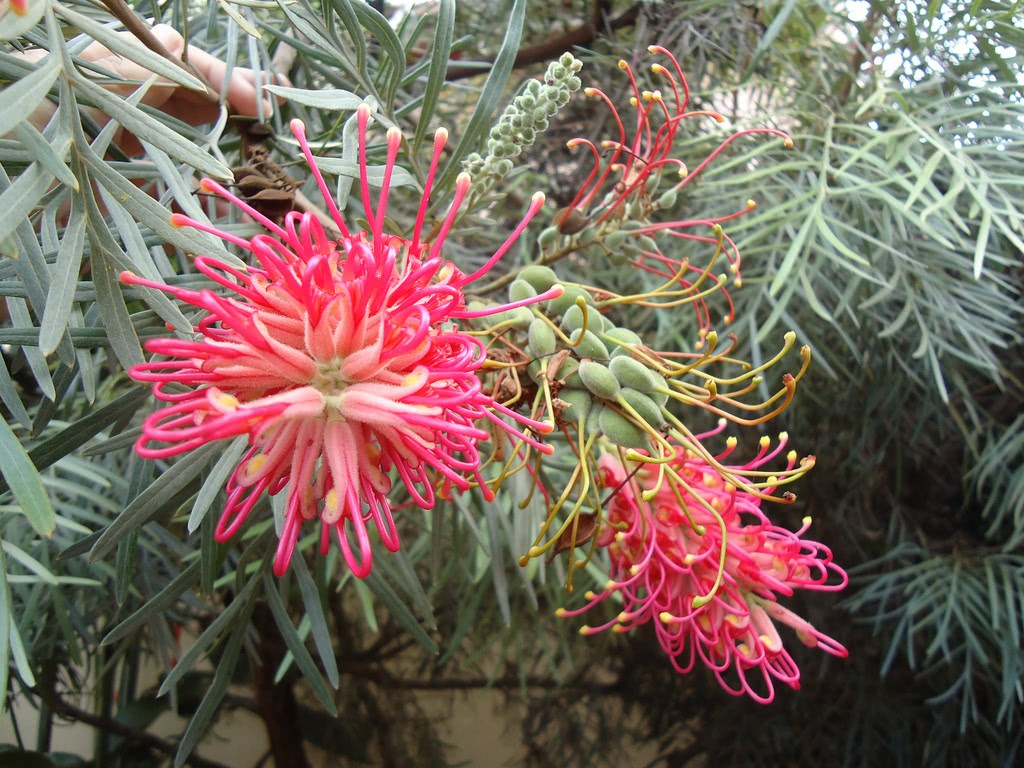
Red flowering grevillea, also known as Banks' grevillea, belongs to the family Proteaceae and originates from the coastal areas of Queensland, Australia, and nearby islands. It is a dense shrub with a variable form, reaching 3 m in height, with large, brush-like flowers in red or white, sometimes pink and apricot. It has a long flowering period and benefits from light pruning of the current year's growth. Its leaves can cause dermatitis in some people.
Morphological characteristics:
An evergreen small tree, up to 5 m tall, with hairy young branches. Leaves alternate, pinnately lobed once, leaflets linear, with dense white hairs on the underside. Flowers from spring to summer, in terminal racemes, with flowers ranging from orange-red to bright red. Follicles obliquely ovate, flattened, turning brown when ripe. Both flowers and leaves are attractive.
Red flowering grevillea
Growing environment:
An important reason why red flowering grevillea has risen rapidly in South China is its outstanding landscape effect. It is an evergreen small tree or shrub that combines ornamental flowers, foliage and form. Its flowers are racemes, resembling large brushes borne at the tips of branches; the corolla is tubular, and the pistil style extends beyond the corolla tube with a curved tip. The bright red flowers are unique and gorgeous. Red flowering grevillea has an extremely long flowering period, lasting more than 250 days in its place of origin. In South China, mature plants can flower year-round, with the peak flowering period from November to May of the following year. At peak bloom, the whole tree is covered in flowers, a dazzling expanse of red. Its leaves are alternate and pinnate, with the underside densely covered in silvery-white hairs, hence the name silvery grevillea.
Red flowering grevillea
Landscape application:
Red flowering grevillea is mainly used in flower borders, courtyards, roadside green belts and the improvement of pine forests. To increase the flowering quantity of red flowering grevillea, it should be pruned once a year. In flower borders, red flowering grevillea can be planted as an upper-layer species for background use, or combined with other shrubs and groundcovers as a roadside barrier species; in park green spaces and gardens, it can be used as an ornamental tree planted singly or in groups. Its long flowering period, beautiful appearance and good pollution resistance have made red flowering grevillea favored by the landscaping market since its introduction.
Red flowering grevillea
Indoor potted cultivation:
When growing it as a small indoor potted plant, seeds can first be sown in a seedling tray, and after germination, seedlings with similar growth rates can be planted in 3-5 inch pots, which will result in more uniform growth. When transplanting, be careful not to damage the roots. Generally, for a 3 inch pot, it is best to plant more than five seedlings so that growth is more luxuriant. The pot can be a rustic ceramic pot or an ornate blue-and-white porcelain pot, both of which set off the delicate leaves of the grevillea well. Finally, place it at a window or in a bright indoor spot. Because the seedlings are limited by the pot, they will not grow too large and can be maintained for a very long time. However, if the growing location has insufficient light, the seedlings are prone to leggy growth, which affects their appearance.