Entering the ingenious world of bonsai artist Nai Weng
Nai Weng and his bonsai art
Original author | Fu Quan
Mr. Nai Weng (1912-1998) was a famous bonsai artist in China. His book "Potted Plant Techniques," written and published in 1982, was the first professional book after the Cultural Revolution to scientifically and systematically introduce bonsai, covering the art creation theory and practice from creation to appreciation and evaluation. Many bonsai enthusiasts in modern China received the most beneficial instruction from this book and entered the palace of bonsai art.
In his book, he proposed that bonsai creation should respect nature and respect the growth patterns of plants, and that one should have in mind the creation principle of a beautiful natural tree; in bonsai creation techniques, he combined the strengths of Lingnan's "branch storage and trunk cutting" and Suzhou's "wiring and bending" techniques to create the creation technique of "cultivation as the main method, combining carving and pruning," and was the founder of modern Xiamen bonsai. His bonsai works such as "Having Seen All the Spring Colors of the World" and "Orioles Sing and Swallows Dance" are models of this technique. Mr. Nai Weng called the unique tuberous root beauty, aerial root beauty, and root tendril beauty of the banyan tree the "Three Beauties of the Banyan," and pointed out the dialectical unity among the three beauties. "Lingering Clouds" is a rare treasure that possesses all three beauties and shows great ingenuity. Mr. Nai Weng also creatively used methods such as startling branches, flying branches, flying tree crowns, and inverted-growing branches to handle certain special branches. For example, his bonsai works "Brushing the Clouds and Holding Up the Sun," "Eagle," "High Sky and Light Clouds," and "Maiden Emerging from Bath" all embody this technique. In 1985, he founded the "Xiamen Bonsai and Flower Association" and hosted the publication "Minnan Horticulture," held cross-county and cross-city bonsai exhibitions, and promoted and spread bonsai techniques. Under his active promotion, the bonsai art of our province improved and developed rapidly, gradually moving to the forefront nationwide. The late Vice Chairman of the National Committee of the Chinese People's Political Consultative Conference, Zhao Puchu, wrote an inscription praising him: "Divine elegance is not only bestowed by nature's clock; one must know that artistic ingenuity seizes heaven's work. A hundred-year-old pine and cypress flourish in a pot; a thousand peaks of mist and cloud thicken on a few. Cannot view enough, cannot learn enough; joyfully see horticulture revive the Southern school. Wangchuan is elegant, Wu Palace is gorgeous; incorporate and absorb both, hoping to carry on and prosper."
Chinese bonsai art is influenced by Confucianism, Buddhism, Daoism, and other schools of thought, emphasizing the harmonious fusion of object and self, and the unity of heaven and humanity. In bonsai, this is expressed by emphasizing the unity of form and spirit and the combination of hardness and softness; in modeling, bonsai is intentionally personified, and artistic conception is stressed. Regarding the relationship between form and spirit, Mr. Nai Weng wrote in his "Potted Plant Techniques": "Spiritual charm resides within form, like a person's abundant spirit and handsome appearance. Once the form is good, the spiritual charm overflows outward." His bonsai works all possess such characteristics, valuing the expression of artistic conception and personal emotion, and paying attention to the arrangement of figures and scenery. Finished bonsai all have titles, with inexhaustible charm, making people never tire of looking at them, and possessing a distinct national style. Mr. Nai Weng advocated that bonsai should not be too large or too small. He said: "If too large, it becomes a field-planted tree; if too small, it cannot express the beautiful posture of a potted tree; neither is appropriate." True bonsai art must achieve "seeing the large within the small."
In the past, people regarded bonsai creation as the manual work of craftsmen and called it "making" bonsai. Mr. Nai Weng said it should be changed to "creating," meaning that it includes artistic processing. In treating bonsai as an "art," systematically and scientifically summarizing its creation theory, introducing its creation methods, and revealing its internal laws, Mr. Nai Weng was the first person.
Mr. Nai Weng clearly proposed that a correct aesthetic view is the guide of artistic creation, emphasizing that "aesthetics is the driving force of bonsai art creation" and "aesthetics is the driving force of innovation," treating aesthetics as the central link in creating and researching bonsai techniques.
I. Aesthetic thought in Nai Weng's plant bonsai
In the study of beauty, there is a clear difference between China and the West. The West mainly studies from a philosophical angle what beauty is and what the essential attributes of beauty are. Traditional Chinese aesthetics, however, directly studies from an artistic angle where exactly beauty lies and how to be beautiful, linking beauty with the grasp of beauty.
In his four-line verse for bonsai appreciation and evaluation, as well as in his plant bonsai creation, Mr. Nai Weng proposed the creation principle of "cultivation as the main method, flexible combination of carving and pruning, and respect for plant growth patterns," which addresses these two questions: how to be beautiful and where exactly beauty lies. His four-line verse is:
Posture enters the spirit, skill rivals heaven's work; dragon-like and aged, lush and dark green,
A full foot looks as if in a valley; who knows the inexhaustible charm within the pot.
This contains four criteria: "posture, age, largeness, and charm." Among them, "age" and "largeness" focus on the physical form of the potted plant, while "posture" and "charm" focus on spiritual charm.
In explaining "posture," he pointed out: "Posture" is the expression of the basic form of the entire potted plant, including the entire outline from the base to the trunk and branch tips. When appreciating, what is seen first is posture. Without posture, the meaning of bonsai is lost. There must be the "Four Virtues" and "Six Taboos" ("Potted Plant Techniques" P9-P11), and one must carefully consider the structure, center of gravity, movement and stillness, energy, and the relationship between form and spiritual charm of the potted plant.
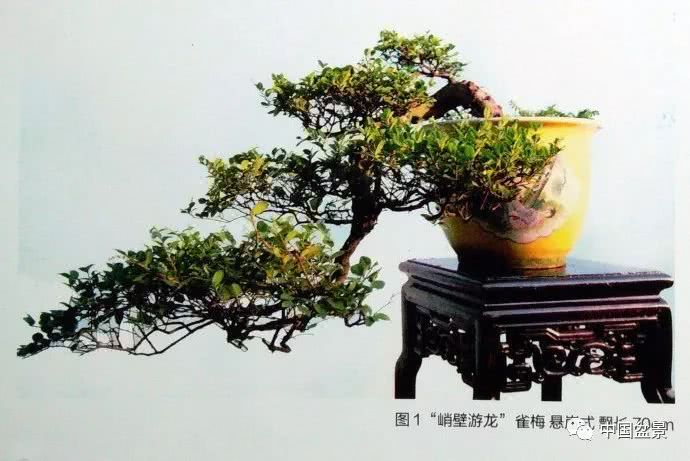
As shown in Figure 1, the bonsai "Wandering Dragon on the Cliff," a Chinese sweet plum cliff-style bonsai (length 70 cm)
It is a bonsai work created by Nai Weng in the 1970s. The trunk bursts out from the cliff, bends and hangs downward, and the tail end naturally and powerfully turns upward, conforming to plant growth patterns. It differs from the practice of artificially pulling it downward to make it drift down section by section. The branches and trunk are soft yet strong, neither sparse nor dense, spiritually resembling a wandering dragon diving into the abyss, with excellent posture. It is a tree that conforms to plant growth patterns, yet spiritually resembles a wandering dragon. The beauty lies in that it is a tree spiritually resembling a wandering dragon.
Regarding the "age" of a potted plant, Mr. Nai Weng summarized from his many years of experience that it should have the following forms: root tendrils raised, trunk mostly bent and with many nodes, bark thick, cracked or wrinkled and coarse, branches and trunk mostly crooked, appearing to have been pruned year by year or to have died and regrown, branches and leaves not too dense, because only young and healthy plants can have luxuriant branches and leaves. Banyan trees have aerial roots hanging down from high places, etc. ("Potted Plant Techniques" P19-20).
As shown in Figure 2, "Having Seen All the Spring Colors of the World," a banyan upright-style bonsai (height 46 cm)
The structure of the whole plant is rigorous, and the density is very harmonious. The coordination between the thickness of the trunk and its height, and between the height of the tree body and the length of the side branches, is extremely appropriate. Its posture leans slightly to the left, while the base is broad and also extends to the left and forward and backward, so it is especially balanced and stable. The side branches and main branches also extend forward, backward, left, and right, with an appearance of looking in all directions. The tree crown is both even and uneven, forming a simple and solemn picture. The momentum is vigorous and strong; the aged thick roots are exposed high above the pot surface; the bark is ancient and thick, either bulging in clumps or deeply sunken; the leaves are neither dense nor sparse. It is a work tempered a thousand times, aged and primitive. At first glance it seems plain, but the more one looks, the more spirit it has. The tree is one hundred and fifty years old, and this tree was cultivated in a pot from a young age. Where is the beauty of this tree? Mr. Nai Weng appreciated its form and spiritual charm step by step from structure, density, roots, trunk, leaves, and bark, and gave it the title "Having Seen All the Spring Colors of the World," which carries profound meaning.
Regarding the "largeness" of a potted plant, it is not being several zhang tall, but rather being small yet seeming large, that is, the meaning of "a full foot looks as if in a valley." It should resemble a naturally ancient large tree and have the spirit of mountain forests. Conversely, if it looks like a small tree, it is meaningless. Even if it is a small shrub such as Serissa japonica, it must likewise have the spirit of a large mountain forest tree. Whether only one chi or half a chi tall, or even a trailing woody plant, it must be shaped to resemble a large tree several zhang tall. Generally speaking, upright styles are majestic and tall; or towering into the clouds, with a tall tree and broad shade for cooling. Twisted and horizontal ones have a momentum like dragons and tigers, not like snakes and worms.
As shown in Figure 3, "Brushing the Clouds and Holding Up the Sun," a banyan upright-style bonsai (height 69 cm)
The composition of this tree is bold and unconstrained, with a tall and upright momentum, not inferior to a tall ancient pine, greatly possessing the force of brushing the clouds and holding up the sun. At the upper right top is a large tree crown; at the lower left ground is a large flat rock; the upper and lower parts are well coordinated, while the right side is slightly denser in the middle, creating mutual care between left and right, balanced yet natural. The large tree bends down to shade the stubborn rock, and the coordination between tree and rock is exceptionally harmonious. Two old men are dotted in, talking and laughing on the rock, greatly enhancing the secluded mood and elegant interest, forming a natural picture. Just as the Yuan dynasty Li Shizhao inscribed on his painting "Reclining Pine": "Ask the situation, it wishes to grasp the empty clouds; spring wind and autumn moon, lush and verdant; the tip is a canopy, the body is a dragon, not following Qili and Lord Xiahuang." Some aerial roots hang down, and some adhere to the trunk, all naturally formed. Even more rare is that the root tendrils exposed above the soil extend to the left, strengthening the stable posture and giving it the force of "brushing the clouds and holding up the sun." Aged and dragon-like, the tree is one hundred years old.
Regarding spiritual charm, it resides within the physical form. Once the form is good, the spiritual charm overflows outward, like a person's abundant spirit and handsome appearance. More specifically, a beautiful and elegant potted plant is graceful and charming; a plain and simple one is free and unrestrained; a sturdy and upright one has extraordinary momentum. Various styles of potted plants each have their own different spiritual charm. For example, the towering style has the force of soaring into the clouds; the curved upright style is like a flying dragon and dancing phoenix; the cliff style has the thrill of a rushing torrent or the secluded feeling of a winding stream for drinking games; the lying style has the melody of a dragon playing in water. These are where their spiritual charm lies.
As shown in Figure 4, "Another World," a Chinese sweet plum upright-style bonsai (height 35 cm)
The composition of this potted plant is very successful. The small pot surface is like an open field. On a large rock somewhat farther away and slightly higher, two old men play chess; the tree is large and shady, the sky is high and the land is far, and the scenery is quiet and secluded. Observing its theme, "Another World," it immediately draws one into the poetic and pictorial mood of Li Bai's lines: "Ask me why I dwell in the green mountain; I smile and do not answer, my heart at ease. Peach blossoms flow away with the water, vanishing; there is another world, not the human realm." This scene is indeed "another world, not the human realm." The lines of the branches and trunk of the potted plant are both hard and soft, vivid and natural, and its rare quality lies in its highly skilled modeling technique. Two secondary trunks, one at the right front and one at the left rear, set off the main trunk, forming only two tree crowns; a small side branch interspersed in the middle makes the variation seem even more ingenious and inspired. Although the tree is only a full chi tall, it is quite aged. This potted plant possesses advantages in all aspects, with a prominent expression of excellent spiritual charm. Spiritual charm overflows; the composition of the whole pot is like a clean picture, and its tree "sways without wind."
Chinese traditional culture regards all things as having spirit. Its aesthetic activity is mainly not observing the physical form of things, but experiencing the spirit of things. Therefore, for the aesthetic object, traditional Chinese aesthetics mainly does not consider why its form is beautiful or what beautiful attributes it has, but rather repeatedly ponders between its form and spirit. For example, Li Bai's "Quiet Night Thoughts": "Moonlight before my bed, perhaps frost on the ground. I lift my head and gaze at the moon, I lower my head and think of my hometown." It sketches a vivid image of homesickness on a moonlit night, inviting deep reflection, and depicts the psychological activity of a traveler far from home thinking of home while gazing at the moon. From "perhaps" to "lift my head," and from "lift my head" to "lower my head," it vividly reveals the poet's inner activity. The moon is also not a simple object, but has rich connotations. However, foreigners consider this poem too simple; this is caused by differences in aesthetics.
As shown in Figure 5, "She Has More Charm Than Peach Blossoms," a Chinese sweet plum curved upright-style bonsai (height 42 cm)
The whole plant is light and lively, full of varied grace, with a graceful and slender manner and a tendency to dance gracefully. Its main trunk bends elegantly, from bottom to top, completed in one continuous movement. The side branches completely display the hard yet beautiful aesthetic feeling of the Chinese sweet plum. The modeling is bold and full of charm; she has more charm than peach blossoms. The main trunk is split and opened with cracks; the base and two thick roots are exposed high above the soil surface. The lower half of the whole plant is so sparse that a horse could pass through, with no scenery arranged, making it appear even more graceful, like a flying immortal in the sky. The tree is nearly one hundred years old, with excellent spiritual charm.
The Chinese worldview is one of time and space as a unity. Art also pursues an artistic conception in which "the image lies beyond the six directions, and flourishing and falling are outside the four seasons." In such art, the individual and nature, the feeling of the subject and the scenery of heaven and earth, the recounting of history and philosophical reflection are fused into one.
As shown in Figure 6, "High Sky and Light Clouds," an elm lying-style bonsai (height 29 cm)
This tree once suffered fire damage, and burn marks still remain. Only two strips of bark and a small amount of decayed wood remain on the main trunk, while the upper part is regrowth after the disaster, still full of vitality. Because the regenerated main trunk happens to stab diagonally to the left, the center of gravity of the plant presses on the left base and appears balanced. The arrangement of the side branches also extends in all directions, and small branches dotted on the right side of the main trunk make the density more appropriate. Its manner is as if lying down and "looking up at the vastness of the universe," and its artistic conception should not stop there.
How can a potted plant be beautiful? Mr. Nai Weng wrote in his "Potted Plant Techniques": "Potted planting is to blend the naturally beautiful tree in one's mind and make it leap forth in the pot." ("Potted Plant Techniques" P56) Obviously, this has gone through the process from "bamboo in the eye" to "bamboo in the mind" to "bamboo in the hand" (Note 1); or rather, the nature in the eye, the nature in the mind, and the nature in the hand are not the same. But what he emphasizes is: "the naturally beautiful tree," and what is natural is beautiful. How can "natural beauty" be realized? In his plant bonsai creation, Mr. Nai Weng proposed the creation principle of "cultivation as the main method, flexible combination of carving and pruning, and respect for plant growth patterns." This is completely consistent with traditional Chinese aesthetic views. Laozi said: The Dao follows nature, and nature is the Dao. The law reflected by the "Dao" is to allow all things to display themselves freely. Following or imitating the law of the "Dao," one must not force anything, but "let nature take its course," so that one endlessly growing world after another can be "naturally" presented before people, in order to achieve the "enduring" of life. Although this "nature" must still be nature artistically reproduced after cultivation and carving and pruning, Mr. Nai Weng still emphasized "respecting plant growth patterns," "caring more and interfering less," and "according to the characteristics of various trees, shaping potted plants of different postures" ("Potted Plant Techniques" P55), that is, naturally reproducing the natural beauty of potted plants. Nature means ultimate truth, and even more, ultimate beauty.
As shown in Figure 7, "Floating as if About to Become an Immortal," a crape myrtle slanting-trunk-style bonsai (height 50 cm)
This plant has a floating, ethereal manner. The trunk has both hardness and softness, is extremely natural, and has very little processing; it is a beautifully natural tree. When the slanting trunk inclines to a certain degree, it turns upward, with considerable momentum. The two trunks are intimate, and the secondary trunk appears nestled in the embrace of the main trunk, like mother and child; it is a good posture for double slanting trunks. If viewed from a purely observational angle, this tree is merely two slanting branches, one large and one small. But what we appreciate is the natural posture of a double slanting trunk bonsai and its resemblance to mother and child nestled together. The beauty lies in the natural posture and the charm of resembling mother and child.
Beauty is produced by human feeling toward objects; it is the product of the mutual infusion of emotion and scenery. "Therefore all light of beauty comes from the fountain of the soul: without the reflection of the soul, there is no such thing as beauty." (Zong Baihua, "Strolling in Aesthetics") In the Southern Dynasties, Wang Wei's "Narrating Painting" says: "Gazing at autumn clouds, the spirit soars; facing the spring wind, thoughts surge boundlessly. Even with the music of metal and stone and the treasures of jade tablets, how could they compare?" This is the embodiment of the author's beautiful inner world in painting, and it is where the true interest of painting lies. Therefore, traditional Chinese aesthetics is essentially an appreciation of one's own personality, and the direct purpose of art is to transmit the heart.
As shown in Figure 8, "Lingering Clouds," a banyan upright-style bonsai (height 69 cm)
"Lingering clouds dense and thick, seasonal rain misty and vast..." are lines written by Tao Qian out of longing for relatives and friends. The tree crown of this potted plant resembles clouds in the sky, with dense thick clouds above and cloud feet below, so Tao Qian's lines are quoted as its title. Its base and root tendrils have already covered the pot surface; it is very aged, natural and without artificial patterns. The tuberous roots and aerial roots form the first and second sections of the main trunk, and the aerial roots together with the main trunk form the third and fourth sections of the main trunk. All have already fused into one, possessing the banyan's unique Three Beauties (Note 2). It was cultivated in a pot by Mr. Nai Weng from a young age. The main trunk bends powerfully toward front, back, left, and right, easily supporting the tree crown, appearing stable and balanced. The density of the whole plant is just right. The bark is ancient, thick, and cracked; it is already over one hundred years old, yet still has the bearing of longevity and health, possessing advantages in all aspects. "Lingering clouds" are clouds that gather and do not disperse, implying auspicious clouds gathering. Nai Weng titled this potted plant "Lingering Clouds" not only because it resembles "lingering clouds" in form, but also to express his longing for relatives and friends, hoping they will come together.
[Note 1] See the second of "Three Inscriptions on Bamboo Paintings by Banqiao": In the clear autumn at a riverside lodge, rising in the morning to look at bamboo, misty light, sun shadows, and fog all float among sparse twigs and dense leaves. In the mind there is vigorous excitement, and thus the idea of painting arises. In fact, the bamboo in the mind is not the bamboo in the eye. Therefore, grinding ink, spreading paper, and setting down the brush suddenly produce transformed appearances; the bamboo in the hand is again not the bamboo in the mind. In short, intention before the brush is the fixed rule. Interest beyond method is the transformative mechanism. Is it only painting clouds?
[Note 2] The "Three Beauties of the Banyan" are aerial root beauty, root tendril beauty, and tuberous root beauty. They were summarized and discovered by predecessors over long-term cultivation practice as unique to the banyan tree. Aerial roots are like an old man's long beard flowing elegantly, showing age; root tendrils interlace like a coiled dragon, showing vitality; tuberous roots are full and lovely like goose eggs, showing nobility. But the three beauties must be unified and harmonious; otherwise they may become grotesque. See Nai Weng's "On the Three Beauties of the Banyan" for details.
II. Aesthetic thought in Nai Weng's landscape bonsai
Regarding landscape bonsai, Mr. Nai Weng believed that the creation of landscape bonsai must achieve the effect of making the artificial appear real. Artificial landscape should, though made by people, seem heaven-made. Moreover, only by refining bonsai and using ingenious techniques to create bonsai with poetic and pictorial charm and artistic conception can it be considered a successful work. He summarized the aesthetic standards of landscape bonsai as the four words "living, clear, spirit, meaning," and described them in a four-line verse:
Green mountains and blue waters, living as if real,
A secluded and clear village cottage with two or three people.
Skill rivals heaven's work, spiritual charm unmatched,
Poetic sentiment and pictorial meaning in one wondrous jade-like stone.
Among the four words, "living" and "clear" are concrete, both expressed in the form of the bonsai, visible and tangible, while "spirit" and "meaning" are imagistic, invisible and intangible. But they are a whole, mutually dependent and inseparable, jointly serving as the basis for aesthetic judgment of landscape bonsai. Among them, "living," "spirit," and "meaning" are primary. In modern times, more and more artists recognize the important value of artistic conception. When making aesthetic judgments, people should consider primary and secondary importance thoroughly. Every landscape bonsai, from the moment it is active in the author's artistic imagination, is an unborn fetus, a work with form, spirit, and meaning. Mr. Nai Weng explained the four words "living," "clear," "spirit," and "meaning" one by one as follows.
"Living" is the objective truth of aesthetics, what we usually call vivid and lifelike. In plain language, it means the artificial landscape looks as if real. Whether natural landscape or cultural landscape, each must express its own reasonableness, and the more profoundly it is expressed, the better. It is neither a mechanical miniature like photography, nor a castle in the air with no basis. The "living" of landscape bonsai should have four aspects of reasonableness, namely: reasonable geology and landforms; reasonable proportions and dynamics of figures; reasonable coordination between cultural landscape and natural landscape; and reasonable expression of the theme by the scenery. For the shaping methods of pavilions, terraces, towers, rivers, lakes, boats and oars, main peaks, secondary peaks, and auxiliary peaks, roads, bridges, rock caves, springs, waterfalls, streams, and ravines, as well as the general features and precautions of various mountain forms, he gave clear explanations.
For example, the bonsai "Neighboring Old Men Come to Play Chess Early in the Morning" (see Figure 9). The theme is selected from the inscription poem on Tang Ziwei's painting in "Jieziyuan Huapu": "Willow shade is thick, summer days are slow; by the village, the high hall overlooks a broad flat pond. The neighboring old man carries a box and takes advantage of the early morning, coming to decide yesterday's chess victory or defeat." The bonsai uses sea coral with good water absorption to shape the karst landform landscape scenery on the banks of the middle reaches of the Li River in Guangxi. A low mountain is the main body, occupying most of the space of the bonsai. Although the mountain is not high, it has front-back depth and a beautiful mountain form with clear distinctions of height, distance, and nearness. A winding footpath shaded by green grass runs through it, and a small bridge spans the stream in front of the mountain. The whole mountain forest is lush, the ground is green as a carpet, and the limestone at the foot of the mountain was pierced into holes by water in ancient times. A summer picture of the Li River bank landscape leaps onto the scene. In the mountain are two or three houses, staggered in front-back, distance, and size. The morning light is clear, the air fresh, all sounds silent, and the scenery especially quiet and secluded. The neighboring house on the left is higher halfway up the mountain, and the household in front of the mountain is lower halfway up the mountain. The sunlight is brighter at the higher place, while the household at the lower place is not fully lit, setting off the early morning scene. The house in front of the mountain is also built on the han (read han, meaning the cliff on the side of a mountain, where people can live) of the mountain. This is a place ancients liked to choose for building houses, and it is also the author's careful layout. The old man in front of the mountain sits waiting, quietly thinking about yesterday's unresolved chess game; the neighboring old man on the left of the mountain carries a box and staff and crosses the bridge, full of enthusiasm. In addition, by the water scenery there is only one stone, with no boats or oars, further expressing the quiet realm of "no noise of carriages and horses at the gate." These profound and meticulous arrangements deepen the height of landscape art and make the spirit of the scenery overflow.
"Clear" has three elements. First is refinement. The same theme can use the most concise composition to highlight the main scene, express the secondary scene, cut away all redundancy, and the scenery can be expressed clearly and freshly, rich in a sense of the times, showing the power of refinement. Second is quiet seclusion. "The birth of the artistic soul occurs in the instant of self-forgetfulness in life," called "quiet reflection" in aesthetics. Quietly observing all phenomena, all phenomena are as if in a mirror, bright and pure, each finding its place. This is what is meant by all things are self-attained in quiet observation. Only then can one comprehend the real image one wants to reflect and the life emotion one wants to express. To use Liu Zongyuan's poem "River Snow" as an analogy: "A thousand mountains, birds fly away; ten thousand paths, human tracks disappear. A lone boat, an old man in straw cloak and hat, alone fishing cold river snow." All sounds are silent, yet it seems one can hear birdsong and smell flowers. Only a mind like still water, without rising waves and without bias, can awaken to the various conditions of the world. This is the refinement and quiet seclusion that scenery writing should achieve. Third is ethereal spirituality. Using limited space to express infinite heaven and earth: "Because it is quiet, it comprehends all movement; because it is empty, it admits ten thousand realms" (Su Dongpo). When ten thousand realms soak into the human soul, that is when the sense of beauty is born.
Artistic form has three functions: first, through spacing and distancing, it creates detached images, activates imagination, makes people distance themselves from reality, and produces an aesthetic distance beyond utilitarian calculation; second, it transforms substantial images into virtual images. Composition and image-making spatialize and typify life, expressing the artistic conception in the mind; third, it leads from virtual images into spiritual flight, into the realm of beauty, and further from beauty into truth. That is to say, the cultivation of aesthetic feeling first requires skill in creating distance from objects, so that one does not cling or stagnate, and objects can be isolated and insulated, forming their own realm. Winding paths leading to secluded spots in gardens, landscapes in clouds and mist, and streetlights in the night are all beautiful scenes born under conditions of distancing and spacing.
In addition to the "separation" caused by external conditions, more important is the "emptiness" within the soul. Spiritual indifference is the basic condition for the etherealization of art. For example, the bonsai scene "A Mustard Seed Contains Mount Sumeru" (see Figure 10) arranges only one tree, one rock, one pavilion, and one person. The tree is made with an expressive brush method to form two or three tree crowns, with extremely great twists and changes. The lower half's horizontally growing trunk and the upper half's vertically growing trunk create a great turn. The structure is extraordinary and refined, attaining its own momentum without the slightest forced artificiality. In the distance there is a pavilion, nearby there is a person, and an upright rock is planted to accompany the slanting banyan. In a space of 20 cm, it forms a scene of distance and nearness, height and lowness. The proportions are appropriate, making the tree appear exceptionally tall. The title "A Mustard Seed Contains Mount Sumeru" makes one feel even more ethereal, spiritual, and deeply Zen. The bonsai "A Mustard Seed Contains Mount Sumeru" expresses Nai Weng's spiritual realm of transcending the self: a mustard seed can contain Mount Sumeru; the clear and empty awakened mind can contain ten thousand realms.
"Spirit" is the soul of scenery, latent within the image. Form is concrete; spirit is abstract. But spirit can also be perceived. It is the expression of the artist's artistic depth, yet depends on the viewer's perceptive ability. If one speaks of spiritual charm, it is wind-spirit and air-rhyme, such as mountains having spiritual aura and divine air; water and rocks being deep and broad, peaks and ridges clear and profound, trees lush; and in bonsai, old people expressing vigorous spirit, while children have bright and clear spirit. All are expressions of spirit. Mr. Nai Weng believed that "spirit" is produced by the highly lifelike scenery in bonsai.
When the bonsai author's creative skill reaches a profound height, the scenery becomes superb and transfigured. The work makes one feel a strong charm at first glance, fascinating and absorbing, giving a feeling that it can be enjoyed, toured, and lived in, producing a profound realm of reverie. For example, Mr. Nai Weng's bonsai "Lion Mountain," which shapes the landscape of Xiamen (see Figure 11). In the pot, coral stone is sculpted into the main peak of Lion Mountain, and a smaller piece of coral stone represents Mount Taiwu across the sea. Xiamen people often have the habit of rising early to climb mountains for exercise. In the pot, an old man winds up the mountain path from the foot of the mountain, step by step. Here morning mist curls, the valley is quiet and secluded, and the scenery is enchanting. In the mountains the forest is dense and strange rocks are jagged. Climbing to the mountain peak, there are even poems and inscriptions everywhere and birdsong at every step. Looking out into the distance, one sees only "distant peaks emerging layer upon layer, light sails hanging piece by piece." The poem says: "For successive mornings the lingering fog locks the jagged heights; one says it is Lion Mountain, but cannot recognize it clearly. Deep in the mist of fragrant grass, the stone tablet is lost; when the partridge calls at sunrise, it summons travelers." Peaks and ridges rise and fall, in a thousand postures and ten thousand forms, gathering the spirit of mountains, waters, trees, and rocks, and incorporating the beauty of pavilions, terraces, and longevity steles. It is truly a fairyland on earth. The landscape bonsai "Lion Mountain" has an ingenious composition. Roads are built and houses are placed within the bonsai, and a mountain climber is arranged, shaped like a real scene, making people desire to climb the mountain themselves, and artistic spiritual charm arises spontaneously.
"Meaning" refers to artistic conception, that is, an artistic realm formed by the fusion of the life scene depicted by the bonsai and the thoughts and feelings it expresses. The former is the scenery created by the author according to the conceived idea and is tangible; the latter is the theme thought to be expressed by the created scenery. Therefore, artistic conception is the crystallization of "emotion" and "scene" (image), through which one glimpses the deepest soul of the self, transforms real scenery into a virtual realm, and creates images as symbols. This is the artistic realm.
The artistic conception of art differs according to person, place, emotion, and scene. Tao Yuanming's poem "Drinking Wine": "I built my hut in the human realm, yet there is no noise of carriages and horses. Ask you, how can this be? When the heart is far, the place becomes remote of itself. Picking chrysanthemums under the eastern fence, carefree I see the southern mountain. The mountain air is good day and evening; flying birds return together. In this there is true meaning; wanting to explain it, I have already forgotten the words." "Building a hut in the human realm" is "the place being remote," while "becoming remote of itself" is the distancing within the soul. Only Tao Yuanming, with "when the heart is far, the place becomes remote of itself," could carefree see the southern mountain and realize that "in this there is true meaning; wanting to explain it, I have already forgotten the words." The artistic realm approaches "true meaning" through "the heart being far."
Artistic conception is not a single-level experience, but multi-level. In his appreciation of the expressive bonsai "Another World" (see Figure 12), Mr. Nai Weng wrote: A single Yingde stone naturally forms a fairyland-like small world. In front is a low mountain range that can hardly be called a mountain but has winding and turning ridges; in the middle are dense trees; in the lower area it seems there is a small farmland; slightly higher there is a pavilion, and one can reach halfway up the mountain; there is a small house, with people in it; behind the small house one can reach a small mountain peak (this is the beautiful scene seen directly). He then wrote: Behind it there seems to be lower mountainous land. On the right side of the island, from a corner of the second island, a bridge is set up, and there are immortals approaching and about to visit this island (this is the second scene conveying active life). Behind the island the sea surface and cloud sky open widely, and there is a boat in the distance, as if an immortal is traveling (this is the third scene from the imagination of the soul). Mr. Nai Weng explained: Many years ago I obtained this naturally perfect Yingde stone, famous in Xiamen. In deeply exploring the history of bonsai development, I learned that the earliest bonsai were created by predecessors sketching from life in imitation of the Penglai fairy islands in garden-making, and therefore I created "Another World."
Since its birth, Chinese landscape bonsai has continuously permeated with the interest of poetry and the artistic conception of painting. The art of landscape bonsai grew up nurtured by poetic sentiment and pictorial meaning. While describing the life scene of the bonsai, the author also integrates the author's natural endowment, sentiment, and poetic and painterly cultivation into the bonsai, containing them within the work's physical form. The title of the bonsai "Another World" comes from Li Bai's poem "Questions and Answers in the Mountains":
"You ask me why I dwell in the green mountain; I smile and do not answer, my heart at ease. Peach blossoms flow away with the water, vanishing; there is another world, not the human realm." The poem describes the scene of peach blossoms vanishing far away with the stream. We generally might associate it with the sadness of "fallen flowers and flowing water, spring has gone," but from the poet's expression of a "smile," we can realize that this green mountain is filled with a "world" of natural, tranquil beauty, truly beyond comparison with the "human realm"!
Appreciating Nai Weng's bonsai works, we can realize that whether plant bonsai or landscape bonsai, whether form or spirit, poetic sentiment and pictorial meaning flow everywhere, entrusting the old man's emotions and breadth of mind. Another of his works, "Listening to the Spring" (see Figure 13): On the left mountain, a stream winds downward, flying down into a stone cave, then turning to strike beside the stream and splashing in all directions, showing a vivid form of mountain spring flow. On the left side of the cave is a small house, with someone sitting quietly inside listening; across the mountain is an elder with a leisurely, self-satisfied manner, sitting cross-legged and enjoying this landscape and the wonderful sound of the spring; in the stream there are no boats coming and going, as if one were in a deep mountain otherworldly peach blossom spring, all sounds silent, with only the sound of the spring. The poem says: "The benevolent and the wise delight in mountains and waters; the old neighbor knows this sound. The clear spring rhymes on the stone, washing clean the hearts of the world." One may say Zen meaning continues unbroken. It can be seen that the many artistic conceptions above differ according to person, place, emotion, and scene, and must be understood by people in their hearts.
Chinese bonsai art, coming from remote antiquity, stands at the historical turning point of modern China. Western culture and art have continuously poured into China, and Chinese culture and art have suffered unprecedented testing. In order to preserve and carry forward the old culture and art, we must first give new evaluation to our old culture and art, keep its essence and discard its dregs, and at the same time absorb the excellent aspects of Western art.
On the Temple of Apollo at Delphi there is a maxim: "Know yourself!" In order to transform this world, one must first know oneself. When comparing Chinese and Western painting methods, Mr. Nai Weng understood that Chinese painters do not stand at a fixed angle and concentrate on a single perspective focus, but grasp the whole from a high place, and have special names such as the high-distance method, level-distance method, and deep-distance method, forming the characteristic of "viewing the small from the large" in Chinese landscape painting. Western painters, however, must depict spatial illusion from a fixed angle and use perspective, and have a complete system. Talking about "artistic conception" with Western painters and talking about "perspective principles" with Chinese painters are equally unworkable! Chinese and Western aesthetic methods are thus so different.
When exploring bonsai creation techniques, Mr. Nai Weng found that many people mentioned Guo Xi's "Three Distances" theory in landscape painting as not applicable to landscape bonsai. The "Three Distances Method" proposes: "If a mountain is to be high, showing it all will not make it high; if mist and rosy clouds lock its waist, then it is high. If water is to be distant, showing it all will not make it distant; if and veiling cut off its flow, then it is distant. If mist and rosy clouds lock its waist, the mountain is naturally high; if and veiling cut off its flow, the water is naturally distant." But here "color clear and bright," "color heavy and dark," and "clouds and mist" are difficult to express in landscape bonsai, and are obviously only suitable for painting. However, such a long passage, once abbreviated by people, becomes the "Three Distances," and is mechanically applied to bonsai creation, truly making it hard for readers to comprehend. If one understands them one by one from the Three Distances, then "high distance" rather has the meaning of "one peak is a thousand fathoms of Mount Tai." Yet in making landscape bonsai, there are main peaks and non-main peaks, high peaks and low peaks, large peaks and small peaks, large rocks and even tiny stones. If all pursue high distance, would that not mislead students? Landscape painting is a flat sheet of paper; near scenery and distant scenery, ten layers or eight layers can be distributed in low and high places, and then expressed with thick-light and bright-dark brush methods. Landscape bonsai is a pot with stones, water, and physical objects. From the front of the pot to the back of the pot is far less than a chi, so it is naturally impossible to express ten or eight layers. How can two artworks of different nature be shaped completely by one kind of technical theory? For example, in landscape painting, front-back overlap can use illusory cloud mist and haze, cutting off the mountain waist and pushing upward, making people feel the mountain is unfathomably high, majestic, and infinitely changing. But bonsai can only extend and bend left and right. Another example: landscape painting can use edges and corners to express half a mountain range, showing that the mountains stretch continuously, while bonsai must be complete, with no margins to rely on. Therefore, landscape bonsai should have its own theory not only in aesthetics, but also in shaping techniques. If "deep distance" and "level distance" are applied to bonsai, then it is the "depth" of the scene, that is, "having distance and nearness," enhancing the three-dimensional sense. This seems more appropriate and clear, and there is no need to mechanically apply painting theory.
In 1985, when Mr. Nai Weng wrote the article "Xiamen Bonsai Style," reviewing the basis for appreciation and evaluation of plant bonsai in his own "Potted Plant Techniques," he changed the original "posture, age, thinness, largeness, difficulty, charm" to "posture, age, largeness, charm," removing "thinness" and "difficulty," which might cause unhealthy factors in bonsai, so that bonsai could better embody the spirit of the times. In 1988, when the China Bonsai Artists Association was established, Mr. Nai Weng first proposed: The life of art lies in innovation, and continuous innovation is the sacred mission of Chinese bonsai artists. In 1992, in his article "Exploration of Bonsai Innovation Issues," he proposed that aesthetics is the driving force of innovation, innovation requires the improvement of aesthetic ability, and one should use one's wisdom to devise innovative techniques. Modern times are a scientific age, and one must rely on scientific innovation. He also clearly proposed that innovation in bonsai art includes: innovation in cultivation methods, reform of techniques, diversification of artistic modeling, and that landscape bonsai should break the traditional creation method of imitating Chinese painting and mainly use sketching from life, expressing famous mountains and beautiful waters, etc.
From the bonsai works and papers left behind by Nai Weng, it can be seen that Nai Weng made tremendous efforts to inherit and carry forward Chinese bonsai art and bonsai aesthetic thought, and to advance bonsai aesthetics from classical to modern. The old man has left us! But his contributions to the development of our country's bonsai art: his taking the correct aesthetic view as the guide of bonsai art creation; his creation technique that fuses northern and southern techniques in one furnace, will forever be engraved in the history of the development of Chinese bonsai art! His spirit of artistic dedication and his thought of continuous innovation are examples for us to learn from. We must certainly inherit Mr. Nai Weng's behest and continuously carry it forward.
Fu Quan
February 22, 2018, at Xiamen University Beicun
(This article is original by Teacher Fu Quan, selected from Teacher Fu Quan's blog, and the copyright belongs to Teacher Fu Quan.)
Author introduction:
Fu Quan, originally named Fu Zixiong, was the second president of the Xiamen Bonsai and Flower Association (1998-2008). He edited and published the monograph "Xiamen Bonsai," with the title inscribed by Ye Fei, Vice Chairman of the Standing Committee of the National People's Congress. On May 26, 2001, he presided over the "Nai Weng Bonsai and Garden Art Symposium" jointly held with the Fujian Provincial Forestry Department and the magazine "Flowers, Trees and Bonsai." In January 2002, he published the film and television disc "Nai Weng Bonsai Art." In 2005, he successfully held the Xiamen-China Bonsai Art Symposium and the 2005 Xiamen Bonsai Art Exhibition and other activities for the 20th anniversary of the association's founding, and edited and published two books, "Research on Nai Weng Bonsai Art" and "20 Years of Xiamen Bonsai," as well as the film and television disc "Unforgettable This Autumn," etc.
Wonderful replay:
Chinese bonsai welcomes you!
Enjoy anytimeappreciatethe bonsai exhibition hall
Promote bonsai culture, exchange bonsai techniques!
Appreciate bonsai art, share a happy life!