Don't panic if your clematis has withered; cut it back right away and it will bloom even more spectacularly next year
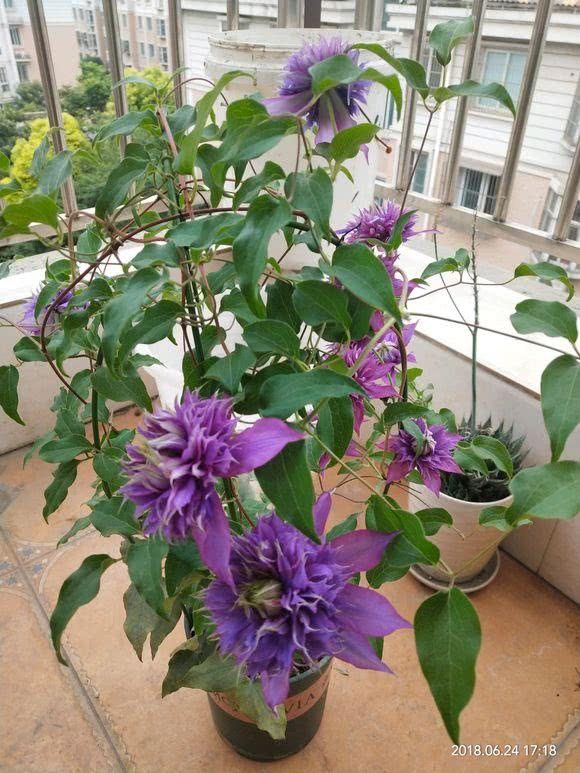
Actually, clematis is very tough and not at all delicate, and it doesn't need special care. After getting a seedling, the first thing we should do is check what growing medium it's in, and when transplanting, try to choose a medium similar to that one. Clematis has well-developed roots, and as for the growing medium, loose and airy matters more than fertile.
First, put some large-particle clay pebbles, bark, or stones in the bottom of the pot; then spread a layer of growing medium, and then tip the seedling out of its nursery pot. At this point, look carefully at the roots - don't just plop it straight in. Loosen the roots and let them spread out a bit, and when you place it in, make sure there are no gaps between the roots. Then slowly fill soil around it, shaking the pot a few times as you fill so the growing medium settles in snugly, but remember not to press the soil down hard, or the roots will be crushed and the soil will become compacted. Finally, trim the seedling a little more and secure the stems. As for the growing medium, for container growing I use: 70% peat + 15% coconut husk + 10% perlite + a mix of odds and ends. Actually, you don't need to be too particular - as long as it's loose and airy, that's fine. Make a point of changing out some of the growing medium every year or moving it up one pot size.
About watering: water thoroughly once the soil has dried out completely, and don't use a saucer, because if water accumulates it will damage the roots. So don't use a saucer just to keep the floor clean - just put in the effort to mop up the water that seeps out. In summer, water in the morning and evening; in winter, water very rarely. It's about the same for plants grown in the ground.
About fertilizing: for small seedlings in pots, add a small amount of slow-release fertilizer; for larger pots, add a bit of organic fertilizer. But don't fertilize often - before sprouting in spring, after flowering, and before winter sets in. Remember, never too much.
About spraying: for antibacterial types, spray potted plants once a quarter, and ground-planted ones twice a year, and the concentration must be light; as for pesticide, as long as there are no pests, stick to not using it, and if you can remove them by hand, also stick to not using it.
Clematis actually isn't that delicate. We shouldn't deliberately fuss over it - the more blindly we fuss, the worse it gets. I've learned that lesson myself. If you find it has withered, don't be too anxious - immediately "cut it all off," and it may bring you some hope. In summer, you must water thoroughly and avoid water accumulation, otherwise it easily suffocates; for potted plants, it's best not to expose them to strong sun. Don't just admire the leaves and flowers and forget the roots - at this time they need even more care and nutrients. In winter, don't just ignore it because it's cold-hardy; give it a trim, tidy up the stems, and refresh the potting soil, and next year it will be even more spectacular.