A Detailed Guide to Caring for Succulents During Their Summer Dormancy
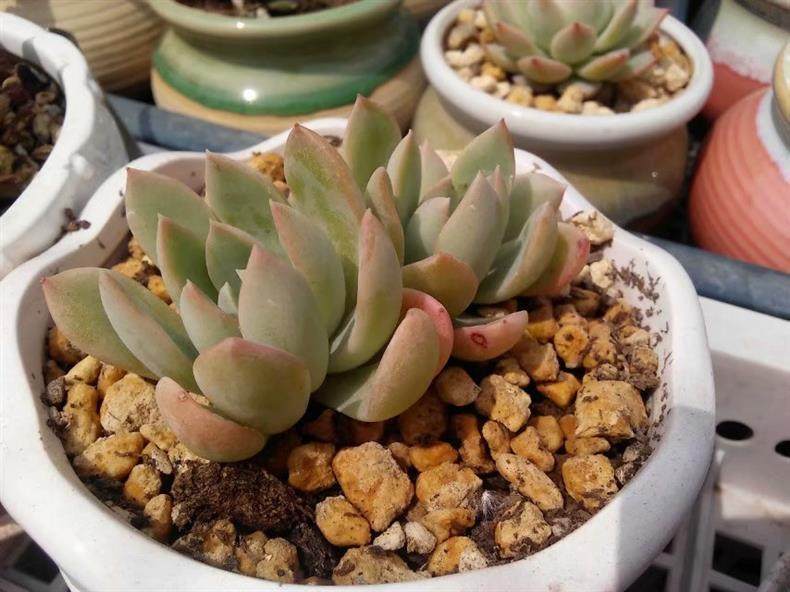
In fact, most varieties of succulents get through the summer by going dormant. So what are the signs that a succulent has entered dormancy?
1. The leaves look dull and lusterless.
2. The leaf color of the whole plant is basically uniform (mainly green).
3. The leaf color of the lower half or even the whole plant changes.
4. The color of the branches, leaves and stems is basically uniform.
5. Stone-like (lithops-type) succulents keep a uniform color.
Why do succulents enter dormancy? It is actually a response the plant makes to cope with a harsh natural environment, and these succulents that enter dormancy temporarily stop growing, sustaining their future growth by consuming the nutrients and water stored during their growing season (as for which specific varieties enter dormancy and when, you will need to look that up yourself).
I. Necessary Protective Measures
Succulents that have entered dormancy are very fragile, and their root systems will not absorb external water or nutrients during dormancy. So at this point they do not need much water or light (but to prevent leggy growth, we can consider installing a shade net on the balcony so the plants receive some filtered light, and of course a few cooling and ventilating fans should be installed as well).
As a rather special category of Crassulaceae succulents, the mountain rose (Greenovia) wraps its central leaves tightly together in hot weather, forming a rose that is ready to bloom. During its dormancy it must avoid unfavorable environmental factors such as strong light and scorching sun (30°C is the threshold; above this limit, shade it promptly).
As a rather unusual type of succulent, the mountain rose (Greenovia) closely resembles a true rose, but its leaf color varies with the succulent's leaf color, variety and growing environment, generally ranging among gray-green, blue-green and emerald green, though after scorching sun the leaves develop red-brown markings.
II. Correct Care Methods
Because succulents enter dormancy in the hot summer, at this time we only need to water once or twice a month, and the amount of water must be small, just enough to keep the potting soil slightly moist (if you cannot guarantee good ventilation in the growing environment, then be sure to cut off water early).
Lithops (living stones) not only look like buttocks, but also produces one small yellow flower after another from within the "buttocks". It likes to grow in loose, breathable sandy loam (preferably neutral). Propagation methods include sowing and division; of course, because of its peculiar shape and vivid flower colors, Lithops also needs appropriate shading and water control in summer.
Butt flowers (Lithops) are highly sought after by succulent lovers because of their strange appearance, and of course their ornamental value is also very high. However, they are not tolerant of low temperatures and should avoid strong sun exposure in summer. The optimal growing temperature for Lithops is between 10-30°C, so the winter temperature must not drop below 12°C, though it can endure 4-5°C for short periods.
III. Common Dormant Succulents
In summer, the succulents most likely to enter dormancy are the Aeonium group and most varieties of the mountain rose (Greenovia). Especially when the temperature of the growing environment rises above 28°C, the inner leaves of the succulent slowly contract while the outer ones gradually wither, forming what looks like a rose bud waiting to open (although the leaves wither easily, this is also the safest way for the succulent to get through summer).
Dwarf stonecrop (Sedum spurium 'Dragon's Blood' / small ball rose) is also a type of Crassulaceae succulent, with a delicate and dainty form. It is not only fairly cold- and drought-tolerant, but also has strong propagation ability, making it suitable as a mixed-planter filler plant or lawn grass. In an environment with large temperature differences and ample sunlight, its leaf color becomes more vivid, a lovely bright red that is very endearing.
If your beloved succulents show symptoms you cannot solve, you are also welcome to exchange and learn from each other in the comments below.