When visiting Qufu, you must try the Kong Family Mansion Banquet, Immortal Duck, and Grilled Flower-Stirred Salmon, among other specialty dishes.
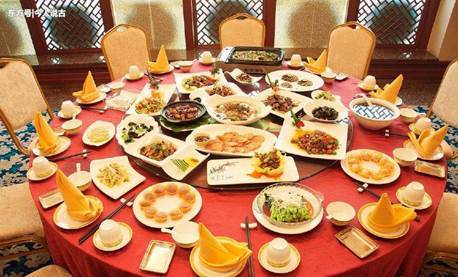
The people of Qufu have always used pancakes and wheat-based foods as staple foods. There are many kinds of pancakes, and the wheat-based foods include steamed buns, shaobing (baked flatbread), fried pancakes, **, noodles, and so on. Residents have always had the habit of drinking porridge, and tea is the main beverage served to guests. When visiting Qufu, besides touring the "Three Confucian Sites," enjoying the Kong Family Mansion Banquet is an activity not to be missed. Qufu's distinctive local snacks mainly include smoked tofu, Kong Family Mansion pastries, and Shandong pancakes. These snacks can be found almost everywhere in Qufu, taste excellent, and are relatively inexpensive -- just a few yuan is enough for a hearty meal.
1. Kong Family Mansion Banquet
The Kong Family Mansion Banquet was the high-grade banquet specially prepared when the Kong Family Mansion received distinguished guests, celebrated hereditary titles, observed memorial days, birthdays, weddings, and funerals. Ingredients were strictly selected and preparation was meticulous. It is based on northern cuisine and is an important component of the Shandong cuisine system. Over several hundred years, by extensively absorbing cooking techniques from all over the country and continuously enriching and innovating, it gradually developed into a family banquet with a unique flavor. The Kong Family Mansion Banquet is an important part of Chinese culinary culture and was specially prepared for receiving distinguished guests, assuming office, birthdays and family anniversaries, weddings, funerals, and celebratory occasions. The banquets followed the hierarchy of ruler and minister, father and son, and had different specifications. It was the high-grade banquet specially prepared when the Kong Family Mansion received distinguished guests, celebrated the assumption of hereditary titles and office, observed memorial days, birthdays, weddings, and funerals. It is a set of family banquets with a unique flavor gradually formed through centuries of continuous development and enrichment. The Kong Family Mansion not only held various folk family banquets but also hosted emperors and imperial commissioners. It encompassed all kinds of banquets and gathered the finest of Chinese banquets. Confucius believed that "ritual" was the highest norm of society, and banqueting and drinking were one of the basic expressions of "ritual."
2. Smoked Tofu
Qufu smoked tofu is famous at home and abroad. It is both a traditional snack unique to the area and one of the famous dishes of the "Kong Family Mansion Banquet" worthy of the finest tables. Its development has a history of several hundred years, and its fame grew greatly after the Qianlong Emperor tasted it and praised it highly. Qufu smoked tofu can be served cold with dressing or stewed and smoked. In particular, putting smoked tofu and chunks of meat into an iron pot, adding water to cover, and adding chili peppers, fennel, Sichuan peppercorns, cinnamon and other seasonings to stew makes a very delicious dish. Smoked tofu is not only loved by the locals of Qufu, but outsiders who come to Qufu also fall in love with it after tasting it. Smoked tofu can be served cold with dressing, stewed and smoked, or cut into thin slices and lightly stir-fried with fresh chili peppers. In addition, many smoked tofu pots are set up in the markets. Smoked tofu and chunks of meat are put into an iron pot, water is added to cover them, and whole chili peppers, fennel, Sichuan peppercorns, cinnamon and other seasonings are added for stewing, making what is called "five-spice oil-chili smoked tofu." Those who sell it mostly use smoked tofu as a fine dish to accompany drinking and meals.
3. Kong Family Mansion Pastries
Kong Family Mansion pastries, like the Kong Family Mansion Banquet, are a kind of pastry with a unique flavor that has a long history and has been passed down from generation to generation. Especially in the Ming and Qing dynasties, Kong Family Mansion pastries were much better than the famous pastries sold on the market. Kong Family Mansion pastries emphasize being eaten fresh and baked fresh, seeking excellence in color, aroma, taste, and shape. They are divided into two major categories: external use and internal use. External-use pastries were mainly used for tribute, gifts, and imperial rewards.
The Kong Family Mansion pastries used for tribute were mainly "jujube pancakes" and "Chan Shou Su." Jujube pancakes "are made with selected fine red dates, sesame, and millet through refined workmanship, sealed in metal" rectangular tins, "and decorated on the outside. Their characteristics are being sweet, fragrant, crisp, and flaky." Chan Xiang Su "is characterized by exquisite workmanship, with a shape as thin as paper, fragrant, crisp, and delicious. The Sheng Mansion pastries are divided into two categories: external-use pastries and internal-use pastries. Their characteristic is the emphasis on being eaten fresh and baked fresh, seeking excellence in color, aroma, taste, and shape. External-use pastries were mainly for tribute and gifts. Ingredients were carefully selected, shapes were ornate, and flavors were unique. Internal-use pastries were divided into five categories: seasonal, year-round, guest-arrival, banquet, and festival. Each category had its own distinctive features. Seasonal pastries were made with seasonal ingredients from the four seasons and eight festivals. Their fillings were sweet, soft, and fresh, and their outer crusts were crisp, flaky, and fragrant with oil. They included spring's wisteria flower cakes and lily cakes; summer's mint cakes, lotus flower cakes, and mung bean cakes for clearing heat and detoxifying; autumn's chrysanthemum cakes and osmanthus cakes; and winter's radish cakes and red bean paste cakes. Year-round pastries refer to regularly stocked pastries suitable for all four seasons, including large crisp cakes, chrysanthemum crisps, and lily crisps. Guest-arrival pastries refer to the tea snacks offered before banquets when guests arrived, such as yikouzhong and cotton candy. The most famous were especially the qiaoguo pastries offered to the moon on "Qixi." Pastries used for banquets were made according to the nature of the banquet; for example, birthday banquets used "longevity" character cakes and "ruyi" cakes. Festival pastries included yuanxiao, mooncakes, qiaoguo, and so on. Kong Family Mansion pastries are best when baked and eaten fresh. Historically, they were enjoyed only by the imperial family, the powerful and noble, and the masters of the Kong Family Mansion.
4. Immortal Duck
This is a traditional famous dish of the Kong Family Mansion. It is said to have begun during the time of Kong Fanpo, a descendant of Confucius in the seventy-fourth generation. When Kong Fanpo served as prefect of Tongzhou in Shanxi, the mansion's chef deboned a duck, added seasonings, placed it in a bowl, covered it, and steamed it in a steamer. The meat was tender and falling apart, the aroma was rich, and the flavor was delicious. After tasting it, Kong Fanpo felt that the method of preparation was different from others. It was steamed in a steamer until three sticks of incense burned out, and its delicious flavor surpassed that of other dishes, so it was named Immortal Duck. It is said that later Kong Fanpo used a catchphrase to praise it: "Steamed duck with three sticks of incense, immortals eat the meat and drink the soup." But some faultfinders thought this was unrealistic, so it was changed to: "Steamed duck for immortals to taste, timed by the water clock and still burning incense."
5. Grilled Flower-Stirred Salmon
Grilled Flower-Stirred Salmon is made with salmon as the main ingredient and grilled over high heat in slices. It is one of the traditional famous dishes of Qufu, Shandong. Salmon is a top-grade ingredient in Kong Family Mansion cuisine. The grilling method is unique, the color is white with a rosy tint, and the flavor is delicious.
Grilled Flower-Stirred Salmon is a delicious recipe. Its main ingredients are salmon, chicken tenderloin, shiitake mushrooms, and so on. This dish is simple to make, nutritious, fresh, fragrant, and delicious. The dish is shaped like a flower basket, with exquisite and distinctive workmanship. The fish flavor is delicious and the meat is tender, fresh, and fragrant. It is an auspicious dish in the Kong Family Mansion Banquet, with the meaning of "abundance and surplus."
6. Kong Family Mansion Yipin Pot
Kong Family Mansion Yipin Pot is a traditional famous dish belonging to Kong Family Mansion cuisine. It was tasted by emperors and empresses. The Kong Family Mansion Yipin Pot was named by an emperor. It is said that successive Qing dynasty emperors often visited the Kong Family Mansion, and the Kong Family Mansion often sent chefs into the palace to prepare fine Kong Family Mansion dishes, respectfully inviting the empress dowager. The Qing dynasty inherited the Ming dynasty's system of official ranks, with official titles ranging from the first to the ninth grade, the first grade being the highest and the ninth grade the lowest. The Qing dynasty listed the Kong Family Mansion as the official residence of a first-grade official of the dynasty. Therefore, the emperor bestowed the name "Current Dynasty Yipin Pot" on the soup dish cooked by the Kong Family Mansion with various precious ingredients such as chicken, pig's trotters, duck, sea cucumber, and fish maw, and it became a famous dish of the Kong Family Mansion and all first-grade official residences, passed down through the generations. Before 1949, this dish was still served in some high-class restaurants in Shandong, Jiangsu, Shanghai, and other places, and later it was interrupted for a time. Now, with the excavation and organization of distinctive dishes from various schools, it has been restored and carried forward. The name Yipin Pot originated from the Kong Family Mansion. It is a famous Kong Family Mansion dish named by an emperor. Its descendants inherited the title of Duke Yansheng and in the Ming and Qing dynasties were granted the official rank of "Current Dynasty First Grade." Among the silver tableware for the "Manchu-Han Imperial Feast" bestowed on the Kong Family Mansion by the Qianlong Emperor, the largest piece was called the Current Dynasty Yipin Pot. In addition, there is another kind of round, undivided single pot, called the "Zhongding Yikou Yipin Pot." Later Yipin Pots, depending on the ingredients put in, also included bird's nest Yipin Pot, shark fin Yipin Pot, sea cucumber Yipin Pot, assorted Yipin Pot, vegetarian pot, and so on.
7. Qufu Pancakes
Qufu pancakes are a famous distinctive traditional wheat-based food and one of Shandong's specialties. Qufu pancakes are made by mixing wheat flour, corn flour, and the like into a batter, spreading and cooking it in a flat pan, then adding a filling made from peanut oil, crushed roasted peanuts, chopped scallions, edible salt, chili powder, and other ingredients, and cooking it. Different flavors can be made according to different ingredients. The main flavors are peanut, sesame, and spicy-numbing. The crust is thin, the filling is generous, and they are fragrant, crisp, and delicious, and rich in nutrients. It is said that the founder of Qufu pancakes was Kong Jifeng (born 1878), a collateral descendant of Confucius in the sixty-ninth generation. Kong Jifeng was then called the local living god of wealth and was also respectfully called "Ancestor Jifeng" by later generations. He was a native of Fangshan in Qufu. Diligent as he was, he reclaimed wasteland and obtained a large amount of grain fields, and planted Chinese toon. He lived very prosperously. But influenced by ancestral teachings and Confucian thought, he was benevolent and righteous to all under heaven and won the hearts of the people. Later, when this stuffed pancake was sent into the Kong Family Mansion for the lords of the Kong family to taste, it immediately won praise and recognition. It was also used by the Kong Family Mansion as a precious gift to be presented many times as tribute to the Daoguang Emperor. Later it independently formed today's Qufu pancake.
8. Bringing the Son to Court
Bringing the Son to Court is a traditional famous Han Chinese dish and a very distinctive dish in the Lu cuisine system. It has a deep red color, fresh and fragrant meat, rich and thick sauce, and is tender, falling apart, and delicious. Duck meat and pigeon meat are the main ingredients. This dish uses one duck accompanied by one pigeon, one large and one small placed on a plate. It has a distinctive flavor and is a major dish at banquets. It has a deep red color, fresh and fragrant meat, rich and thick sauce, and is tender, falling apart, and delicious. Its implied meaning is that the Kong Family Mansion served as officials generation after generation and went to court generation after generation, always as an official household, with hereditary titles continuing without interruption. This dish uses one duck accompanied by one pigeon, one large and one small placed on a plate. It has a distinctive flavor and is a major dish at banquets. Father and Son at Court means that both father and son are officials. The sea waves are the tide, and "tide" is homophonous with "court."