The horned melon, also known as the kiwano, has delicate, juicy flesh that is like jelly, with a refreshing texture and a light, sweet flavor.
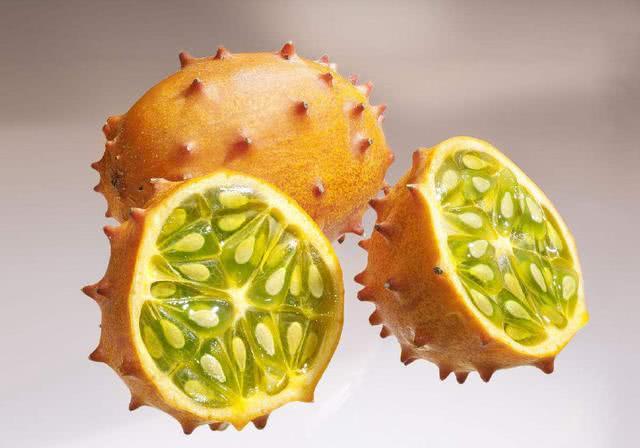
Horned melon
The horned melon (Cucumis meluliferus), also known as kiwano, horned melon, African horned cucumber, African horned melon, Martian fruit, sea cucumber fruit, golden hedgehog, Kiwano melon, horned melon, jelly melon, fire peach, and so on, is an annual vining herbaceous plant in the Cucurbitaceae family, genus Cucumis. Its skin is extremely hard and bumpy.
The flesh is delicate and full of seeds, gelatinous like a cucumber, with a light, sweet flavor.
It is native to the Kalahari Desert region of southern Africa, and is now cultivated in New Zealand, the United States, Australia, Chile, Germany, Zimbabwe, and other countries.
The strangely appearance of the horned melon makes it a fruit loved by many. In Chinese it is generally translated as "African horned melon," and some also call it "fire peach."
In its place of origin, because its root system can reach the underground aquifer, it was once an important source of vitamins and water for the local people.
Morphological characteristics
The horned melon is a vining herbaceous plant with a shallow root system; its stem has 5 ridges, and both stems and leaves are covered with fine hairs; the leaves are elliptical and alternate; it grows tendrils like those of a grape and is climbing in nature; it bears yellow flowers and is monoecious;
After the fruit ripens, the rind turns golden yellow, the skin is hard and bumpy, and the surface is covered with wart-like spines, making the fruit look like a spiny olive; the flesh is emerald green, and the seeds are embedded in the flesh in a gelatinous form;
The flesh is delicate, juicy, jelly-like, refreshing in texture, and lightly sweet in flavor, resembling a mix of cucumber and zucchini or a blend of banana, lemon, and cucumber. After tasting it, a faint herbal freshness remains in the mouth.
Growing environment
The horned melon is not strict about soil texture, and can be planted in either sandy or clay soil. Its cultivation techniques and climatic requirements are relatively close to those of cucumber and loofah, making it a novel and exotic fruit that is very easy to grow.
The horned melon grows in dry climatic conditions, has strong disease resistance, and is not cold-tolerant; in high-humidity, rainy environments it is prone to disease.
Geographical distribution
The horned melon is native to the Kalahari Desert region (the desert plateau of southern Africa), and today it also grows in California and New Zealand.
In 2010, the horned melon was introduced from Africa to China for cultivation. It has strong adaptability, and can be grown wherever cucumber, zucchini, or vegetables can be grown.
Surveys have found that horned melon cultivation in China is currently mainly distributed in Guangdong, Guangxi, Hunan, Hubei, Jiangxi, Jiangsu, Zhejiang, and other provinces, with the largest cultivation scale in Poyang, Jiangxi.
In recent years, it has appeared on the domestic market, and some regions in China have already introduced it for cultivation. The product is deeply welcomed by consumers, and its selling price is as high as 8-10 yuan each, with a yield of 8,000 fruits per 667 sq m, showing remarkable economic benefits.
Cultivation points
Open-field, greenhouse, and glasshouse cultivation; greenhouse and glasshouse cultivation require a medium for pollination. This plant is monoecious, and male flowers generally open a few days before female flowers.
For trellis cultivation, generally 600-700 plants per mu are planted. From sowing to harvest takes about 3.5-4 months. The seed germination temperature should be controlled at 20-35°C. The seeds germinate in a seedling tray, and are transplanted when they grow to two leaves.
For open-field cultivation, the transplanting temperature in spring must reach above 15°C. Under glasshouse conditions, planting can be done in early autumn.
One week before the first flowering period, water twice, replenishing 40% of the water evaporation; after the first flowering period, replenish 80% of the water evaporation.
Cultivation techniques
Sowing period
The sowing period of the horned melon differs depending on the insulation coverage conditions during the seedling stage.
Taking the provinces in the middle and lower reaches of the Yangtze River as an example under coverage conditions:
Insulation measure Sowing period Planting period Market time
Open-field planting Mid-April Mid-May Mid-to-late September
Single-layer cover Early March Late April Late August
Double-layer cover Mid-to-late February Mid-April Mid-to-late July
Triple-layer cover Early-to-mid February Late March to early April Late June to early July
Seed treatment
Before sowing horned melon seeds, simple disinfection treatment, low-temperature or variable-temperature treatment, and soaking with trace elements are required.
Seed soaking and germination
After treatment, the seeds are placed at 28-30°C for germination, sprouting in about 24 hours. During this period, the seeds should be washed 2-3 times to remove substances that inhibit germination and to promote gas exchange.
Seedbed
Seedbed soil formula: 30% decomposed pig and cow manure, 20% aged stove ash, 10% decomposed night soil, 40% peat soil. Another formula: 50% decomposed animal manure, 10% aged stove ash, 20% decomposed night soil, 20% peat ash. To each square meter of the above mixed nutrient soil, add 4 kg of superphosphate, 1 kg of plant ash, and 1 kg of ammonium nitrate.
Seedling stage management
Sow the pre-germinated seeds in a sand box. First water thoroughly, then after sowing cover with 1 cm of sand, and cover with agricultural film or woven cloth for insulation. Keep the temperature inside the sand box at 28-30°C. Seedlings emerge one after another after 24 hours. When 80% of the seeds have emerged, lower the temperature appropriately to prevent leggy growth, to 20-25°C during the day and 16-17°C at night.
Another method is to directly sow the germinated kiwano seeds into seedbed soil made of peat soil and garden soil inside an insulated shed. When the seedlings grow to 10-20 cm, transplant them directly. The temperature control is the same as the previous method.
Timely transplanting
The best time to transplant horned melon seedlings into seedling nutrient pots is when the cotyledons are fully expanded, that is, on the 4th day after the cotyledons open, about the 8th day after sowing. This is the optimal time for transplanting, when the nutrients stored in the seeds have basically been consumed and the plant begins to absorb nutrients through the root system for growth. If transplanted too late, the seedling period is prolonged, and after the cotyledons are fully expanded the seedlings are prone to nutrient deficiency and easy aging, which is a phenomenon that often occurs in current production. At the same time, the number of transplanting operations should not be too many; once is appropriate. The germinated seeds can also be sown directly into seedling pots without transplanting, reducing root damage.
Adult seedling stage management
When the first true leaf of the horned melon expands, it enters the adult seedling stage. The soil should maintain a certain humidity and a relatively high low temperature (15-20°C). During the seedling stage, according to nutritional status, 0.2% monopotassium phosphate can be used for foliar topdressing, and carbon dioxide gas topdressing can also be carried out. This should be done 1 hour after the sun comes up in the morning, and the temperature should be raised rapidly to 28-30°C.
Pest and disease control
Disease control: Horned melon varieties have relatively strong disease resistance. Comprehensive control measures based mainly on ecological control are adopted, with increased application of phosphorus and potassium fertilizers, combined with the use of biological pesticides and fungicides.
The main diseases are downy mildew, fusarium wilt, powdery mildew, and viral diseases. Downy mildew can be controlled by spraying 70% mancozeb 500x solution or 55% dimethomorph 1,000x solution.
For sporadic cases of fusarium wilt, spray Celest (fludioxonil) 1,500x solution. For powdery mildew control, spray 20% triadimefon 1,500x solution.
For viral disease control, spray 20% Kangrun (20% moroxydine acetate-copper wettable powder) 5,000x solution, while also controlling aphids and avoiding contact transmission during pruning.
When high-temperature weather occurs after rain, spray pesticides promptly for control, using 25% Jinku (25% tebuconazole) 3,000x solution or 70% mancozeb 800x solution.
Insect pest control: The main insect pests are tobacco whitefly and aphids. Tobacco whitefly can be controlled by spraying 20% acetamiprid EC 1,000x solution, 1.8% abamectin 3,000x solution, or 5% chlorfluazuron 2,000x solution.
Aphids can be controlled by spraying 50% imidacloprid water-dispersible granules 1,000-1,500x solution, matrine 600x solution, or 3% acetamiprid EC 1,500x solution. For other noctuid pests, spray emamectin benzoate 1,000x solution.
Main value
Nutritional value
The seeds of the horned melon are covered in a gelatinous substance, and the rind is rich in vitamin C and plant fiber.
The horned melon fruit has high nutritional value. It is rich in nutritional elements such as iron, potassium, calcium, and magnesium, among which the iron content is relatively high, 4 times that of cherries. It also contains vitamin B1, B2, B3, B6, vitamin C, anthocyanins, carotene, and water-soluble dietary fiber. It has effects such as antibacterial and anti-inflammatory, beauty and skin care, intestinal cleansing, detoxification, weight loss, promoting digestion, strengthening the body, improving immunity, improving sleep, calming the nerves and nourishing the brain, and invigorating the blood. In addition, the horned melon is also a rare sugar-free fruit, very suitable for the elderly and people with diabetes.
How to eat
After washing clean and peeling off the outer skin, the horned melon can be cut into thin slices or small cubes and eaten, or made into juice. It can also be cut in half and the flesh scooped out with a spoon.
When eating the horned melon, you can cut off the top, insert a straw, and drink it directly; it can also be mixed with honey for a perfect flavor, making it a rare natural beverage.
Cooking
The horned melon can be made into an excellent salad dressing, and can also be used instead of vinegar.
Adding a few drops of lime juice, lemon juice, and a little sugar to horned melon juice has a special effect that can suppress dry mouth, and it tastes just like orange liqueur (liqueur, that is, a sweet and aromatic strong liquor).
The flesh of the horned melon can be added to sauces, soups, salads, sherbet, and yogurt.
How to make honey kiwano:
Ingredients: 1 kiwano, honey to taste
Method
1. First wash the kiwano clean with water;
2. Cut in half, and you can see seeds similar to cucumber segments;
3. Use a spoon to take out the seeds and put them in a small bowl or cup;
4. Add honey and mix well! When eating, you can use a straw to take it.
Tips:
1. Without honey it will be a bit sour. Besides honey, you can also add sour plum powder for a unique flavor!
2. When children at home eat it, please be careful of the kiwano seeds.
Decorative value
Because the fruit of the horned melon looks like a spiny olive, it is very suitable for decoration. But in Zimbabwe, the horned melon is mainly used for fruit snacks and salads, and is less often used for decoration.
Legend of the horned melon
A very, very long time ago, aliens visited Earth and brought with them a strange fruit. After eating it, they casually threw away the remnants, and some of them were left in the southern African desert. Over time they began to sprout, then grew vines, flowered, and bore fruit.
Because of the harsh environment, this strangely shaped fruit evolved over a long period into a tough, spiny outer shell for self-protection (very similar to a sea cucumber), so that birds and beasts would also retreat and not dare to approach it. Chinese people named it "huo shen guo" (kiwano) because of its appearance.