The twice-fruiting red raspberry berry is sweet and tart with a slight aroma, suitable for fresh eating and for processing into juice and jam.
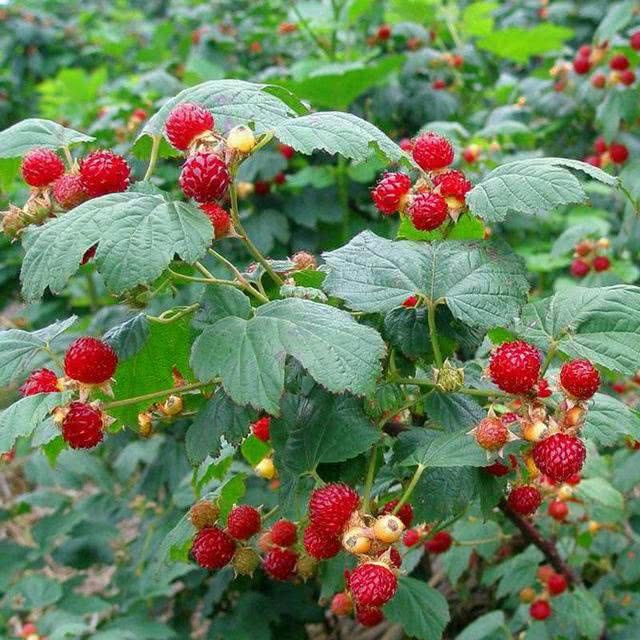
Twice-fruiting red raspberry
Twice-fruiting red raspberry, a type of raspberry, is a new raspberry cultivar successfully introduced from abroad and selected and bred by the Chinese Academy of Forestry.
First-year canes are green, 2-year-old canes are yellowish brown, and the canes are densely covered with small prickles.
The fruit is bright red, semi-spherical, with an average fruit weight of about 10 grams and a maximum single fruit weight of 16.3 grams. The fresh fruit contains 12.8% soluble solids, 1.41% titratable acid, 25 mg of vitamin C per 100 grams, and 22 mg of calcium per 100 grams. The berry is sweet and tart with a slight aroma, very suitable for fresh eating, processing into juice, and making jam.
Early fruiting and high yield. Under ordinary conditions, first-year canes can form flower buds at their tips and bloom and bear fruit.
The berries begin to ripen in early July and can be harvested continuously until frost.
The fruiting plant rate of first-year canes can reach 90%. At a plant spacing of 0.4 x 0.6 m, a first-year plantation yields 125 kg per mu, and a second-year plantation averages 1300 kg per mu, increasing year by year thereafter, with a continuous full-bearing period of more than 30 years.
Strong cold resistance. It can overwinter naturally and safely at minus 35 degrees in winter.
Long harvest period. In addition to the fruiting canes that grow from second-year canes, the first-year canes sent up from the ground in the same year can also bloom and bear fruit. Ripening begins in mid-June and continues until frost.
Morphological characteristics
First-year canes are green, 2-year-old canes are yellowish brown, and the canes are densely covered with small prickles.
The fruit is bright red, semi-spherical, with an average fruit weight of about 10 grams and a maximum single fruit weight of 16.3 grams. The fresh fruit contains 12.8% soluble solids, 1.41% titratable acid, 25 mg of vitamin C per 100 grams, and 22 mg of calcium per 100 grams. The berry is sweet and tart with a slight aroma, very suitable for fresh eating, processing into juice, and making jam.
Strong cold resistance. It can overwinter naturally and safely at minus 35 degrees in winter. Long harvest period.
In addition to the fruiting canes that grow from second-year canes, the first-year canes sent up from the ground in the same year can also bloom and bear fruit. Ripening begins in mid-June and continues until frost.
Growing environment
Sandy loam soil, requiring a soil pH of 6.5-7.0.
Origin
A new raspberry cultivar successfully introduced from abroad and selected and bred by the Chinese Academy of Forestry.
Propagation method
Propagated by root suckers.
Cultivation techniques
1. Orchard establishment and planting: Sandy loam soil should be chosen for establishing the orchard, requiring a soil pH of 6.5-7.0; planting should be done in spring or autumn using the strip trench method, with planting trenches more than 0.5 m deep and wide, row spacing 2.0 m x 0.3 m, and 1110 seedlings planted per mu. It is best to apply sufficient base fertilizer all at once.
Before planting, soak the seedling roots in water for 4 hours, then plant. The planting method is very simple: dig a hole 10-15 cm long, wide and deep, spread the seedling roots open and place them in the hole, then cover with soil and firm it by stepping on it. The key point is: deep planting with shallow covering, and the standard is: the soil covering the seedling roots and around the seedling should not exceed the original water mark on the seedling from when it was in the nursery. Where conditions permit, watering thoroughly after planting if there is no rain, or covering with plastic film, can ensure the survival rate.
2. Management during the growing season: In the year of planting, only general management such as weeding, watering, and loosening the soil is needed. In the autumn of that year, it can bloom and bear fruit. In July of the second year, harvest the fruit on the 2-year-old canes, and after harvest, cut the fruited mother canes off from the base; from August to September, harvest the fruit on the first-year canes that sprouted in the same year.
3. Winter protection against cold: In northern cold zones with strong wind and little snow, the 2-year-old canes need to be buried in soil for cold protection to prevent flower buds from freezing and canes from drying out.
Before the ground freezes, when burying the canes in soil, press the selected canes down in one direction and tie them, then cover them completely with soil (about 15 cm thick). After the ground thaws the following spring, remove the protective soil and tie the canes up onto the trellis.
Main value
The fresh fruit contains 12.8% soluble solids, 1.41% titratable acid, 25 mg of vitamin C per 100 grams, and 22 mg of calcium per 100 grams. The berry is sweet and tart with a slight aroma, very suitable for fresh eating, processing into juice, and making jam.
Early fruiting and high yield. Under ordinary conditions, first-year canes can form flower buds at their tips and bloom and bear fruit.
The berries begin to ripen in early July and can be harvested continuously until frost.
Relatively high yield. The fruiting plant rate of first-year canes can reach 90%. At a plant spacing of 0.4 x 0.6 m, a first-year plantation yields 125 kg per mu, and a second-year plantation averages 1300 kg per mu, increasing year by year thereafter, with a continuous full-bearing period of more than 30 years.