Green Giant bonsai: absorbing waste and welcoming freshness, a complete analysis of the care guide
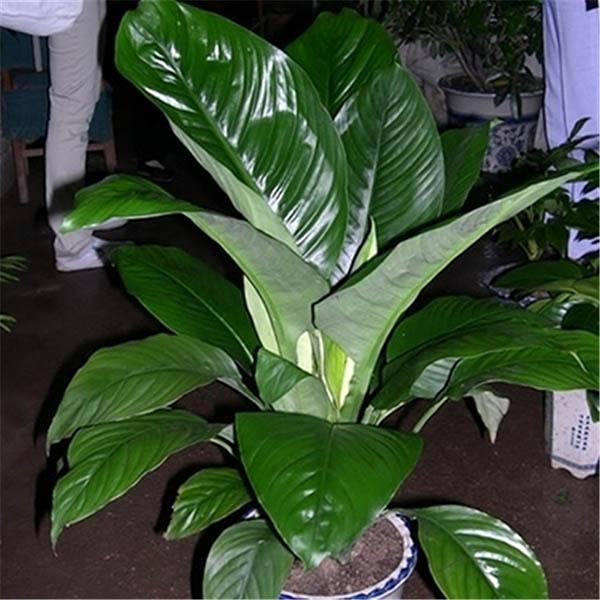
"Absorbing waste and welcoming freshness" Green Giant bonsai care guide
The Green Giant is a perennial evergreen herbaceous plant, native to the tropical rainforests of Colombia and other South American regions. It is a new flower species introduced into our country in recent years and much loved by flower growers, and has become one of the many new flowers moved from the south to the north. It is now planted in many cities in our country. The Green Giant has beautiful leaf shapes and pure white flowers, with strong ornamental value. The picture shows a potted Green Giant.
1. Environmental protection effects
The Green Giant has a relatively high transpiration rate and can raise indoor humidity. The Green Giant has a strong inhibitory ability against ammonia and acetone, and can also filter harmful gases such as benzene, trichloroethylene and formaldehyde from the air.
2. Care guide
(1) Environment The Green Giant is very sensitive to light, prefers semi-shade, and fears direct sun; it can grow normally when placed in a spot with diffused bright light. If the Green Giant is kept in too dark a place for a long time, it will not only grow weakly and lack vitality, but also be unlikely to form flower buds and bloom, reducing its ornamental effect. Therefore, it should often be given some diffused light to ensure its healthy growth.
(2) Watering Because the Green Giant has huge leaves and a well-developed root system, it is advisable to use a deep flower pot. It has a strong ability to absorb water and nutrients, so it must be supplied with sufficient water; even a slight lack of water will cause wilting. If the lack of water is severe, once the leaves dry up and scorch, the plant will be difficult to recover. Therefore, during care, special attention must be paid to providing sufficient water and maintaining air humidity. In the high-temperature seasons of summer and autumn, water should also be sprayed on the leaves frequently to cool and retain moisture, which helps keep the leaves fresh and glossy green.
(3) Fertilizing The Green Giant needs relatively more nutrients. Generally, a thin cake fertilizer solution should be applied once every half month. When kept indoors for a long time, it is best to apply a compound fertilizer to promote robust plant growth and bright leaf color [Jishan Huayao].
(4) Potting soil When choosing potting soil for the Green Giant, leaf mold soil and peat soil can be used, with a little river sand, perlite and so on mixed in to make a growing medium, plus a small amount of bone meal, decomposed dried poultry and livestock manure, or decomposed soybean cake as a base fertilizer. It is best to additionally apply potassium fertilizer such as plant ash to aid growth, so that the stems and leaves stand upright and remain verdant, and do not lodge.
(5) Repotting To keep the Green Giant plant symmetrical, the flower pot should be turned once every half month to prevent the plant from growing lopsided. The Green Giant has strong tillering ability, so it is advisable to repot once every year in early spring.
(6) Propagation The Green Giant is commonly propagated by division. Division is best done after flowering. When dividing, lift the whole plant out of the pot, cut the rhizome apart from the base of the clump, and each division must have at least 3-5 leaves. After planting, water thoroughly to settle the roots, cover with plastic film to retain moisture, and place in a spot without direct sunlight. Then strengthen water and fertilizer management, and after about 3 months it can be potted and transplanted. Treated this way, a one-year-old plant can be propagated into 10-13 plants. In addition, it can also be propagated by sowing and tissue culture methods.