Detailed Guide to Hydroponics and Care of Aspidistra
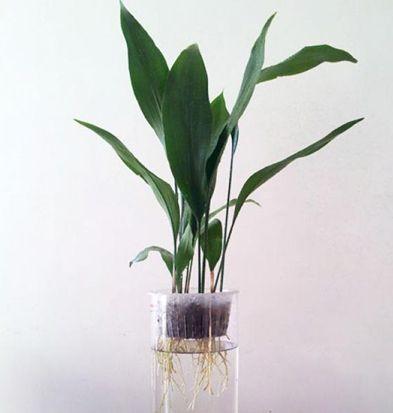
How to Grow and Care for Aspidistra in Water?
Aspidistra, also known as cast-iron plant, with alternate names such as bamboo-leaf plate, large-leaf evergreen, bamboo-joint tendon-stretcher, nine-dragon plate, etc., belongs to the Liliaceae family, genus Aspidistra, and is a perennial evergreen herbaceous plant. The aspidistra has thick creeping rhizomes, with single basal leaves that can reach up to 70cm in length, hard in texture, with the base narrowing to form a grooved long petiole. A single flower grows at the leaf base, with a bell-shaped perianth, brownish-purple, producing a capsule. The natural flowering period is April-May, and the fruit ripening period is June-August.
1. Hydroponic Method
(1) Cut 3-5 leaves with new buds from the creeping stem of the aspidistra, and directly immerse the plant in a container with nutrient solution. In the early stage of hydroponics, the nutrient solution should be appropriately diluted.
(2) The aspidistra stem is short and sturdy, with upright and slender leaves, and nutrient solution consumption is not high. In summer, add clean water once every 7-10 days, and renew the nutrient solution once every 30-60 days. The initial liquid level of the nutrient solution must not be too high; it is enough to just submerge the root system. As fleshy water roots grow out, the nutrient solution can be lowered to submerge 2/3 of the root system. The figure shows hydroponic aspidistra.
2. Care Guide
(1) Light and Temperature The aspidistra is highly adaptable, tolerant of shade and cold, and can be kept long-term in a bright indoor location for cultivation, or moved outdoors after the beginning of spring to a semi-shaded spot or under other plants. In summer, it must not be placed in direct sunlight. When new leaves grow in spring, place it in a location with sufficient light. When cultivating in the north, it should be moved indoors before winter, with the temperature controlled below 25°C to prevent the room temperature from being too high and causing the leaf surface to lose its luster [Jishan Huayao].
(2) Fertilization During the vigorous growth period in spring and summer, the aspidistra is mostly fertilized with decomposed cake fertilizer or farmyard manure, generally once every 10-15 days.
(3) Watering Hydroponic aspidistra requires regular removal of dust from the leaves, which can be done by spraying water or wiping with a cloth. When the air is dry, a small amount of water can be sprayed on the leaves and the ground.