Is it true that mountain roses never wither?
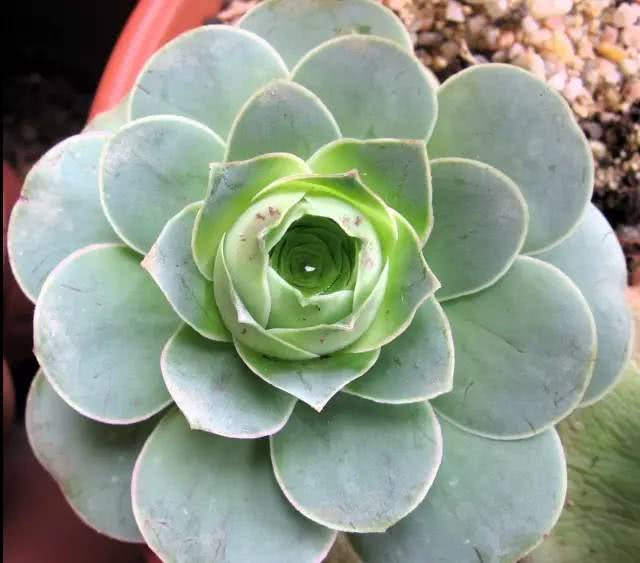
Succulent enthusiasts surely know that there is a succulent named for resembling a rose. It ismountain roseAeonium aureum. However, they are not roses growing on mountains, but a general term for a group of Crassulaceae succulents. The reason they are called mountain roses is not because their flowers look like roses, but because during the high-temperature period in summer, their rosette-growingleaves close togetherand enter a dormant state, looking exactlylike a rosebud。
The part said to resemble a rose is actually the leaves. Image: bramwellii / Flickr
Mountain roses are Aeonium plants, derived from the ancient Greek word "aionos", meaningeternal". However, ironically, of the genus's approximately 35 species,the mother plant slowly withers and dies after flowering。
Most members of the Aeonium genus have thick, branched, fleshy stems, with fleshy leaves clustered in rosettes at the ends of the branches, and star-shaped flowers densely packed on inverted-pyramid-shaped inflorescences. The commonly seenAeonium arboreum 'Zwartkop'in flower markets is a representative horticultural variety of this genus.
In California, USA, many people grow some species of Aeonium like trees in their backyards. Image: fineartamerica.com
Is tighter wrapping better?
Compared with the "giants" of the same genus that can grow to 1-2 m, mountain roses appear much shorter. Their maximum size is only 20-30 cm, with extremely short stems, growing flat against the ground like a Musella lasiocarpa. This is also one of their cute points.
Although they are not roses, mountain rosesreally do grow on mountains. Their homeland is a series of islands formed by volcanic eruptions in Spain's Canary Islands. The seemingly delicate mountain roses thus brave the wind and dew on red-ochre cliffs, guarding this period of tranquil years.
Mountain roses in their native habitat. Image: Ficai Paolo / Flickr
Succulent fans like mountain roses simply because they like their leaves"the tighter they wrap, the better", thinking this is very cute. In fact, this leaf appearanceis not their healthy state. When succulents encounter high summer temperatures, they all to some degree change their external morphological characteristics and halt their metabolic functions to survive the harsh environment.
Mountain rosesgo dormant in summer, with newly grown leaves closing toward the center to form a bud state, reducing the transpiration area, while the outer old leaves dry up and fall off, sacrificing themselves. This is their self-protection behavior. At this time, care should include shading and ventilation, taking care not to overwater, and they can even go without water for two months.Too much care will instead cause their roots to rot and kill them.
Mountain roses during dormancy. Image: s-media-cache-ak0.pinimg.com
Spring and autumn are the growing seasons for mountain roses. If you slowly give them some water, they will be awakened. At this time, the tightly wrapped leaves slowly unfold from the outside, and the pinkish tender color fades,turning into the look of a big cabbage. Many succulent fans feel they are not as cute then and become quite dismissive, but this is their normal growth phenomenon. There is no need to be overly critical; just treat it with a calm mind.
Mountain roses during the growing season. Image: jardinexotiqueroscoff.com
Does flowering mean death?
Because mountain roses themselves look like flowers, many people overlook their true flowering appearance. Mountain roses are perennial succulents, and after about 3-4 years of growth, they will send up huge flower stalks from their small bodies. Their flowers are bright yellow, with finely toothed calyxes, and slender inversely lanceolate petals spreading densely around the flower disk, like upside-down jellyfish, making the entire inflorescence quite spectacular.
But flowering consumes a large amount of nutrients, and after flowering the mother plant slowly withers and dies, hence there is"after flowering, the mother plant dies"”saying.
Feel the size of the flower stalk. Image: worldofsucculents.com
But do not worry too much; mountain roses have their own way of continuing the population. In addition to producing large amounts of seeds, mountain roses also growan indefinite number of offsetsbefore flowering is complete, forming clustered growth. For plants of the Aeonium genus, leaf propagation is not impossible, but the success rate is very low. Therefore, the most common and most efficient vegetative propagation method for mountain roses is beheading offsets for propagation.
Clustered growth; propagating mountain roses from offsets is the most effective. Image: wiki
How many species of mountain roses are there?
Currently, according to mainstream views, mountain roses have been discovered and determined to be 4 species, and most of those commonly seen on the market are their varieties and cultivars. Let's get to know them together~
The most common is A. aureum, with the commercial trade nameCanary Golden Mountain Rose, called "Tamahime Tsubaki" in Japan. The specific epithet means"golden-leaved", with broad obovate leaves. During the growing season the leaf color is grayish-green, and only when in peak condition do the leaves take on a yellow tinge. This species is medium-sized, with leaves spreading up to 20-30 cm in diameter, widely distributed on the islands of Gran Canaria, Tenerife, La Gomera, La Palma and El Hierro at altitudes of 400-2000 m in mountainous areas, where their traces can be found.
"Golden-leaved" A. aureum. Image: ucculents.jp
A. diplocycla, this species does not yet have a circulating Chinese name. Because their leaf spread and size are larger than other species - large enough to cover a face - they are often called"large mountain rose". Aside from size, this species' appearance and characteristics are similar to the golden mountain rose, with the difference being that the former generally has only 19-24 petals, while the latter can have as many as 32 petals.
This species has a variety, A. diplocycla var. gigantea, with the trade name"Egg Rose". The variety name gigantea means "giant". In summer they wrap up like a giant egg, reaching up to 40 cm tall, and at a glance can be distinguished from other mountain roses. Large mountain roses are distributed on the slopes of La Gomera, La Palma and El Hierro at altitudes of 50-1700 m.
A. diplocycla, with few but huge petals. Image source see watermark
A. dodrentalis, no Chinese name for now, distributed only on Tenerife. Recently, due to frequent human activity leading to habitat destruction and excessive collecting and digging, their numbers have become critically endangered. This species is small, with a leaf spread of 3-6 cm, but it is especially prone to producing offsets, forming spectacular large clusters, simply a professional over-breeder. It is said that the common domestic mountain rose cultivar"Emerald Ball"is a horticultural cultivar of this species.
A. dodrentalis, especially prone to forming large clusters. Image: Flickr
There is alsothe least mountain-rose-likemountain rose, A. aizoon, called"Green Jade Cup"in Japan. It is a small species, generally with leaves spreading only 3-5 cm in diameter. The leaves are densely covered with fine hairs, narrow and long, spoon-shaped, densely forming a rosette. During the growing season, their leaves are almost flat like a disk, growing in the form that Echeveria species should have. Green Jade Cupis almost the rarest mountain rose, distributed only on the rock walls of Tenerife at altitudes of 600-1600 m.
Having read this introduction, do you feel tempted to start growing one? Hold on, it is summer now, and mountain roses are not easy to grow. Before getting one, you should first listen to the succulent doctor's tips!
The succulent doctor is making a house call
If you also have these questions:
"Why is it that as soon assummercomes, succulents look listless?"
"My succulent has alreadyrotted/dried up/gotten pests, is there still hope?"
"What doesgetting succulents through summermean, and what should I do?"
Then hurry and listen to the succulent doctor@Attacking Succulents's online lecture!
In this lecture, you will not only gain a great deal ofpractical advice on caring for succulents in summer, but also canfreely ask questionsto the succulent expert! As long as it is a succulent-related question, you can ask him!
Whether you can keep mountain roses and other succulent babies alive this summer depends on this lecture!
Spots to freely ask the succulent doctor questions are limited, first come first served, scan the code to register now!
S
p
o
t
Calendar Girl's avatar today
Crassulaceae Kalanchoe pinnata