Home › General News › Article

Taiwan macaque conservation status proposed for downgrade; COA should disclose the basis and conduct a prudent assessment

General News 0 views
Animal Society / Speaking up for the only two primate species on the island of Taiwan! To downgrade the conservation status of the Taiwan macaque, the COA should disclose the basis and conduct a prudent assessment

According to a report published on April 8 of this year (2018), the Forestry Bureau of the Council of Agriculture (COA) has already convened an "Expert Meeting on the Operational Guidelines for Wildlife Assessment and Classification." At the meeting, experts reached a consensus that "the Taiwan macaque population is steadily increasing, and it is recommended that it be removed from the protected species list and reclassified as a general species." This will be confirmed after the Forestry Bureau convenes the "Wildlife Conservation Advisory Committee" in June. If the downgrade is confirmed, in the future when macaques cause agricultural damage, farmers may directly capture and kill them without needing to report it.

It is understood that today (June 25), the Forestry Bureau will convene the "Wildlife Conservation Advisory Committee" to discuss and assess the "adjustment" of the conservation levels of more than 20 species of mammalian wildlife, including the Taiwan macaque, Reeve's muntjac, sambar deer, and masked palm civet.

"Conservation success" is worth celebrating, but will the downgrade cause an impact?

From a conservation perspective, any animal needing to be listed as a protected species, or even reaching "Vulnerable" or "Endangered" status, is a regrettable and lamentable matter. Therefore, if the Taiwan macaque or more protected species can be moved from protected status back to general status, the so-called "conservation success" is truly worth celebrating.

However, for the Taiwan macaque, which currently has the most conflicts with human activities, is the "downgrade" assessment really as the COA claims: "the population is steadily increasing, and it can be removed from the protected species list and reclassified as a general species"? And what impact will this "downgrade" measure have on wildlife? Has the competent authority, the Forestry Bureau, conducted an appropriate assessment? This must not be taken lightly.

The Taiwan macaque is the only primate on the island of Taiwan besides humans. In the past, it was once nearly extinct due to mass hunting by people and habitat destruction. After the Wildlife Conservation Act was passed in 1989, it was listed as a protected species. Because its habitat highly overlaps with areas of human activity, the frequency of human-macaque conflict is higher than for other wildlife. In recent years, the media has repeatedly reported agricultural damage caused by Taiwan macaques, and farmers' claims that "the macaque population is excessive and should be downgraded" have been persistent. Whether the conservation level of the Taiwan macaque should be "lowered" has attracted widespread attention from all sectors.
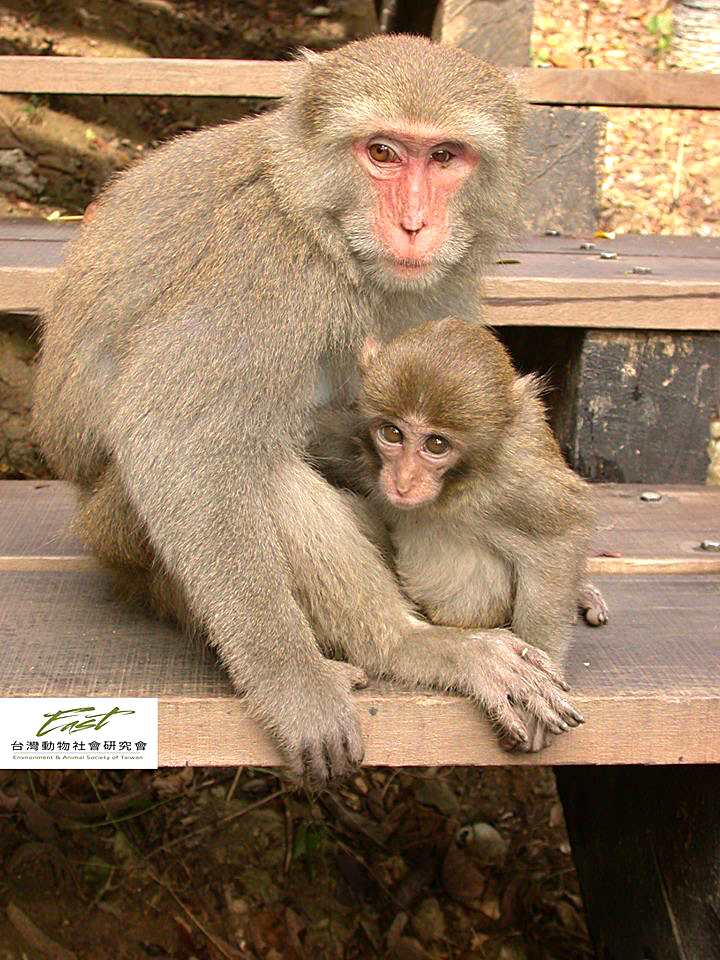
Taiwan macaque (photo / Ke Chin-yuan)

2. The basis for estimating macaque troop numbers has large errors, and there is no impact assessment after downgrading!

All current "claims" about how many macaques there are in Taiwan are based on the COA's 2000 publication, which calculated macaque troop samples of 30, 22, and 22 respectively according to three vegetation zones where Taiwan macaques are active: broadleaf forest, mixed forest, and coniferous forest. The macaque troop densities in these three vegetation types were 0.7219, 02756, and 02824 troops/sq km respectively. From these densities, the total areas of the three vegetation types in Taiwan (11204, 3912, and 4385 sq km) were used to estimate a total of 10,404 macaque troops nationwide. Then, based on the common macaque troop size of 20-30 individuals, it was estimated that there are about 200,000 to 300,000 macaques in Taiwan.

However, this study itself also emphasized that time, manpower, weather, habitat and animal disturbance, among other factors, may all affect the estimate, and attention must be paid to possible errors. In other words, this "estimate" ignores differences in macaque distribution, troop size, and troop density across different habitats, as well as various factors since 2000 such as environmental development, climate change, and human disturbance.

Moreover, according to the Forestry Bureau's separate macaque population survey reports conducted in different regions from 2011 to 2017, it can be found that macaque troop densities vary greatly by region, and are not all 0.7219 km/troop, nor are troop sizes consistent. (See Table 1 compiled by our association.)

Based on the above, first, from 2000 to the present, for 17 years, the Forestry Bureau has not updated or conducted a comprehensive macaque population survey. Second, the condition of macaque populations varies greatly across different regions. After such a long time, can the large-scale "estimate" data produced in 2000 be used as the basis for claiming that "the overall macaque population across Taiwan is stable and continuously growing, and even that conservation has been successful"? And then, on this basis, "lower" the conservation level of the Taiwan macaque! This should be considered prudently.

On the other hand, Chang Shih-wei, associate researcher at the Endemic Species Research Institute (2013), also pointed out that macaque troop density and macaque damage problems are not positively correlated. The macaque damage problem mainly lies in the abundance of agricultural activities and proximity to forests, which increases opportunities for macaques to enter farmland to feed. Moreover, if macaque troops in some areas are small populations, using capture and removal as a control method may cause regional population extinction.

In fact, at the "Expert Meeting on the Assessment and Classification of Mammalian Wildlife" in November 2013, the participating experts and scholars at the time "unanimously agreed that there is currently insufficient new evidence to change and lower the conservation level of the Taiwan macaque, and that primates are all internationally jointly protected species and should still remain listed as protected species and other wildlife that should be conserved."

In the Forestry Bureau's 2015 special report to the Legislative Yuan responding to "addressing the problem of agricultural damage caused by macaques," it also clearly pointed out that "adjusting the Taiwan macaque to a general wildlife species cannot solve the macaque damage problem. The number causing human-macaque conflict is about 1,000 to 5,000, accounting for less than about 5% of the island's population. It is still difficult to justify affecting the conservation level of the entire population based on a problem caused by less than 5% of individuals."

Between 2013 and 2017, the Forestry Bureau did not publish any new facts or new evidence sufficient to overturn the above statements or sufficient to support "lowering" the conservation level of the Taiwan macaque!

In short, based on currently available public information, the scientific data by which the COA intends to lower the conservation level of the Taiwan macaque is not sufficient or complete. Importantly, before an assessment of the impact of the downgrade and preparations for responding to it are proposed, a hasty downgrade would have worrying consequences.

3. Only by establishing and implementing a reporting and long-term monitoring system can the macaque ecology and the reality of agricultural damage be fully understood

Whether in Professor Lin Liang-kung's research report "Taiwan Macaque Damage Prevention, Control, Guidance Platform and Technical Advancement" or the Forestry Bureau's published "Management of the Taiwan Macaque," both state that the macaque damage problem should actively establish an effective reporting system and handle it by levels. A reporting and monitoring system can not only accelerate the response of farmers and the government when facing agricultural losses, but also establish a concrete and effective database to understand the distribution and changes of macaque populations, for use in future macaque research and agricultural damage prevention and control.

From many survey reports, it can be seen that human-macaque conflict is not necessarily because the macaque population is too large, but rather due to improper or illegal land development and crop cultivation. The government should actively face the problem of illegal forest land use and should not indulge farmers who illegally use land, resulting in the long-delayed establishment of a reporting system to understand macaque troop ecology, the extent of agricultural damage, and handling levels.

If the government does not actively face the "man-made disaster" problem of law-breaking people, but instead only targets animals, downgrading the Taiwan macaque to a general species and making hunting and killing macaques no longer require reporting, this is not only a "saw-off-the-arrow remedy" that makes matters worse, but will also make the establishment of an agricultural damage reporting and monitoring system indefinitely delayed.

4. Subsidies for prevention and control equipment need to come first!

According to the "General Report on the Review of the 107th Fiscal Year Central Government General Budget," the total amount of agricultural loss subsidies nationwide rose from 6.34659 billion yuan in Fiscal Year 101 to 38.339665 billion yuan in Fiscal Year 105, a sixfold surge, reaching a record high. Such a huge subsidy amount is already difficult for government finances to bear.

Some farmers and elected representatives advocate that the government should compensate for agricultural losses caused by macaques. But first, there is currently no established macaque damage reporting system, so how can the damage caused by macaques be confirmed? How can the extent of agricultural damage and the basis for compensation be assessed? Second, agricultural damage subsidies will cause government funds used for disaster relief to expand without limit. In facing the problem of macaque agricultural damage, the COA should actively start with subsidies for prevention and control equipment.

The Taitung Agricultural Improvement Station developed a new-style macaque-proof net cover in 102; the Kaohsiung City Government completed six macaque corpse models in 103 to deter macaque troops; the Taoyuan Agricultural Improvement Station released a "macaque deterrent warning device" in 105, all of which tested as "highly effective." If the reporting system can be successfully established, various macaque prevention and control devices can be comprehensively subsidized and put to good use.

In addition, installing electric fencing is considered the most effective. The COA also approved in January 105 the "Demonstration Plan for Subsidizing Local Governments to Guide Farmers in Preventing and Controlling Damage to Crops by Taiwan Macaques," with a total central budget of 8 million yuan to subsidize the installation of electric fencing. After a review in December, it further lowered the eligible farmland area from 1 ha to 0.2 ha, expanded central subsidies from only electric livestock fencing powered by electricity to include electric fencing materials, and simplified the approval process, hoping thereby to increase farmers' willingness to apply.

Since various macaque prevention devices invested in over the years have all been said to be highly effective, promotion of their use by farmers should continue, and more effective prevention and control tools should be developed, in order to reduce macaque damage to crops.

5. Implement government information disclosure; democratic participation cannot be "pretend play"!

The adjustment of wildlife conservation levels is assessed by the Forestry Bureau according to the "Operational Guidelines for Wildlife Assessment and Classification" based on five major conditions: "wild population distribution of wildlife, current population size of the wild population (adult individuals), population trend of the wild population, taxonomic status, and threats faced," and different assessment scoring benchmark tables are drafted according to different species. For example, to assess whether to lower the level of the Taiwan macaque, the attached table "Applicable to Terrestrial Amphibians, Reptiles, Birds, and Mammals" is used, and scholars and experts are commissioned to assess it. The assessment results are discussed at the "Expert Meeting on the Operational Guidelines for Wildlife Assessment and Classification," and the consensus on species downgrading is then sent to the "Wildlife Conservation Advisory Committee" for confirmation.

However, for this adjustment by the Forestry Bureau of the conservation levels of more than 20 species including the Taiwan macaque, the records and meeting materials of the successive expert and scholar meetings will only be made public after the advisory committee meets. If our association wants to obtain the above materials to facilitate a deeper understanding of the issue, it must obtain them through a legislator's office. All sectors of society are even less able to understand the actual wild population distribution, population size, and population trends of species such as the Taiwan macaque. The non-disclosure of relevant information also needlessly increases suspicion and panic among conservation groups and the public concerned about different species, and does not help policy promotion and implementation.

In fact, in the July 5, 106 record of the "Wildlife Conservation Advisory Committee," the Forestry Bureau consulted committee members on whether to open meetings for livestreaming. The meeting resolved that future committee meetings should move toward a more open method (including livestreaming), and should follow the Environmental Protection Administration's model of planning livestreams for environmental impact assessments, so that stakeholders may participate and express opinions at appropriate times.

The Forestry Bureau should not only make public and fully record or livestream the complete discussion process of tomorrow's (June 25) "Wildlife Conservation Advisory Committee," but should also publish all relevant meeting materials in advance and open participation to all sectors to provide opinions. Future related meetings should also follow the same practice, making the conservation decisions and bases for every kind of wildlife and plant more open and transparent.

Appendix: [Table 1] Overview of Macaque Population Survey Reports in Different Regions from 2011 to 2017 (compiled and tabulated by the Taiwan Animal Society Research Association)

Related Articles