The nipplefruit, also known as the golden fruit or five-finger eggplant, has brightly colored fruit and an attractive shape and is mostly grown for ornamental purposes.
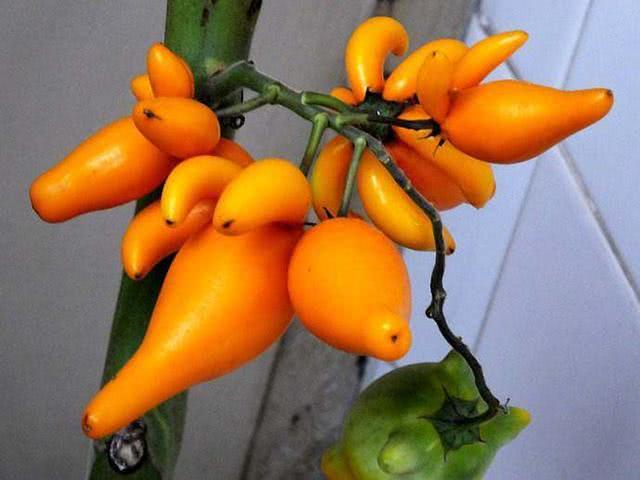
Nipplefruit, golden fruit (a plant of the genus Solanum in the nightshade family) generally refers to nipplefruit.
Nipplefruit (scientific name: Solanum mammosum L.), also known as golden fruit, five-finger eggplant, etc.
Upright herb. About 1 m tall, the stem is covered with short soft hairs and flat prickles, and the branchlets are covered with jointed long soft hairs.
Leaves ovate, both surfaces densely covered with very long bright white long soft hairs and short soft hairs; lateral veins about equal in number to the lobes, flat on the upper surface, slightly protruding on the lower surface, with slender loess-colored prickles.
Scorpioid cymes extra-axillary, often borne at the outer base of the axillary buds, covered with indumentum similar to that of the branches and leaves.
Peduncle very short, without prickles.
Calyx nearly shallowly cup-shaped, externally covered with very long jointed long soft hairs and glandular hairs, corolla purple hibiscus-colored, the tube hidden within the calyx;
Stamens 5, nearly equal, anthers oblong-conical, base rounded, upper part elongated, tip yellowish, apical pores opening upward; ovary glabrous, ovate-acuminate.
Berry obovoid-pear-shaped, externally loess-yellow, internally white, with 5 nipple-like protuberances, seeds blackish brown. Flowering and fruiting period between summer and autumn.
Native to the Americas; now introduced and successfully cultivated in Guangdong, Guangxi and Yunnan in China. The fruit has a beautiful shape and is mostly cultivated for ornament. The plant contains solanine.
Morphological characteristics
Upright herb. About 1 m tall, the stem is covered with short soft hairs and flat prickles, the branchlets covered with jointed long soft hairs, glandular hairs and flat prickles, the prickles wax-yellow, glossy, pale purple at the base, 3-5 mm wide, pointed at the tip, subulate, straight or slightly curved, 4-12 mm long.
Leaves ovate, 5-10 cm long, width nearly equal to length, often 5-lobed, sometimes 3-7-lobed, lobes shallowly sinuate, apex acute or obtuse, base slightly concave, both surfaces densely covered with very long bright white long soft hairs and short soft hairs;
Lateral veins about equal in number to the lobes, flat on the upper surface, slightly protruding on the lower surface, with slender loess-colored prickles, prickles 8-20 mm long, base flat, grooved, apex subulate; petiole 2.5-8 cm long, grooved on the upper side, covered with jointed long soft hairs, glandular hairs and prickles.
Scorpioid cymes extra-axillary, often borne at the outer base of the axillary buds, covered with indumentum similar to that of the branches and leaves, usually 3-4 flowers, peduncle very short, without prickles, pedicels about 5-10 mm long.
Calyx nearly shallowly cup-shaped, externally covered with very long jointed long soft hairs and glandular hairs, 5-parted, lobes ovate-lanceolate, apex acuminate, 5-6 mm long; corolla purple hibiscus-colored, the tube hidden within the calyx, about 1.5 mm long, limb 25-32 mm in diameter, 5-parted, lobes oblong-linear, 20-22 mm long, 4 mm wide, apex acuminate to very acute, externally covered with long soft hairs, internally glabrous, margin membranous and ciliate;
Stamens 5, nearly equal, about 1.1 cm long, filaments about 1 mm long, anthers oblong-conical, base rounded, upper part elongated, tip yellowish, apical pores opening upward; ovary glabrous, ovate-acuminate, about 5 mm long, style 3 mm long, stigma green, shallowly 2-lobed.
Berry obovoid-pear-shaped, 4.5-5.5 cm long, externally loess-yellow, internally white, with 5 nipple-like protuberances, seeds blackish brown, nearly circular and flattened, about 3 mm in diameter. Flowering and fruiting period between summer and autumn.
Growth habits
Nipplefruit prefers a warm, humid environment with ample sunlight. The optimum growth temperature is 15-25°C. It has a certain degree of cold tolerance and fears waterlogging and drought. It can withstand low temperatures of 3-4°C. It prefers fertile, loose, well-drained sandy loam. In winter the temperature must not fall below 12°C.
Origin and distribution
Native to the Americas; now introduced and successfully cultivated in Guangdong, Guangxi and Yunnan in China.
Propagation methods
Nipplefruit is mainly propagated by sowing. After the berries mature, the seeds are removed and stored dry.
In the south, sow in March; in the north, sow in April, at a depth of 0.3-0.4 cm, keeping the potting soil moist at all times.
After the seeds germinate and emerge, shade the seedlings in the early stage, then gradually expose them to more sunlight and strengthen fertilizer and water management. When the seedlings are about 15 cm tall, they can be planted out.
Cultivation techniques
Soil
Nipplefruit grows well in deep, loose, fertile, well-drained, slightly acidic sandy loam, but it can also grow in neutral and slightly alkaline soil.
Fertilizing
Apply sufficient base fertilizer when potting or repotting; 50 g of hoof and horn pieces can be placed in each pot. During the seedling stage, apply more nitrogen fertilizer, applying liquid fertilizer once every half month. After flowering and fruit set, mainly use phosphorus and potassium fertilizers, or spray a 0.2% potassium dihydrogen phosphate solution on the leaves, so that the fruit becomes robust and the seeds plump.
Watering
Nipplefruit prefers moisture and dislikes drought and waterlogging. In summer, water once or twice a day to prevent the leaves from drying out and falling, which affects growth. During the flowering period, excessively wet soil easily causes flowers to drop and reduces the fruit set rate. During the fruit ripening period, the soil should be moist to prevent the fruit from drying yellow and losing its luster. Under high temperature and dryness, it is prone to the phenomenon of flowering without fruiting.
Pruning
Vine-shape pruning: when the plant grows to 30-40 cm tall, pinch the tips appropriately 2-3 times to promote the growth of more side branches, form a full and well-proportioned plant shape, and also favor flowering and fruiting.
For pot cultivation, keep 3-4 branches; for field cultivation, keep 5-6 branches, and remove excess axillary buds and branches.
Fruit thinning
To fully dwarf a tall plant, remove the terminal bud when its stems and branches grow to 50 cm tall, so that the plant no longer grows taller and the side buds grow.
When the side buds reach an appropriate height, spray with paclobutrazol to inhibit height and promote flowering, until the fruit ripens.
After fruiting, if the plant bears too much fruit, stakes should be set up to prevent breaking and lodging. Fruit can be appropriately thinned without affecting ornamental value to ensure the fruit is large.
Main value
Ornamental
The fruit has a beautiful shape and is mostly cultivated for ornament. The nipplefruit has a peculiar fruit shape, a fruit-viewing period of up to half a year, and brightly colored fruit.
Nipplefruit can also be used as a cut-flower material. For example, using nipplefruit and red small chrysanthemums as the main flowers, paired with fern leaves and cattail grass, presents nature, harmony and hope.
If nipplefruit and paphiopedilum are used as the main materials, paired with red-twig dogwood branches and cycad leaves for vase arrangement, it appears even more dignified and elegant, conveying the spirit of Eastern art.
Medicinal
It can be used medicinally; the plant contains solanine.
Its main medicinal effects are clearing heat and detoxifying, and it is mainly used to treat heart and stomach qi pain, lymphatic tuberculosis, armpit sores, carbuncles, erysipelas, scrofula and other conditions.
Generally, only people who are ill need to take it; it cannot be consumed in large quantities as an ordinary fruit and is only suitable for external use.