Detailed Explanation of Supporting Cultivation Techniques for Hongdan Crisp Jujube
Supporting Cultivation Techniques for Hongdan Crisp Jujube
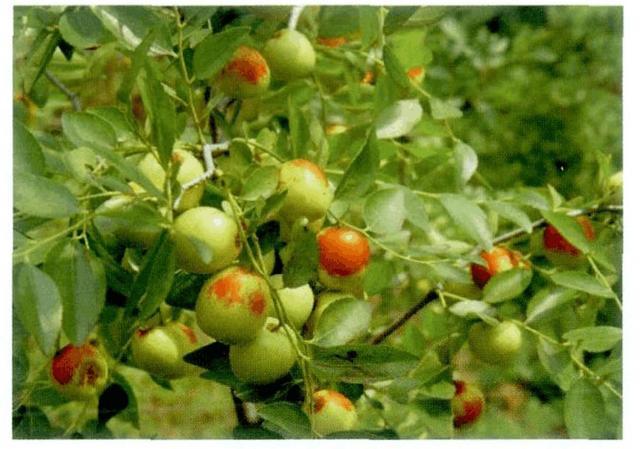
Hongdan Crisp Jujube is a variant of Zaozhuang Crisp Jujube discovered in 1998 in the jujube orchard of Songshanwan Village, Xinzhuang Town, Feixian County. The fruit is oval, with a single fruit weight of 16.5-22.5 g, thin and crisp skin, light green at the white-ripe stage, and mottled at maturity, with ochre-red covering 70%-80% of the fruit. The flesh is crisp and tender, intensely sweet and juicy, with a mellow taste. The stone is extremely small, sugar accumulates early, and the soluble solids content (mass fraction) is 26.3% (Figure 1). This variety has strong productivity; a small number of fruits can be seen in the year of planting, all plants bear fruit in the 2nd year, and in the 3rd year the average yield per plant is 5.5-8.5 kg, with stable fruit set and high, stable yields. By the end of 2017, more than 10,000 mu had been developed in Feixian County alone, with an annual output of more than 3 million kg.
1 Planting
The planting period for jujube seedlings is from after leaf fall to before freezing and from after thawing to the budbreak stage. When planting, dig planting holes of 0.8 m × 0.8 m. When backfilling, apply 20-25 kg of thoroughly decomposed farmyard manure and 0.5 kg of special compound fertilizer for fruit trees per plant. After backfilling, be sure to water to settle the soil and cover with plastic film.
2 Trunk Heading
The trunk heading height is 70-80 cm. If the heading height is too low, the main branches tend to droop and drag on the ground after fruiting, causing difficulties in orchard management under the tree and a decline in jujube fruit quality; if the heading height is too high, the growth of the jujube shoot is small, making it difficult to form the canopy quickly and delaying the entry into the fruiting period. If seedling quality is poor, leave 2 buds and cut back heavily. After sprouting, select a vigorously growing jujube shoot to retrain the trunk, and pinch the tip when the seedling height reaches more than 80 cm.
3 Training and Pruning
Hongdan Crisp Jujube has moderate branching ability and a small tree body. In production, the free spindle shape or cylindrical shape is suitable. For the free spindle shape, the plant-row spacing is (2-3) m × (3-4) m; for the cylindrical shape, the plant-row spacing is (1-2) m × (2-3) m. The free spindle shape has a tree height of 2.5-3.0 m and a trunk height of 60-80 cm. The whole tree has 8-10 main branches in total, and the thickness of the main branches does not exceed 1/3 of the central leader. They are arranged spirally on the central leader. The first main branch at the lowest position is best selected in the southeast or southwest direction. The spacing between two adjacent main branches is 20-30 cm, and the spacing between two main branches in the same direction is not less than 100 cm. No secondary branches are provided; fruiting branch groups are borne directly on the main branches. The opening angle of the lower main branches is 80°-90°, and the upper main branches open to 70°-80°. The cylindrical shape has a tree height of about 2 m. The whole tree has 10-12 branch groups borne directly on the main branches, strong at the bottom and weak at the top, distributed horizontally and evenly on the central leader. During training, 4-6 secondary branches should be retained more than 60 cm above the ground. When the secondary branches grow to more than 6 nodes, pinch the tips. In the second year, when the newly emerged jujube shoots grow 6-8 secondary branches, pinch the tips, and when the secondary branches have more than 6 nodes, pinch the tips. During training, maintain the uprightness and growth advantage of the central leader, pay attention to controlling the growth of jujube shoots, and shorten or pinch appropriately when necessary to prevent the inner canopy from becoming bare. Fruiting branch groups of jujube trees have the strongest fruiting capacity at 3-8 years, so timely renewal should be noted (Figure 2).
Figure 2 Training and pruning of jujube trees
4 Soil, Fertilizer and Water Management
4.1 Base Fertilizer
Each autumn after fruit harvest and before leaf fall, dig 3-4 holes per jujube tree and apply 10-15 kg of thoroughly decomposed organic fertilizer or 3-4 kg of biological bacterial fertilizer, and 0.3 kg of nitrogen fertilizer.
4.2 Topdressing
Apply 3-4 times before flowering, at the young fruit stage, and at the fruit swelling stage. Dig 4-6 holes per tree and apply compound fertilizer, about 0.25 kg each time, to promote more flowering and better flowering of jujube trees and promote fruit swelling.
4.3 Water Management
Each fertilization should be combined with watering to facilitate the transformation and absorption of fertilizer and the swelling of fruit. During the growing season, water timely according to drought conditions.
4.4 Soil Management
Because jujube orchards are mostly established on hills and ridges, where the soil layer is thin, deep plowing and hole expansion should be carried out every year in combination with fertilization to increase the soil layer thickness. During the growing season, natural grass growing between rows or biological mulching should be adopted for the soil. Grass growing or biological mulching can regulate the temperature and humidity of the orchard, improve soil aggregate structure, increase soil organic matter content, prevent soil erosion, and reduce jujube fruit cracking. However, it should be noted that when growing grass, malignant weeds such as Humulus scandens and Chenopodium album should be removed in time, and beneficial weeds such as crabgrass and foxtail should be retained. Supplement nitrogen fertilizer appropriately (additional application of 2.5-5 kg per mu). When the grass height reaches 40 cm, mow it in time, leaving a stubble height of 15-20 cm (Figure 3).
Figure 3 Grass growing in a jujube orchard
5 Flower Promotion Measures and Flower and Fruit Management
5.1 Branch Bending and Propping
Generally carried out from May to July to make branch distribution even, provide good ventilation and light transmission within the canopy, moderate tree vigor, and promote flower formation and fruit set.
5.2 Bud Removal
From late April to early July, for newly sprouted jujube buds with no useful value, remove them from the base as early as possible, retaining the base jujube pendants, to save nutrients and benefit tree growth and development and flowering and fruit set.
5.3 Tip Pinching
Tip pinching is an effective measure to control vegetative growth and save nutrients. Tip pinching can reduce flower and fruit drop and significantly increase the fruit-setting rate. From budbreak and leaf expansion to mid-July, pinch the tips of new jujube shoots, secondary branches, and jujube pendants to inhibit excessive growth of jujube shoots.
5.4 Girdling
Jujube tree girdling is also called ringing. Its purpose is to prevent organic matter produced by the aboveground part from being transported to the roots and can increase the fruit-setting rate of jujube trees. Girdling should be carried out on vigorous trees over 5 years old. The best time is in early June at full bloom. The girdling site is selected on the trunk 30 cm above the ground, at a smooth place without scars. The girdling width should not exceed 1/10 of the trunk diameter, and it must not be too deep to damage the xylem. Girdling should be carried out on a sunny, windless day. One week after girdling, apply 150-fold liquid of Mieyouniao No. 3 to the girdling wound once to control pests at the wound and promote wound healing 20-30 days after girdling.
5.5 Water Spraying at Flowering Stage
The flowering stage of jujube trees is often dry, and the relative air humidity is low, which is unfavorable for pollen germination and thus affects fertilization and fruit set. Therefore, when drought occurs during the flowering stage, use a sprayer to evenly spray clean water on the canopy, which can increase the fruit-setting rate by more than 1 time. The best time for spraying water is after 5:00 p.m. Spraying at this time can avoid the pollen-shedding time of jujube flowers and maintain moisture for a longer time, which is beneficial to pollen germination. Generally, spray for 2 consecutive days, once a day.
5.6 Bee Release at Flowering Stage
Releasing bees in jujube orchards increases the cross-pollination rate and thus can increase the fruit-setting rate. Most varieties of jujube trees can self-pollinate and set fruit. However, cross-pollination can significantly increase the fruit-setting rate. Releasing bees during the flowering stage in jujube orchards can fully pollinate jujube flowers, and the fruit-setting rate can be increased by more than 68%. Moreover, the closer the jujube trees are to the beehive, the better the effect.
5.7 Foliar Fertilization
At the flowering stage and young fruit stage, foliar fertilization with 0.3% (mass fraction, the same below) potassium dihydrogen phosphate solution, amino acids, 0.1% boric acid, etc. can not only reduce the occurrence of flower and fruit drop, but also increase the fruit-setting rate, increase single fruit weight, and improve fruit quality.
5.8 Spraying Plant Growth Regulators and Trace Elements
Spraying plant growth regulators and trace elements can increase the fruit-setting rate. At present, commonly used plant growth regulators include gibberellin, 2,4-D, sodium naphthaleneacetate, etc., among which gibberellin (commonly known as "920") is widely used. Gibberellin can promote the germination of jujube pollen and also stimulate unpollinated jujube flowers to set fruit. Spraying 10-15 mg/kg gibberellin once at full bloom can increase the fruit-setting rate by more than 70%. Trace elements such as boron, zinc, and iron also have a certain promoting effect on fruit-setting rate and yield. Spraying 0.2%-0.3% boric acid or borax at the flowering stage has the effect of increasing the fruit-setting rate, because trace boron can significantly increase the pollen germination rate.
6 Pest and Disease Control
The main pests and diseases of Hongdan Crisp Jujube include jujube fruit shrinkage disease, black rot, jujube rust, jujube witches' broom, green plant bug, jujube geometrid, jujube leaf roller, tortoise wax scale, red spider mite, peach fruit borer, leafhopper, etc.
Pest and disease control in jujube trees should focus on prevention, strengthen forecasting, and emphasize integrated agricultural, physical, and chemical control. Agricultural and physical control: during the dormant period, scrape tree bark, clean up dead branches and fallen leaves and bury them deeply in a centralized manner, and deep-plow the tree disk (10 cm) to freeze overwintering pests in the soil; in early to mid-April, bind 10 cm wide plastic film around the base of the trunk and coat it with waste engine oil to prevent female moths of the jujube geometrid from climbing the tree; use black light traps to kill adult jujube leaf rollers, hang peach fruit borer sex pheromone lures in mid-June, bind grass bundles around the trunk base in early September to trap pests, and remove and burn the grass bundles after leaf fall. Chemical control: for pests such as green plant bug, jujube geometrid, jujube leaf roller, tortoise wax scale, red spider mite, peach fruit borer, and leafhopper, according to the occurrence period, apply 3% phoxim granules on the ground and hoe (for peach fruit borer); on the tree, choose 10% imidacloprid 3,000-fold liquid, 1.8% abamectin 4,000-fold liquid, 22.4% spirotetramat 4,000-fold liquid, 5% fenpyroximate 1,500-fold liquid, 25% thiamethoxam 2,000-fold liquid, pyrethroid pesticides, etc., mixed and applied alternately for control; for diseases such as jujube fruit shrinkage disease, black rot, and jujube rust, choose 72% agricultural streptomycin 3,000-fold liquid and 10% difenoconazole 1,500-fold liquid, 43% tebuconazole 3,000-fold liquid, 5% pyraclostrobin 1,000-fold liquid and other fungicides applied alternately for control. The pathogen of jujube witches' broom is mycoplasma-like organisms, mainly transmitted through grafting, root division, and insects such as Orange-banded Cicadella, Cicadella sinica, red-flashing leafhopper, and concave-margined Cicadella. After jujube trees are infected, the therapeutic effects of existing pesticides are not ideal, so prevention should be the main approach. The main measures include cultivating disease-free seedlings, planting orchards away from Platycladus orientalis (Platycladus orientalis is the main place where Cicadella overwinter and reproduce), and promptly eradicating diseased branches.