You can't rush bonsai; all these skills must be developed slowly.
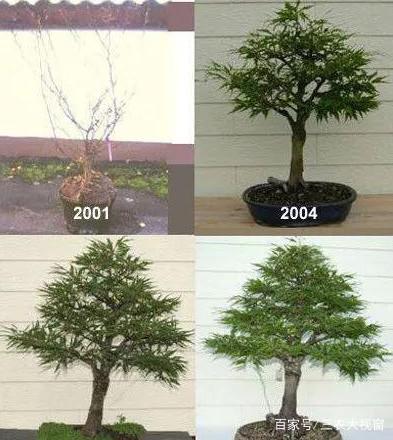
Bonsai is the art of living. The growth of potted plants cannot be forced beyond their natural way of growing. Therefore bonsai creation can only be gradual, never rushed. Experienced bonsai artists speak of years of study and creation, even using bonsai to create their own bonsai. But some enthusiasts, especially beginners, are impatient. They can't wait to turn their works into masterpieces. I too paid expensive tuition fees, because in the eager pursuit of success, some poor practices easily appear in bonsai creation; discussing with colleagues, we try to minimize the mistakes caused by quick profits and instant benefits.
In practice, there are several phenomena that easily give rise to impatience.
One, greed. Not considering one's own capacity to bear costs, nor the value of the raw trunk material, blindly expanding the scale; some future trunks are kept, and after a few years, having no great value, they are abandoned with regret, and end up becoming one's own burden.
Two. When collecting trunks, the trunk is not carefully examined. Regardless of whether the trunk is good or bad, as long as it has a little value, not only are good trunks not selected, but worthless trunks become future "chicken rib" trunks. It also causes damage to the ecological environment.
Three. Successfully collecting the trunk is treated as urgent. When the trunk has not yet been dug out, the surrounding soil is not moved away to work with a firm wrench, but instead the wrench is moved left and right, so the trunk's small roots must be broken, making the trunk less likely to survive.
Four. When the trunk is cut, the trunk is not carefully examined. When the trunk is cut, there is an eager desire to shape it, followed by regret. I also had a serious lesson. I once bought a Huanghai trunk for 3500 yuan. I had a stack of photos, but the photos were not taken out. The trunk's main branch had two choice points. In the end, the choice of the front part or the cut point differed from the choices of several friends. I did not consider carefully, and then I cut off the main branch. When the photos came out, I found the front part was much stronger than the trunk. Unfortunately, I was in a hurry to cut the trunk. Without waiting for the pictures to be cut, a good raw trunk became an ordinary raw trunk. Once some trees are cut, they cannot be put in place, the new shoots are not in place, or there are too few sprouts. In the future, there will be no extra branches, or because the sprouting is not in place.
Five, when planting the trunk, the appropriate base soil for the trunk is not chosen. Some trunks need acidic soil, some trunks need coarse-grained soil. It does not consider the need and randomly plants the raw trunk, causing the death of the raw trunk. For example, rhododendrons are very difficult to keep alive without cultivation in acidic soil.
Six. When planting, the soil is not inserted into the soil, causing part of the trunk's roots not to be covered by soil and to be "suspended", leading to the death of the trunk.
Seven. When the raw material is raised, the position is not chosen. The shade curtain is not set up in the shade, and sunlight is not placed in the sun, affecting the survival of the trunk.
Eight, rushing to remove the cover. Some of these are new film bags, which can expose moisture or eliminate shade, and cause buds.
Nine, the trunk is frequently moved. The trunk has just sprouted, and it is considered alive. When the raw material is moved to a sunny place, the sun sprouts it and it is moved to the shade. This is urgency. New trunks not only fail to adapt to environmental changes, but also affect the development of new trunk roots, affecting the survival rate of the trunk.
Ten, eager to apply buds. New shoots can promote rooting, and the new trunk is not completely alive. Therefore, eliminating excess buds, causing photosynthesis and trunk death, is urgent. For example, new rhododendron buds sprout from many new shoots. If the new shoots are rubbed off in the first year, they will affect the trunk's roots and mold.
Eleven, eager to prune. It is necessary to roughly cut a few branches and cut them to uneven lengths. Therefore, not only are a few branches cut off, but after a long period of pruning, the raw material will not grow very well.
Causing shrinkage or death. For example, the branches of a new tree cannot be pruned in the first year. If they are cut off, most will die. When the branches are not lignified, some branches are pruned. In particular, the thickness of large branches must be increased, and pruning them too early.
Twelve, eager for food. A long, thick new branch soon appears, and there is an urge to bundle the branches, which suppresses the growth of the branches. As a result, two long branches can grow for three years, or just a small twig.
Thirteen, eager to go to the pot. Planting the trunk in a small basin or a shallow basin is urgent. The result is that the plant's growing environment is poorer, branch growth is suppressed, and the branches cannot thicken for a long time.
Fourteen, eager to root. The roots of a lush ancient tree are pre-cultivated, revealing the plant's fine roots, drying or dying.
Fifteen, eager to admire the flowers. Some plants have not yet fully survived. They are eager to see the flowers. When the plant blooms, it consumes a large amount of nutrients, and the plant dies. New rhododendrons, like new rhododendrons, have already bloomed in the second year. At this point, the rhododendron has not yet fully survived, the plant's nutrients are exhausted, and the likelihood of the plant dying is very high. Some plants have not yet taken shape. They are eager to see fruit, consuming plant nutrients, suppressing plant growth and prolonging the shaping time.
Sixteen, eager to shape. In order to sell well, we must bundle a few sticks together.
The thick work is far from being seen, but it seriously violates the laws of creation.
Seventeen, eager to fertilize. In order to make plants grow quickly, they do not consider the plant's ability to withstand strong fertilizer, increase the concentration and strength of the fertilizer, and cause the plant's roots to be burned, preventing growth or causing death. For example, a new trunk cannot be fertilized in the first year. Some concentrated fertilizers make the plant grow and develop root nodules, reducing ornamental value. A friend of mine used compound fertilizer on an old Lagerstroemia trunk, five kilograms each time. The lesson is profound.