Biological Characteristics of Ornamental Bromeliads and Key Points of Cultivation and Management Techniques
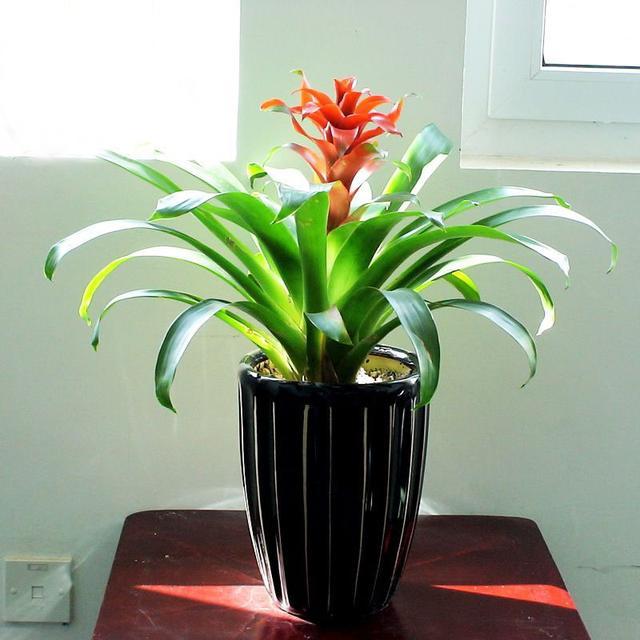
Main Biological Characteristics of Ornamental Bromeliads and Main Cultivation and Management Techniques
Ornamental bromeliads, also called pineapple flowers, are perennial herbaceous plants with the largest number of varieties in the current Bromeliaceae family. Among monocotyledonous plants, the Bromeliaceae family alone contains more than 50 genera and over 2,500 species, with more than 1,000 hybrid species alone, making it a family with a relatively large number of both genera and species. Because ornamental bromeliads have high ornamental value, compact plant form, good leaf glossiness, varied flower shapes, very rich flower colors, and a relatively long flowering period, most ornamental bromeliads have a single inflorescence flowering period of about 90 days. Whether it is the inflorescence, cotyledons, or fruit, all possess unique ornamental value, so they can rival tropical plants such as tropical orchids and anthuriums, and they are also high-grade ornamental indoor plants with relatively high sales at present. Their place of origin is in the tropical rainforests and coastal areas of Central America and South America, growing in warm and humid semi-shaded environments, and they have long been attached to the trunks of forest plants or stone walls. At present, ornamental bromeliads developed through artificial hybridization have replaced native varieties. The most common ornamental bromeliads in the flower sales market are mainly those of the genus Guzmania, with more than 200 species, all of which have been developed through multiple generations of hybrid breeding, with excellent quality and brilliant colors, occupying a relatively large proportion of market sales.
1 Main Biological Characteristics of Ornamental Bromeliads
1.1 Morphological Characteristics
1.1.1 Roots. The root system of ornamental bromeliads is mostly fibrous roots, most of which are black, with some brown, and only a small portion of the root system is green, and they are directly exposed to nature for a long time. The root system of ornamental bromeliads is very fine and has many branches, and the tips of new roots are densely covered with root hairs. Their main function is to fix the stem and perform corresponding absorption. Newly emerging roots have a very strong regenerative function and can grow directly in a moist flowerpot without being cultivated with roots. Some aerial bromeliad varieties do not have a root system even when mature, and their growth and development mainly rely on obtaining the needed nutrients and water from the air.
1.1.2 Stems. The main function of the stems of ornamental bromeliads is to support the leaves and inflorescences and to transport the water and nutrients needed for growth and development. Nutrients can be stored in the stems, and there are many growth hormones at the top of the stems that can promote rapid plant growth and development. The stem part can be divided into aboveground and underground parts. Most aboveground stems are very short and small, surrounded by leaves so that they cannot be seen. Only some PUYA bromeliads and Tillandsia recurvata varieties have very obvious aboveground stem parts. For example, the aboveground stem parts of some Aechmea coral-type bromeliads are in a creeping state, and the plant at the top of the stem replaces the plant that has flowered and died and continues to grow and develop. The underground stem part is mostly fibrous roots, has many branches, shows woody characteristics, and is directly covered by soil. Only some aerial bromeliads have underground stem parts exposed and growing in nature.
1.1.3 Leaves. The cotyledons of ornamental bromeliads are mostly broadly band-shaped, with some linear or needle-shaped. Most cotyledon surfaces are leathery or fleshy, and the leaf margins are serrated, with some entire. The cotyledon surface is rough and can obtain the nutrients needed for growth and development from the air. Most bromeliad varieties have abundant cotyledon structures, and different cotyledons grow crossing each other, forming a lotus-like water-storing cup at the base of the plant, which can also be called a leaf cup. During the growth and development of ornamental bromeliads, all nutrients and water needed are provided by the leaf cup, which is even more prominent than the role of the root system. Related research suggests that in 10,000 sq m of forest, there are 175,000 bromeliads, and the actual water storage exceeds 50,000 L. Therefore, in the artificial cultivation of ornamental bromeliads, it is only necessary to irrigate and fertilize in the leaf cup.
1.1.4 Flowers. The flowers of ornamental bromeliads generally refer to the entire inflorescence, not merely a simple flower. Ornamental bromeliads have many flower shapes, which can be said to be in a thousand postures and a hundred poses, with very brilliant flower colors, a relatively long flowering period, and beautiful appearance, and they are very popular among the general public in market sales. The flowers of ornamental bromeliads are mostly spicate, compound spicate, and paniculate. Most are covered by bright bracts, and some peduncles develop directly from the leaf cup, while a few are capitulum-type inflorescences hidden in the leaf cup for flowering. In fact, the true flowers of ornamental bromeliads are not large, and generally open hidden among the leaves inside the brightly colored flower bracts. Most are bisexual flowers, and some are unisexual flowers. There are 3 sepals and 3 petals; some bromeliad varieties are separate, and some directly form a tube at the base; stamens are arranged in 2 rows with 6 in total, anthers show free development, 2 locules; pistils total 3 and are connate, the style is slender and long, with 3 main stigmas growing separately, ovary inferior or semi-inferior, 3 locules, and each locule has multiple ovules developing.
1.1.5 Fruit. Most fruits of ornamental bromeliads are berries and capsules, and some are aggregate fruits, usually with elliptical, round, or elongated sepal-like appendages. At maturity they can have various colors, including red, blue, white, etc. Their main function is to attract birds to forage and thereby disperse them.
1.2 Ecological Habits
The ecological habits of ornamental bromeliad varieties are closely related to their growing environment. Different types of bromeliads differ in their degree of adaptation to light, sensitivity to temperature and humidity, required nutrients, and response to the quality of cultivation substrates. Among ornamental bromeliad varieties, epiphytic varieties account for about 80%. These bromeliads all have a lotus-like leaf rosette at the base, namely the leaf cup, whose main function is to maintain the nutrients and water needed for normal plant growth. Epiphytic bromeliad varieties are the most classic tropical crops and require relatively high temperatures throughout the year to develop, and they also have certain requirements for light duration and suitable humidity; these are key factors that promote their healthy development.
The cotyledons of terrestrial ornamental bromeliad varieties are mostly leathery, some fleshy, with serrations at the margins, and they prefer to grow in environments with longer light duration, warmth, and humidity. Some ornamental bromeliad varieties have fleshy cotyledons and can survive in desert areas with poor environmental conditions, with serrations or pointed tips at the leaf margins or leaf tips. There are also some terrestrial ornamental bromeliads growing in highland areas that can adapt to direct exposure to high-intensity ultraviolet rays and environments with large day-night temperature differences. Such varieties have tall plant forms, and after growing and maturing they flower once and then reproduce offspring. Aerial ornamental bromeliads mainly originate in Latin America and mainly grow in areas with relatively insufficient rainfall, more cloudy and foggy weather, an altitude of about 1500 m or more, and long sunlight duration. The plants are not large, the root system is not extensive, and the cotyledons have many silver scales, enabling them to directly absorb the needed water and nutrients from the air. Moreover, aerial varieties differ from other bromeliads in ecological habits and can achieve symbiosis with ants, being typical ant-dwelling plants. Ornamental bromeliad varieties are Crassulacean acid metabolism plants. Normally, their stomata are closed during the day and open only at night for gas exchange, absorbing carbon dioxide and releasing oxygen, converting the nutrients accumulated by daytime photosynthesis into nutrients urgently needed for plant development, which is opposite to the photosynthesis carried out by ordinary plants.
2 Main Cultivation and Management Techniques for Ornamental Bromeliads
2.1 Planting Plan
The size of the ornamental bromeliad plant directly determines the size of the flowerpot needed for cultivation. Generally speaking, a flowerpot with a diameter of 10 cm is most suitable for planting ornamental bromeliad plug seedlings 10-12 cm high. Different flowerpots are placed closely together, and 100 pots can be placed per 1 sq m. Depending on seasonal differences, the actual growth and development speed of bromeliads also differs. Generally, after about 4 months of cultivation, they need to be transferred to flowerpots with a diameter of 14 cm for planting, with about 25 pots placed per 1 sq m on average. After 5 months of cultivation, artificial thinning is carried out, widening the original spacing, with about 15 pots placed per 1 sq m on average. Some special ornamental bromeliad varieties finally need 18 cm flowerpots and are repotted after 4 months of cultivation, while also increasing the placement distance.
2.2 Substrate
The role of the root system of ornamental bromeliad varieties is to support root growth and development and absorb the nutrients needed for growth. There is no very strict requirement for the humus contained in the substrate during cultivation, but it must still remain light, loose, and have good water retention capacity. In most cases, peat soil, perlite, and coconut coir are mixed as the substrate. According to the volume ratio of the above 3 substrates of 10:1:1, mix appropriately. During substrate mixing, a 1% formalin solution can be sprayed for disinfection. After mixing well, cover and seal it with plastic film, so as to use formalin fumigation to eliminate pests, diseases, and other weed seeds contained in the substrate. After 30 d, uncover the covered plastic film, spread out all the substrate to volatilize the residual formalin, and it can be used normally after 1 week.
2.3 Temperature and Humidity Management
Ornamental bromeliads have a very wide range of adaptation to temperature and humidity. Generally, they can grow normally under conditions of 5-37°C. The most suitable temperatures are 10-18°C at night and 21-32°C during the day, with a day-night temperature difference of more than 6°C. The most suitable relative air humidity is 62%. When it is >80%, under conditions of high temperature and high humidity, ventilation treatment is needed in time. When it is <40%, under conditions of high temperature and low humidity, watering treatment should be carried out as soon as possible. In winter, under conditions of relatively low temperature, water spraying cannot continue, but when a person feels stuffy, a fan should be turned on in time to continue air convection.
2.4 Light Management
The growth and development state, flower shape size, and color of ornamental bromeliads are directly related to light intensity. Within a suitable light range, increasing light intensity can promote faster growth and development of ornamental bromeliads, with compact, wide, and thick leaves, robust plant growth, greater inflorescence length, no small corolla, and diverse flower colors. In most cases, the light intensity required just after potting at the seedling stage is 8000 Lx. After 1 week, the light intensity is set at 12500 Lx. After 90 d, it is set at 22500 Lx. The most suitable light intensity is 18000 Lx.
2.5 Water and Fertilizer Management
Ornamental bromeliad varieties all have leaf cups at the base, which can ensure normal plant growth and development. The water temperature requirement is 18°C, and the most suitable humidity at the seedling stage is 82.5%. After 3 months of cultivation, control the humidity at 75-80%. Too high humidity easily leads to fungal growth, while too low humidity slows photosynthesis. Rainwater irrigation is best, followed by treated pure water. Because ornamental bromeliads mainly rely on the leaf cup to absorb water and nutrients, liquid fertilizer should be used. Ornamental bromeliads are very sensitive to some elements. Excessive application of copper and chlorine elements will cause the plant to turn black and eventually die; excessive zinc will cause leaf tips to dry up; boron will cause leaves to curl or fall off; excessive phosphorus will also cause poisoning symptoms, such as dry leaf tips. Under leathery cotyledon conditions, more magnesium is needed. If magnesium is sufficient, the leaves will directly emit the metallic luster of magnesium. Therefore, an appropriate amount of magnesium should be added to the fertilizer, generally added at 10% of the potassium element.
2.6 Flower Forcing Management
Under natural conditions, ornamental bromeliads need a very long time to bloom. In actual cultivation, in order to obtain better consistency and uniformity and achieve the expected sales time and price, artificial flower forcing must be carried out, which is very critical in the production process. The main method is to keep acetylene gas in water for 0.5 h to convert it into a saturated acetylene aqueous solution, then close the acetylene gas cylinder, and directly pour the acetylene aqueous solution into the plant leaf cup, once every 3 days, about 150 mL per plant each time, for a total of 3 times. The specific date of flower forcing should be carried out within 2 months before the target flowering time. Within 1 month before flower forcing, fertilizer cannot be applied, and the frequency of watering should be appropriately controlled to keep the plant relatively dry. Only within 1 month after flower forcing is finished can fertilizer be applied, and potassium fertilizer should be the main type applied.
2.7 Pest and Disease Management
When ornamental bromeliads grow in a greenhouse, Spodoptera litura occasionally appears at the seedling stage, but in most cases there are no pest problems. If too much water is given and the water quality is poor, the most likely problem is heart rot. The main symptom is gradual blackening starting from the base of the leaf rosette, with brown rot in the heart leaves, which are relatively easy to fall off, and the difference from unaffected leaves is prominent. At this time, diseased plants should be removed as soon as possible, and carbendazim solution should be added along with watering and fertilization at a concentration of 0.1%, watering once a week. More ventilation is needed, regular disinfection treatment should be carried out in the greenhouse, and the heart leaves should often be rinsed with clean water.