Seedling-Stage Cultivation and Management Techniques for Cyclamen in Greenhouses in Western Liaoning
Seedling-Stage Cultivation and Management Techniques for Cyclamen in Greenhouses in Western Liaoning
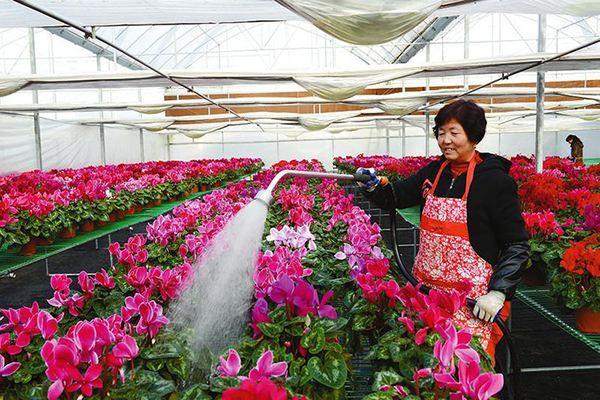
Currently, cyclamen is the main flower variety cultivated in greenhouses in the Western Liaoning region. Its flowering period is long, up to 5 months, and coincides with traditional festivals such as Christmas, New Year's Day and the Spring Festival, so market demand is huge, production value is high and economic returns are significant. Cultivating strong seedlings is the foundation for obtaining high-quality cyclamen pot flowers. Based on years of greenhouse cultivation practice, the seedling-stage cultivation techniques for cyclamen in Western Liaoning greenhouses are summarized below.
1 Cultivation plan
In order to cultivate high-quality cyclamen pot flowers, a plan must be made before cultivation. First determine the selling time, then determine the sowing time according to different varieties. Generally, cyclamen with 5 to 6 flowers is regarded as the best time for sale, and the period from National Day all the way to the Spring Festival is regarded as the important selling time.
2 Seed selection
Seeds should be purchased from professional producers or breeding companies to ensure seed purity and germination rate, and seeds newly harvested in the current year are best. Appearance characteristics of high-quality seeds: bright red color, good purity, no impurities, plump grains. The quantity of seeds purchased should be 20% to 30% more than the planned number of pot flowers to be produced. A germination test should be carried out 2 months before sowing. Once a problem is found, contact the seed supplier immediately so as not to delay production.
3 Sowing time
It depends on the growth period of the variety, the marketing time and climatic conditions. If the scheduled marketing period is New Year's Day or the Spring Festival, generally October is suitable for conventional large-flowered varieties; F1 hybrid varieties (large-flowered type) can be sown in late November, and medium and small types are postponed by 1 to 2 months. Earlier sowing results in larger plant shape, and the flowering period is correspondingly earlier.
4 Preparation before sowing
4.1 Substrate and cultivation containers
The pH value of the substrate should be kept between 6.0 and 6.5. The substrate formula is decomposed and sieved corn stalk fertilizer : vermiculite : perlite : decomposed sheep manure : compound fertilizer = 5 : 4 : 1 : 1.0 : 0.1.
Substrate disinfection methods: (1) Steam disinfection method: heat the substrate to 80 to 90°C with steam and maintain for 1 h, which can kill almost all harmful organisms and weeds in the soil. (2) Chemical disinfection method: evenly mix 2 000 times... potassium permanganate and 1 : 5 000 times phoxim solution and spray the substrate, then pile it up and cover it sealed with plastic film for 5 to 7 d. (3) Used sowing utensils should be soaked and disinfected in 2 000 times potassium permanganate solution before use. Seedling trays are used as sowing containers, and tissue-cultured plantlets are planted directly in pots.
4.2 Greenhouse disinfection
For every 100 m3 of greenhouse space, use 100 g sulfur powder and 350 g sawdust, divide into several small piles and burn them for fumigation disinfection. Spraying with 1 000 times thiophanate-methyl for disinfection can also be used.
4.3 Seed treatment
Seeds can be soaked in 0.1% potassium permanganate solution for 24 h, or soaked in warm water at 35 to 40°C for 24 h, and soaked in 1 000 times carbendazim solution for 1 h, then taken out ready for sowing.
5 Sowing
The sowing time is determined by the marketing time of the finished flowers and the growth period of the variety, and the influence of environmental conditions on its growth rate must also be considered. The best sowing time is from October each year to January of the following year, the best sowing temperature is 18 to 22°C, and the air humidity is 75 to 85%. Seeds are sown in plug trays (288 and 128 cells), sown one seed per cell, and the covering soil thickness is 1.5 to 2 times the seed thickness, generally 0.3 to 0.4 cm. Vermiculite can be used for covering. After sowing, use the tray-soaking method to let the substrate absorb enough water completely. Cover the seedling tray with black plastic, keep the temperature at 15 to 28°C and the air humidity at 65% to 85%, check the humidity of the seedling tray frequently, and replenish water in time if it is dry.
6 Seedling-stage management
Seedling raising is divided into 4 stages, namely the germination stage, the emergence stage, the early seedling growth stage and the hardening-off stage.
6.1 Germination stage
The humidity requirement during the germination stage is above 90%. At the very beginning of germination, the seeds need a large amount of water to swell and germinate. Generally, when covering the seeds, cover the surface with fine-grained vermiculite, which can effectively retain the moisture of the substrate. If placed in a germination room, intermittent spraying can be used to increase air humidity. The seedling tray can also be wrapped in black film to provide insulation. When the humidity is less than 50%, the seeds will enter dormancy again. This stage requires a dark environment. Because the germination process of cyclamen seeds requires a dark condition, the seedling tray or seedling bed after sowing is generally covered with black plastic film to provide shading and at the same time retain moisture. The most suitable temperature is 18 to 20°C; a high temperature above 30°C will hinder germination, below 15°C will delay germination, and below 10°C germination basically stops. No fertilization is needed at this stage, and the substrate EC value is required to be 0.5 to 0.75. From 14 d after sowing, check every day whether the radicle appears. Generally after 21 to 25 d, the cyclamen seed forms a small corm the size of a mung bean and grows 1 root. When 50% to... 60% of the seeds germinate and emerge from the soil surface, move them out of the germination room into the greenhouse to receive light, and enter the emergence stage.
6.2 Emergence stage
During the emergence stage, the substrate should be kept moist to prevent the plants from drying out and to help the cotyledons grow out of the soil. At this time, the seed coat still wraps the cotyledons. If the air temperature is below 80%, it is difficult for the seed coat to separate from the cotyledons, and a humidity above 90% is favorable for the separation of the cotyledons from the seed coat. In order to increase air humidity, aerial spraying can be used to increase air humidity, or a small arch shed can be set up above the seedling bed and covered with agricultural film to help retain moisture, or new non-woven fabric can be used for covering. At the same time, pay attention to spraying chemicals to control damping-off and Rhizoctonia rot. In terms of temperature management, the suitable temperature is 18 to 20°C, and the temperature must not be too high; shade at noon when light is strong and the temperature is high; when below 10°C, heating should be applied to facilitate healthy growth of the seedlings. When just moved from the germination room into the greenhouse or when the black plastic film is removed in the greenhouse, light should be introduced gradually, generally by shading at noon and uncovering in the morning and evening. After the cotyledons are fully unfolded, with a soilless substrate, 50 to... 75 mg/L calcium nitrate can be applied once a week. After the cotyledons unfold, the early seedling growth stage begins.
6.3 Early seedling growth stage
When the cotyledons are fully unfolded and the first true leaf appears, begin applying 75 to... 100 mg/L ammoniacal nitrogen fertilizer and calcium nitrate alternately, once every 7 to 10 d. Ammoniacal nitrogen fertilizer promotes leaf growth, and calcium fertilizer can make the plants stronger. If growth is too fast and the leaves are too tender, the application rate of ammoniacal nitrogen fertilizer can be reduced. When the cyclamen leaves grow 2 to 3 true leaves, transplant the seedlings into 50- or 70-cell trays. The humidity is 80% to 85%; a substrate that is too dry will cause the seedlings to enter dormancy. The daytime temperature is 18 to 20°C, and the nighttime temperature is 15 to 16°C. The light intensity is generally 5 000 to 25 000 lx. After the seedlings emerge completely, gradually strengthen the light, with high temperature and high humidity during the day. Insufficient sunlight will cause leggy leaves and weak petioles, and damping-off is likely to occur. Seedlings are relatively tolerant to low temperatures, but prolonged low temperature (around 5°C) often causes the leaves to turn purple-red and growth to stop. When the third true leaf of the seedling is fully unfolded, the hardening-off stage begins.
6.4 Hardening-off stage
The daytime temperature is 18 to 20°C, the nighttime temperature is 15 to 16°C, and the humidity is 70% to 80%. Apply once a week a compound fertilizer with N : P : K = 20 : 20 : 20 at 100 mg/L, and the light is 35 000 lx. During this stage, the leaves will completely cover the entire cell hole but not extend into other cell holes, and the root system can firmly support the plant. Appropriately control water and strengthen light to harden the seedlings. Nutritional diagnosis standards for cyclamen small seedlings: leaves are dark green and glossy, and growth is good; if the leaves are dark red, nutrition needs to be increased.
Through careful seed selection, a reasonable substrate formula and good seedling-stage management, the strong seedling rate can generally reach more than 80%, laying a good foundation for the production of high-quality pot flowers.