The bulb is a succulent that comes with its own summer halo
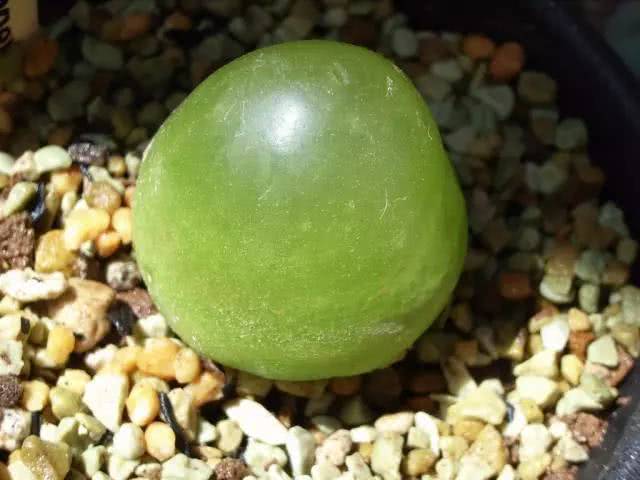
As mentioned in today's second article, growing succulents in summer is extremely hard. So, is there a succulent that comes with its own summer halo? There really is, for example...Bulb。
Don't laugh, this is a serious plant name. It looks like this:
A light bulb. Image: fish bird / flickr
The bulb you see is a leaf
The bulb, whose scientific name is Conophytum burgeri, is a perennial succulent of the Aizoaceae familygenus ConophytumThe bulb's native habitat is Namaqualand, South Africa, the succulent heartland, but its distribution is narrow and limited; it can only be seen in a small area near the mineral veins at the town of Aggeneys in Northern Cape Province, on the farm of the Burger family, which is how the bulb's specific epithet burgeri came about. Because the bulblooks like a small onion as a whole, they have the nickname Burger's onion, so next time you see it, don't think it refers to a vegetable.
Aggeneys is a mining town located in the northwestern corner of South Africa. Image: our-africa.org
The part of the bulb you see is not a stem, and certainly not a fruit, but ametamorphosed leafThe bulb plant has almost no stem, and its leaves are highly succulent, narrow at the top and wide at the bottom, forming a beautiful, soft cone with a bluntly rounded tip; viewed from the side, it looks like a small hill.Under the sunlight, the bulb's pale green leaves appear translucent and glossy, and crystalline crack-like textures can also be seen on themUnder conditions of large temperature differences and strong sunlight, the fresh green leaves will put on a tender pink-red coat. At this time the bulb is at its cutest, like a living ruby, very endearing.
The bulb is actually a leaf. Image: picssr.com
Secretly asking the holy monk, is the bulb beautiful? Image: miyatake30 / flickr
The bulb's opposite leavesare almost completely fused together, with only a not very obvious depression at the top of the cone. By autumn, flower buds can be observed forming inside the leaf body, and when the time is ripe they will push openthe thin membrane at the top of the coneand poke their heads out..
The bulb's flowers have many petals, slender as threads, with agradient from white to purplefrom base to tip, like the "filament" extending from a light bulb, and also like brilliant blossoming fireworks; their beauty is off the charts. However, their flowers generally open during the day and close at night, so you have to pick the right time to admire them.
A little bulb in bloom. Image: World of Succulents
Fuji lingering snow, the bulb's dormancy and rebirth
A dormant bulb, doesn't it look like a shriveled onion? Image: Paul / flickr
When the growing season arrives, the old kraft-paper-like leaves gradually peel off, which is the so-calledsheddingThe old skin that has not yet fully faded hangs on top, and I actually find it has a kind of "Fuji lingering snow" wabi-sabi feeling.
A group of bulbs that have not yet fully lifted their "veils": if interpreted by a literary youth, their papery skin is like a layer of first snow covering continuous little hills; for a food lover, a half-peeled bulb is like a pudding sprinkled with a layer of icing sugar, waiting for you to uncover it and savor these delicious, moving beautiful bodies. Image: Dave's Garden
After shedding is complete, you will be pleasantly surprised to find that your little bulb is a size larger than before. At this point, if you can slowly increase watering, after a period of time the bulb will recover its crystal-clear, handsome appearance.The bulb's demand for water is not high,Overwatering during the growing season will cause the leaf tissue to swell, leading to rupture of the leaf epidermis, leaving ugly scars, and possibly rot.
Overwatering will cause the bulb's leaf epidermis to rupture. Image: oribinu / flickr
The cute bulb, survival is not easy
The bulb grows slowly; a three-year-old seedling is only about the size of a fingernail, but as long as you persevere (if it doesn't die), it is said the bulb can grow to the size of a chicken egg. Unlike other Conophytum species, the bulbgenerally does not easily form clustered plants, so vegetative propagation is not easy, and it generally relies on collecting seeds forsowing and raising seedlings。
Don't think that just because the bulb looks delicate, it grew up in favorable conditions from a young age; in fact, its living conditions are quite harsh. The bulb's native habitat is a stretch ofbarren and desolate quartz gravel plain, where white crystals and red-ochre clay can be seen everywhere, and with fierce sunlight and little rain, it is practically purgatory for ordinary plants. Fortunately, the bulb's succulent leaves store abundant water, and it grows close to the ground, with most of its body buried in the clay and only a small part exposed for photosynthesis, which allows themto endure extreme weather, while the quartz stones on the surface also reflect part of the sunlight, providing the bulbs with a relatively cool shelter.
Can you spot the bulbs in the picture? There are 2 of them. Image: cactuspro.com
Besides coping with the challenges of the natural world, the bulb also faces man-made threats. Due to mining destruction and land cultivation, the bulb's living space has become increasingly severe; in addition, its special appearance and cute attributes have made the horticultural world dote on it, which directly led for a period of time torampant illegal digging and smuggling; plus, in the natural environment, the bulb grows extremely slowly and reproduces and renews itself very slowly, all of which together have led to a sharp decline in bulb numbers. At present, wild bulbs are listed in South Africa asan endangered species, and are strictly protected.
A ruby-like bulb, super cute. Image: nabeya / flickr
The bulbs currently sold on the market are basically grown from seeds purchased from some qualified horticultural companies abroad, thensown and propagateddomestically before being released onto the market. Due to their scarcity and the difficulty of care, the price of bulbs has remained high. In any case, this can to a certain extent meet the needs of enthusiasts while also easing the pressure on habitat protection. Here we call on all succulent lovers,do not buy protected succulents originating from their native habitats。
Sometimes I wonder whether I'm growing a wax apple. Image: seonin.com
Note: even bulbs cannot stand extreme high temperatures!What summer-survival safety cards work for your succulents?
Next Thursday, the author of this article, @Succulent Attackwill answer your questions in the Species Calendar online salon! Long-press the QR code below to sign up right away and grab an interactive seat.