7 things to watch out for when caring for roses, so they can keep blooming year-round
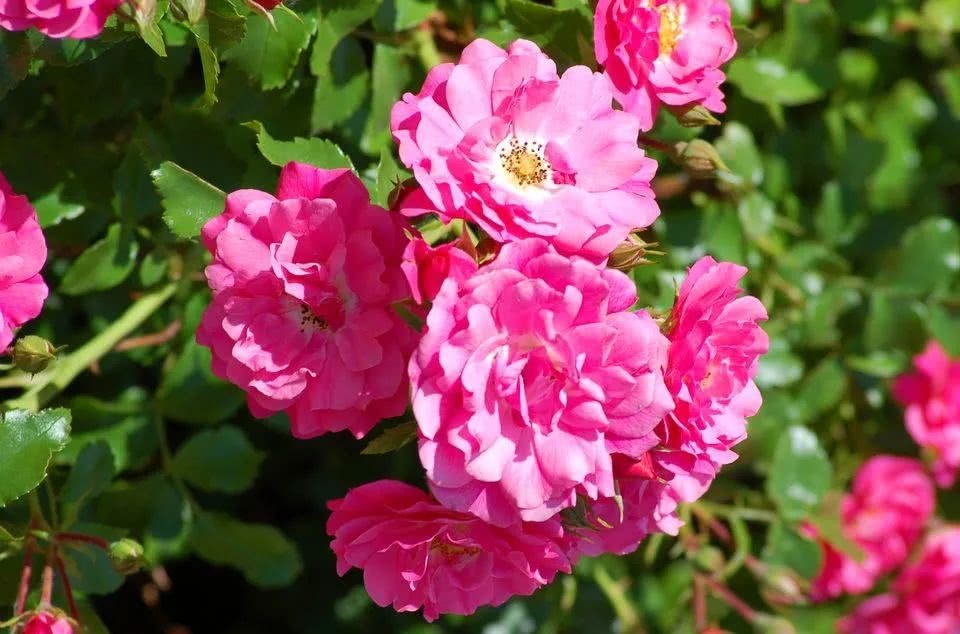
If you love roses but often fail to grow them well, take a look at the care methods below. Caring for roses is very troublesome, because they need regular fertilizing and regular prevention of pests and diseases so they can grow healthily and produce bright, beautiful flowers. Let's take a look at the 7 things to note when caring for roses.
Roses often get infected by pests and diseases, so you must take preventive measures, discover problems in time, and deal with them in time. Only this way can you avoid the condition getting worse and help maintain a year-round blooming state. Master these care methods and your roses will surely bloom year-round.
1. Apply mulch appropriately
When planting roses, you can cover the area around the roots and stems with a 3-5 cm thick layer of mulch. This helps retain water better and prevents any fungal diseases in the soil from splashing onto the leaves when you water.
You can use decomposed wood chips and sphagnum moss instead. This is mulch, and in winter it can also keep the rose roots from freezing.
2. Use slow-release fertilizer
Roses look very beautiful when they bloom, but they need quite a lot of nutrients to grow, so you need to replenish nutrients regularly. When planting roses, it is very necessary to spread a layer of decomposed manure at the base of the roots and stems, separated with some compost soil, or you can use other slow-release granular fertilizer.
When caring for roses, you must not fertilize too frequently, otherwise it easily causes fertilizer burn. Roses also have certain requirements for water. Generally, once the soil is dry 3-5 cm below the surface, water it in time to avoid excessive drought, but the soil must not become waterlogged.
3. Supplement with phosphorus and potassium fertilizer
Roses need proper nutrition to grow better. If you do not want to give too much chemical fertilizer, you can prepare some eggshells and bone meal yourself. Eggshells can be washed clean, dried in the sun, crushed into powder, and mixed into the soil.
You can also make some bone meal yourself. Put them in a pressure cooker, steam them properly, remove the meat scraps, dry them in the sun, crush them into powder, and then put them into the soil to become very good phosphorus and potassium fertilizer.
Of course, you can also directly give potassium dihydrogen phosphate, and regularly give some compost as mulch, which can replenish nutrients well and promote continuous blooming.
4. Prevent pests and diseases
If you find disease spots on rose leaves or pest damage, you must deal with it in time. A small number of pests can be pinched to death directly. If disease is found, spray fungicide in time. You can directly water with chlorothalonil or thiophanate-methyl to prevent the condition from worsening. Generally, apply once every 5-7 days, and about 4 consecutive applications can completely clear it.
5. Remove spent flowers in time
After rose flowers fade, remove the spent flowers in time to avoid consuming too many nutrients. Once the flowering period ends, cut them off. By cutting off spent flowers in time, nutrients can be sent to other branches and leaves instead of being wasted on flowers that cannot recover.
6. Set up supports
Caring for roses requires giving them proper support, to avoid excessive growth of branches and leaves, to avoid being blown down by strong winds, to prevent animals from trampling them, and to properly support their lush flowers.
Setting up supports can also prevent rose branches from growing across each other, help maintain ventilation and light between plants, and prevent fungal infection.
7. The benefits of regular pruning
When caring for roses, be sure to prune regularly. This can maintain healthy growth and also maintain a year-round blooming state.
There are two pruning techniques for roses. Cut off all dead branches, diseased branches, and crossing branches. Do not feel that this is a pity. Removing those poorly growing branches can save more nutrients and supply nutrition to the branches that are good for blooming.
Another pruning technique is to pay attention to choosing the right time. Avoid pruning in hot and humid summer, otherwise it easily leads to pest and disease infection. So prune when frost is about to end, and cut off spent flowers in time after blooming.