Gardening essentials: Master these hardscape and softscape elements, and you'll never fear building a garden again
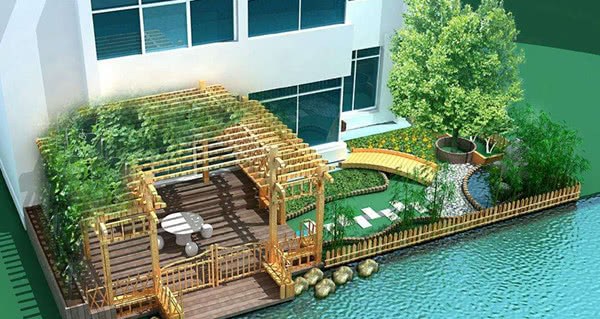
Having a garden of your own in a city of reinforced concrete is what many people long for. But once you have a courtyard and want flowers fragrancing every path, how should you design and build a garden? Garden-making is simple to describe yet hard to do: simple, because it really comes down to two aspects, hardscape and softscape; hard, because each of these requires choosing the right materials, using the right methods, and completing them in the right places.
Garden hardscape:
1. Garden paths:
To make walking and working easier, a garden must have paths. And once the direction of the paths is set, the garden's framework is established too. But what material the paths are built with (red brick, blue brick, stone, railway sleepers, concrete, gravel, etc.), where they are built, what shape they take (straight or curved), and which direction they run all require careful thought.
Build them well, and first, the garden's structure emerges; second, garden work becomes easier; third, it's done once and for all. Build them poorly, and plenty of people end up digging them out and rebuilding, which costs money and effort, and leaves the garden in a terrible mess.
A fairly workable approach is: if you truly don't know what choice to make, just place some stepping stones (wood or stone will do) temporarily in the garden. As long as you don't harden the surface, you can change the direction of the paths at any time.
2. Flower beds (planting beds):
Flower beds can make a garden more three-dimensional, or become its focal point, but whether to build them, where to build them, and what shape to build them in are also factors that must be considered in garden-making.
People usually build flower beds against walls. Personally, I think if the garden isn't large, you can skip building flower beds, because once built, the courtyard feels even smaller. Of course, if the garden is large enough, building a circular flower bed at the center of the garden may make it the focal point. If it's a terrace, and you want to grow flowers or vegetables, then building flower beds is still necessary, but waterproofing must be done properly.
3. Walls (fences):
For safety and for private space, building walls (fences) is essential. But what material the walls (fences) are built with (wrought iron, wooden fencing, red brick, etc.), the different styles (tall or short), and even different colors (white or natural wood tone for wooden fencing) all produce different effects.
4. Trellises:
Whether you have a courtyard or a terrace, you'll probably want to put up a trellis. That's because a trellis can, like an arch, make full use of the garden's space and make the garden look fuller; it also has a practical function that arches lack, namely providing a great platform for climbing plants to grow on; besides that, once covered in plants, a trellis provides shade, and beneath it becomes the best place for a family's outdoor activities.
So besides being decorative, a trellis is even more practical. Building a trellis also requires considering many factors: where to build it, what material to use (pressure-treated wood, or a brick-and-wood or brick-and-stone mix), and how large it should be must all be considered.
5. Arches: An arch can make full use of the garden's space while potentially becoming the garden's focal point. Whether to build one, where to build it (at the entrance or in the middle), and what material to use (wrought iron or wood) all produce different effects.
6. Water features (ponds):
Water features (ponds) make a garden more lively. As the saying goes, "where there is water, there is spirit," but for a specific garden, especially a small one, whether to build a water feature (pond) requires careful consideration. Places with water definitely have more mosquitoes in summer, so whether to build a water feature, where to build it, and what it should look like all need careful thought; otherwise, there really are gardening friends who built one and then filled it in afterward, and to my knowledge there's more than one such veteran gardener. Also, if you build a water feature, you must do water purification work, which requires skill.
7. Ornaments: A garden with character cannot do without garden accents. These include garden chairs, terracotta pots, garden ornaments, and so on.
8. Others: such as outdoor kitchens, etc.
Garden softscape:
So-called garden softscape is really just plant pairing. A good garden must have a reasonable mix of trees, shrubs, and herbaceous plants, with vines and bulbs nestled among them.
1. Trees: Should a small garden have trees? Fruit trees, foliage trees, or flowering trees? Where should they be planted? All need careful consideration; otherwise, in a few years you may well end up moving or cutting them down.
2. Shrubs: Likewise, where flowering shrubs are planted and what is planted also need careful consideration. Though shrubs are shorter than trees, they are usually still considerably taller than flowers, so they are generally planted behind perennials as a backdrop; of course, flowering shrubs like hydrangeas are themselves a landscape feature and can absolutely be highlighted by planting them directly at the very front.
3. Herbaceous plants: including annual and biennial flowers and perennials. There are too many perennial varieties to list one by one; what to plant mainly depends on what color you like, or which flower shape you prefer. And people's preferences change over time, so you can absolutely adjust the kinds you plant according to your own changes. Annual and biennial herbaceous flowers, like perennials, can be changed according to your preferences.
4. Climbers: A garden must have climbing plants, not only because they make better use of space, but more importantly because they can create landscape effects. But there are many kinds of climbers, divided into fruit-producing types (such as grapes, kiwifruit), flowering types (climbing roses, clematis, Chinese trumpet creeper, etc.), and foliage types (Boston ivy, Virginia creeper), among others; each grows differently and has a different decorative effect. Even among the ivies used to green walls, the three-lobed and five-lobed kinds have different effects. So which climbing plant is more suitable for your garden, or what purpose you want to achieve, also needs careful consideration.
5. Bulbs: Bulbs usually bloom in spring. As for whether to plant lilies, tulips, or daffodils, it's entirely up to your own preference.
6. Ground cover: Many plants can serve as ground cover. Golden creeping Jenny, stringy stonecrop, and many sedum-type greenery can all be used as ground cover. Some flowers with fine, tiny blooms can also serve as ground cover, such as moss phlox.
Helpful tips:
Before building a garden, replacing the soil is mostly essential. Especially for courtyards made by developers, at first glance the surface layer looks level and seems to be all good soil, but dig down just a little and most of what's below is construction waste. So replacing the soil is generally a must; otherwise, endless troubles lie ahead.
Before replacing the soil, first dig about 50 cm deep into the garden's soil; if you want to plant trees, you need to dig deeper. This task must not be skipped. After digging, replace the soil. To save on costs, the soil dug out can be sifted and reused, but it must be sifted to remove all the stones and broken tiles; then mix in one third garden soil, one third sand or stove ash (for drainage), and one third organic fertilizer, then backfill. This ratio can be adjusted slightly, for example using a bit less sand.