Four Essential Techniques from Bonsai Expert Hu Zhiwei
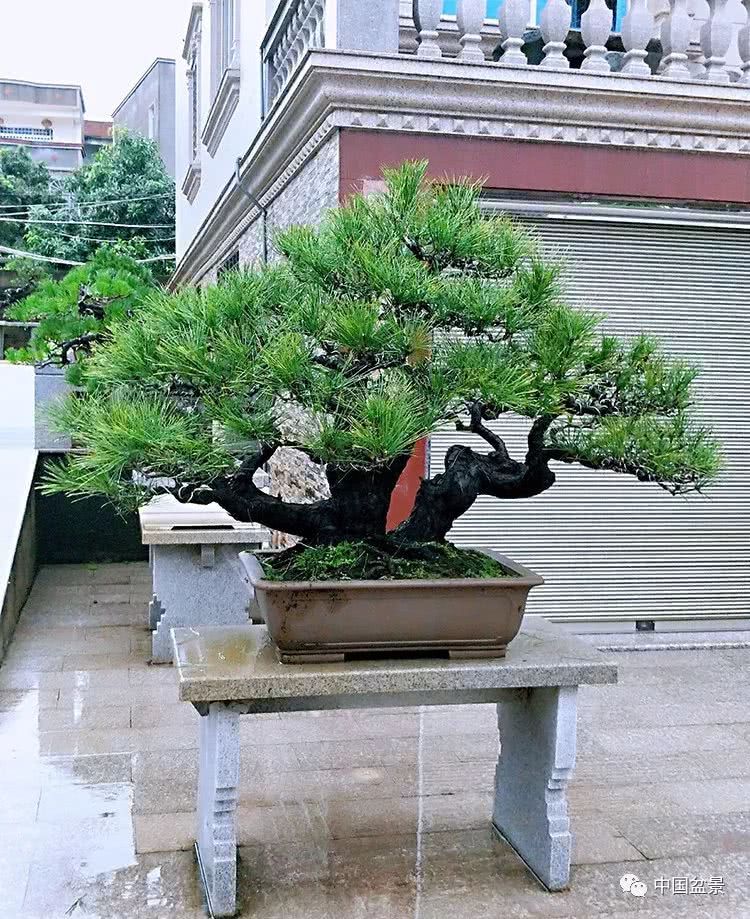
New Look of Huang Yucong's Bonsai in Quanzhou, Fujian
Chen Wentu's Ficus Bonsai "Listening to the Rain" in Quanzhou, Fujian
[Bonsai Enthusiast's Reflections]
Text | Xiamen, Fujian @Zhou Yingzhi
Life is never smooth sailing and never goes exactly as one wishes. Many frustrations require a calm mindset to face properly, so that one can break free from confusion. Since time has given us the process of living, and fate has given us the opportunity to survive, we must learn to cherish it, learn to love others with addition; to resent with subtraction; to be grateful with multiplication. Life is too short, time is too long. To live and be happy is what happiness is all about. Have a good attitude, live as yourself, and be happy one day at a time!
Hu Zhiwei's "Bonsai" Life
Photos and text | Donghai Diaoke
Hu Zhiwei, a resident of Hongxing Community, Zhaobaoshan Street, Zhenhai District, Ningbo City, Zhejiang Province, is quite "old-fashioned." Though not old in age, he has old-fashioned hobbies. He likes collecting "old things": "antiques, root art, comic books" and so on. But his greatest hobby is making bonsai himself.
During a casual chat, as soon as I brought up bonsai, Mr. Hu Zhiwei said with great enthusiasm: "My connection with bonsai was quite accidental. I remember it was in the spring of 1990, when a few friends and I went hiking on the mountains near Xiaogang Town in Beilun. I happened to see someone searching the mountain for good-looking tree stumps, and I couldn't help but ask out of curiosity. It turned out this master ran a nursery nearby and was looking for beautiful material for bonsai, and he told me some daily techniques for making bonsai. So the next year, a few like-minded friends and I went up the mountain to search for bonsai material and began our first attempts at bonsai making."
"1990? By now you've been making bonsai yourself for nearly twenty years. Isn't bonsai making tedious?"
"It's all right. Making bonsai is like a teacher cultivating students - it requires patience. A good bonsai takes more than ten years, or even longer. For example, in the first year after bringing the bonsai material back, you plant it in a pre-dug soil pit to cultivate it. From sprouting that year, it can only be shaped and branches wired in autumn. In the second year, you repot it and adopt traditional shaping methods, using palm fiber or wire of different thicknesses, and applying techniques such as 'climbing,' 'hanging,' 'pulling,' and 'wiring' to arrange the structure well, then gradually refine it through pruning. Hence the saying 'coarse wiring and fine pruning.' Formal-style bonsai generally require dense and full branch pads. Natural-style bonsai, on the other hand, has branches and leaves that are well-spaced, with layered and uneven tiers, simple and natural, full of elegant charm."
"What tree species do you generally use for making bonsai? How many bonsai do you have now?"
"For bonsai, it's best to use deciduous trees such as: Japanese bush cherry (Sageretia thea), elm, and boxwood (Buxus sinica). For pine and cypress bonsai, five-needle pine and Chinese juniper are best. Of course, Buddhist pine (Podocarpus macrophyllus), bougainvillea, and snow-in-summer (Serissa japonica) are all fine. As for how many bonsai I have, just count them and you'll know - about 100 pots. At most, I once had over 200 pots. Later, because there was nowhere to put them, I gave away quite a few one after another. Now I can only adapt to local conditions and break them up into smaller groups, placing some in the living room, on the balcony, and in the community green belt. Of course, if I had the space, I would definitely make more bonsai."
"Will you continue this hobby all along?"
"Of course I will. Making bonsai has changed my personality quite a bit. I used to be a little impatient, but in recent years I've become much more peaceful. I personally understand this as perhaps the beginning of a 'simple and contented life.' Besides, these bonsai are a continuation of green life. Every day I 'serve' them, and they 'repay' me with 'spring scenery everywhere.' Tell me, would I ever 'abandon' them!"
Mr. Hu Zhiwei pruning bonsai
[Experience Exchange]
To enjoy bonsai, you must learn these four techniques
Recommended text | Xiong Ge
Recommended photos | Yage
Tree growth has the characteristic of apical dominance, with the apex continuously growing upward. If not controlled and left to grow naturally, it becomes wild and loses its beautiful form and ornamental value. In order to keep the tree stump in a beautiful tree shape in the pot, it is necessary to pinch the growing tips, remove buds, remove leaves, and prune.
1. Pinching
When the tree stump grows, branches and buds that have been wired into shape will grow naturally and constantly change the tree's form, so they must be controlled. When the branches of the tree stump are relatively sparse, in order to promote the development of axillary buds and increase the number of branches, you can use your fingers or scissors to remove the growing point at the tip of the young shoot. This can inhibit apical dominance growth, promote the growth of side branches from lower branches, and maintain the tree stump's original posture.
2. Bud Removal
For some tree species, the base trunk, trunk, and branches of the tree stump often sprout many adventitious buds. If left to grow, they not only affect the beauty of the tree shape but also consume nutrients, hinder air circulation and sunlight penetration, and easily cause pest problems. Therefore, excess branches must be removed. Overgrown branches and buds on the crown should also be shortened in time. For example, the roots of snow-in-summer (Serissa japonica) easily grow many tiller buds, which should be cut or removed in time; when five-needle pine sprouts, 2/3 of the bud tips should be removed; for the branches and buds of Ficus, when 2 to 3 are kept, the leaves can be reduced in size, improving ornamental value.
3. Leaf Removal
Bonsai appreciation includes viewing leaves, trunks, flowers, and fruits. When new leaves have just grown is the best time for leaf viewing. Some tree stumps can extend their best viewing period by removing old leaves. When removing leaves, all leaves should be removed, and bud removal and pinching should follow. Leaf removal should be carried out during the tree's growing season. After leaf removal, attention should be paid to applying thin fertilizer and keeping the pot soil moist, so that branches and buds sprout normally and grow new leaves. Ficus can undergo leaf removal after Qingming and before Bailu; red maple undergoes leaf removal at Major Heat and Minor Heat, and in autumn and winter the leaves will be even more brilliantly red.
4. Pruning
Thinning:Thinning allows plants to better transmit light and ventilate, and also allows nutrients to be better supplied to the branches and leaves that need them. But if thinning is done improperly, it cannot be recovered. When thinning branches, do not cut close to the main trunk; try to cut at the position of 2 to 3 buds.
Shortening:Shortening is commonly used in shaping. It involves cutting longer branches shorter, but not removing them entirely, thus maintaining the overall shape of the tree stump and also allowing plants that have grown too tall to be dwarfed, making their trunks more robust.
Building Branches and Trunk Chopping:Building branches and trunk chopping is generally a pruning method that imitates the tree shapes of nature. The shape after pruning is no different from a naturally grown tree shape. This pruning method is generally carried out in the tree's juvenile stage. When the juvenile stage is at its most robust, the trunk is chopped, retaining part of the branches.
Tongqu Garden, Anqing, Anhui@ErliSelf-recommended new works as follows:
Chinese bonsai welcomes you!
Enjoyanytimeat the bonsai exhibition hall
Promote bonsai culture, exchange bonsai skills!
Appreciate bonsai art, share a happy life!