An In-Depth Guide to the Origins and Appreciation Points of Lingnan Penjing
[Penjing Enthusiast's Reflections]
Text | Xiamen, Fujian @Zhou Yingzhi
Every morning, remind yourself that life is short and beautiful, with no time for brooding, no time for pettiness. Only by letting go of those meaningless burdens can we stride forward freely. Plant a tree of dreams in your heart, and let it grow together with you. If there were no clouds, would the sky feel lonely? If there were no sky, where would the clouds anchor? Take a breath, lift your head, straighten your chest. I am willing to face the light and live up to the grace of time... Life is too short to leave room for regret. If this is not the endpoint, please shoulder your mission and keep moving forward!
[Penjing Masters' Forum]
Tracing the Origins of Lingnan Penjing
Photos and text | Luo Wende
This article was first published on the "Lingnan Penjing Network Subscription Account"
Copyright belongs to the original author
Trace the roots and never forget the source; deep roots and lush leaves reveal fragrance.
Lingnan penjing originated in the Ming and Qing dynasties, and only after the founding of the People's Republic of China did it develop into the uniquely styled Lingnan School of penjing. It stands out among the various schools of Chinese penjing, with latecomers surpassing earlier ones.
In Guangzhou's penjing circles, there has long been talk of the "Three Outstanding Figures of Penjing" and "Kong in the north, Su in the south," and the "trunk chopping and branch training" method first created by Kong Taichu was established as the definitive Lingnan penjing technique.
Assuming it is correct that ideology and culture determine penjing artistic style, can we make the following inferences:
Kong Taichu, influenced by Confucian thought, used the principle of yin-yang transformation from Taiji to create the "trunk chopping and branch training" technique and produced "large tree style" penjing, vigorous and rich...
Kong Taichu's Penjing
Su Ren, influenced by Buddhist thought, advocated emptiness and created "tall towering style" penjing, transcendent and refined...
Su Ren's Penjing
Mo Minfu, influenced by Daoist thought, advocated non-action and created "natural style" penjing, full of wild charm...
Mo Minfu's Penjing
From this it can be seen that Lingnan penjing integrates the three major elements of Chinese culture - Confucianism, Buddhism, and Daoism - so it is hardly surprising that it is deeply loved by people from all walks of life!
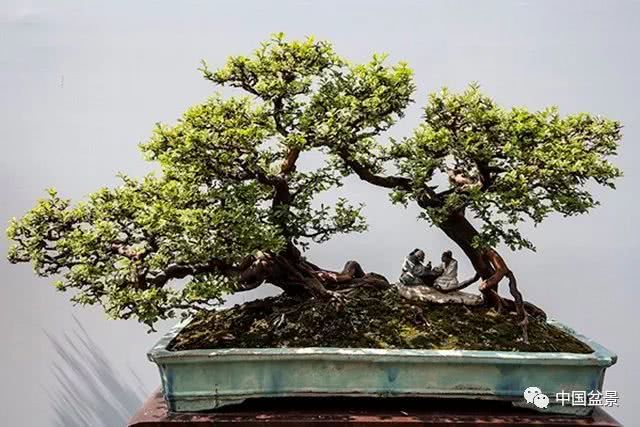
The root of Chinese culture is the I Ching. The "trunk chopping and branch training" technique of Lingnan penjing: when the first section of branch on a tree (that is, the side branch on the main trunk) grows to the required thickness, it is heavily pruned; at the same time, a second section branch (or bud) with a suitable angle and position is selected and retained, and when the second section branch is cultivated to the required thickness, it is pruned again, and the third section, fourth section... are all carried out in this way. Generally, about two small branches (or buds) are kept on each section of branch, one long and one short. After years of pruning, the proportions of the branches and trunk become well-balanced, twisted and powerful. Its branch pads "curl upward like deer antlers and hang down like chicken claws," quaint and picturesque, with distinctions among leaping branches, floating branches, and spreading branches. The branch claws of the second, third, and fourth layers of each branch pad are required to taper gradually and be evenly distributed. Is this not precisely the evolution of "Taiji"? It is exactly the embodiment and application of the I Ching culture's principles of simplicity, change, and constancy - truly a small penjing with great wisdom!
Tan Daming's Work Chinese Hackberry
In summary, the "trunk chopping and branch training" technique of Lingnan penjing is the foundation. Only by continuously innovating while inheriting traditional techniques can Lingnan penjing forever preserve its vitality and vigor and continue to develop forward.
Han Xuenian's Work Mountain Pine
Lingnan penjing art master Xiao Gengwu once said on site: "Using snow-pressed branches to form the apex solves the problem of the apex being too tall and is worth promoting." Master Xiao once confidently said: "Using snow-pressed branches changes the growth direction of branch tips toward the sun. By using aluminum wire binding and wrapping to press the branch tips downward, they appear more vigorous and quaint, and the spatial distribution becomes more scientific and rational, embodying beauty and dynamism." The aluminum wire plays the role of "guidance," with the purpose of changing the growth angle and direction of branch tips. The technique is still trunk chopping and branch training - this is the innovative technique of snow-pressed branches.
Xiao Gengwu's Work Orange Jessamine
For those who practice Lingnan penjing, it is very necessary to learn from and seek guidance from experienced penjing enthusiasts, which can help avoid detours and mistakes. Lingnan penjing is not only an art but also a culture and a way of thinking. The "trunk chopping and branch training" technique of Lingnan penjing must not be abandoned - without it, it would no longer be called Lingnan penjing. Of course, this technique is also advancing with the times; it is a developmental process of constant affirmation through self-negation.
Tan Hongnü's Work Orange Jessamine
Appreciation of Lingnan Penjing
Image recommendation | Qiu Zheng
Highlights replay:
Lu Zhiquan's red fruit penjing from Guangzhou, with a cascade length of 97 cm
Chinese Penjing Welcomes You!
EnjoyAppreciateAnytime Penjing Exhibition Hall
Promote penjing culture, exchange penjing techniques!
Appreciate penjing art, share a happy life!