Why Are Succulents Still Green in Summer Despite Plenty of Light?
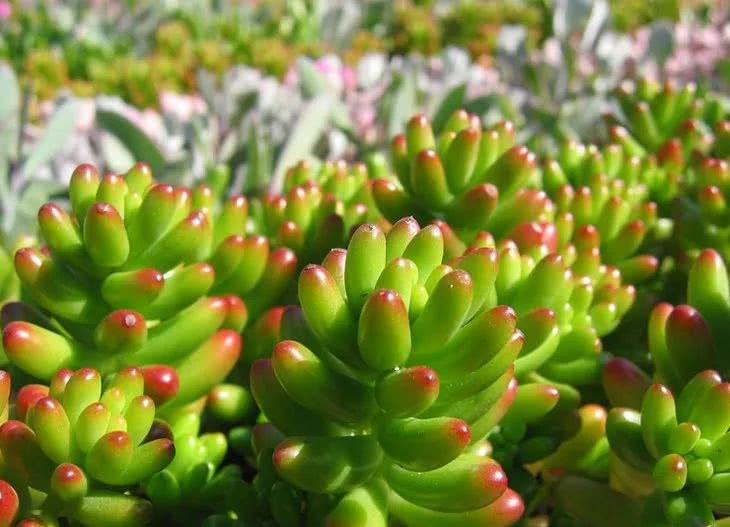
Have you ever wondered in summer: the summer sun is so good, so why are our succulents still green?
Although we use all kinds of methods to block some of the sunlight, as long as you measure the sunlight intensity a little, you will find that even the sunlight intensity under a shade net in summer may exceed the intensity of direct sunlight in winter.
For example, I measured it yesterday: under a shade net with 60% shading rate, I still measured a sunlight intensity as high as 37,000 lux. Such sunlight intensity is indeed not weak at all. Moreover, summer daylight hours are also considerably longer than in winter, so why just can't the succulents' colors become beautiful?
But if you think about it carefully, the facts are actually not always like this.
If we do not block the sunlight, succulents in summer are still easily sunburned by the scorching sun into a yellow color or liver-red (commonly known as sunburn), just like the string of pearls in the picture above: under strong sunlight, it cannot maintain its calm green, but is sunburned yellow.
A more classic example is the Aeonium genera, the "mages" and "roses." They are a beautiful scenery in the hot summer. No variety attracts more attention in summer than the Aeonium mages and roses.
Since not all succulents fail to develop their colors, where exactly is the problem? Why are those succulents that stay green in summer unwilling to turn red?
The answer is actually very simple: the high temperatures that we think will affect succulent growth are actually very much liked by succulents. The reason they turn green and even become prone to leggy growth is that they are in a period of vigorous growth. Succulents in vigorous growth need more sunlight to meet their growth needs.
Does this answer overturn your understanding a bit? Don't succulents go dormant under such high temperatures? How can they still grow vigorously?
In fact, for most plants, in a high-temperature environment, the rate of metabolism will accelerate. If we recall the chemistry knowledge learned in junior high school, we know that most chemical reactions can be sped up by heating.
Plants themselves are extremely complex chemical factories, so they are no exception: when the temperature rises, plant metabolism also accelerates. As long as the temperature is not high enough to denature the proteins in the plant, the level of metabolism will rise as the temperature rises. At this time, the level of chlorophyll synthesis in the succulent body will also increase greatly, continuously producing chlorophyll, which of course makes the succulents green.
So why do the Aeonium mages and roses show particularly beautiful colors in summer? This is because in their distant homeland, the Canary Islands, high temperatures are always accompanied by the dry season. In the Canary Islands, it is very likely that not a single drop of rain will fall throughout the summer. Therefore, for the roses and mages, rising temperatures mean the arrival of the dry season; at such times they must enter dormancy, lowering their metabolic level and water consumption. This is the reason the mages and roses can develop their colors in summer.
So, are green, vigorously growing succulents good or bad?
First, vigorously growing succulents have relatively active metabolism and are not easily infected by diseases; moreover, even if they are damaged, they are more likely to repair themselves. So if your succulents are in a green state, this is a good thing, because at least they are very healthy right now.
But vigorous growth is sometimes accompanied by leggy growth. Leggy growth makes the plant weak and tender, with leaves and stems that are not sturdy, and it is prone to lodging. This is the bad news brought by summer vigorous growth.
When succulents enter a state of vigorous growth, the entire growth process is likely to be unbalanced. For example, succulents that may produce a large number of side shoots in spring and autumn often do not produce side shoots in summer, growing into a silly big lunk. Some succulents may suddenly shoot up tall, completely destroying their beautiful rosette lady-like image. Once this happens, it takes the entire autumn and even half of winter to recover their condition, which seriously affects our enjoyment of the succulents.
So here comes the useful part: in summer, how should we control these vigorously growing succulents?
A very important thing is to lower the nighttime temperature. If the nighttime temperature in summer is also high, it will affect the efficiency of succulents collecting carbon dioxide at night. If the succulents do not collect enough carbon dioxide at night, it will affect the efficiency of photosynthesis the next day. In this case, the vigorous growth of the succulents is more likely to become leggy growth, making the succulents weak and feeble.
For hobbyists who do not grow their plants outdoors, you can open the windows for ventilation after the sun sets, to dissipate the high temperature accumulated during the day as quickly as possible. In the evening, you can sprinkle water and mist the environment where the succulents grow, to lower the temperature through water evaporation.
In addition to paying attention to shading the succulents during the day, you can also consider shading and cooling the walls that receive scorching sun. In this way, you can avoid the walls releasing residual heat at night, which also helps lower the nighttime temperature.
For green, vigorously growing succulents, you cannot control growth by restricting or cutting off water; this is detrimental to their growth. Moreover, summer temperatures are high, and succulents need more water. So in terms of watering methods, you should try to adopt the method of less water and frequent watering instead of thorough heavy watering. Avoid flood irrigation watering methods as much as possible. This can effectively control vigorous growth and also reduce the probability of black rot in succulents.
Some potting soils with high fertility (for example, those with added slow-release fertilizer, or with a relatively high peat ratio) can also cause excessive vigorous growth. Such succulents can be properly pruned in summer, cutting off the leggy parts; the new side shoots will help the succulent distribute nutrients and reduce the leggy growth caused by excessive nutrients being supplied to old leaves.
There are many chemicals on the market that can control leggy and vigorous growth, such as chlormequat-type chemicals. But here Wusha wants to remind hobbyists that if you want to use such chemicals, you must start by trying one or two succulents, and only gradually expand the scope of use after experimenting and exploring step by step.
Abusing hormone-type chemicals may cause very terrible chemical damage. Excessive hormones may take several months or even several years to be completely metabolized, so the use of hormones must be cautious, cautious, and more cautious.