The vast majority of succulents have shallow root systems.
Sometimes plant lovers agonize over how deep a pot they should use for their succulents. Before choosing a pot, people often try to figure out which succulents are deep-rooted and which are shallow-rooted, so they can pick a pot of the right depth for them.
On this point, I think there is really no need to overthink it, because the vast majority of succulents you can find are shallow-rooted plants. Or, to put it bluntly, every plant you can buy online that is shipped bare-root with the soil removed is a shallow-rooted plant, without exception.
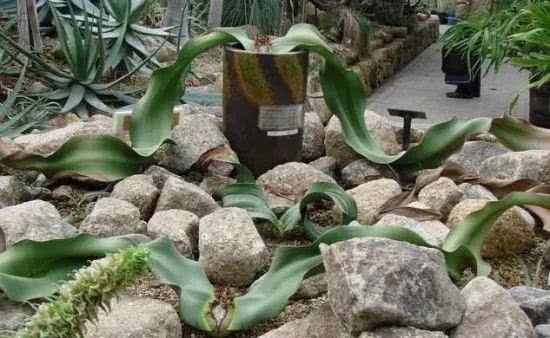
As for deep-rooted plants that can be considered succulents, I can only recall having introduced one, called Welwitschia.
Welwitschia has an incomparably long, deep root system. Even a very young Welwitschia seedling has roots reaching more than 1 m deep. Welwitschia can hardly be transplanted successfully, because it is very difficult to avoid damaging their extremely long roots during transplanting.
The dandelion is probably the most common deep-rooted plant around us. The photo above shows the powerful root system of a dandelion. Unfortunately, though, this dandelion's root system is not complete; the main root is still broken off, otherwise it would be much longer than what is shown in the photo. The roots of deep-rooted plants are like a deep well, continuously drawing water up from deep in the soil. Even if the surface soil is extremely dry, as long as there is still moisture deeper down, they can survive tenaciously.
Many plant lovers assume that succulents growing in arid regions must have very, very deep root systems, and therefore also need very, very deep pots to grow them. In fact, this is not the case.
The root systems of these plants growing in arid regions are often like the one in the photo above. Not only do they lack the straight, thick roots we imagine, but they are also truly fibrous root systems. These roots do not drill straight down like a well in search of water; instead, they actively claim as large an area as possible.
The purpose of this is quite obvious: arid regions rarely see rain, and most of the time it is the morning dew condensed on the surface soil by the large temperature swings that serves as the drink they rely on for survival. Even when it does occasionally rain, the rainwater is not enough to penetrate deep into the soil layers.
So in such an environment, the surface soil is the water source, and the larger the area their roots occupy, the more moisture they can collect. Naturally, these plants evolve toward becoming shallow-rooted plants.
Then surely succulents like Haworthia, which have thick, long fleshy roots, must be deep-rooted, right? And haven't we always advocated using relatively deep wide-mouthed pots to grow Haworthia, precisely to accommodate their deep root systems?
Unfortunately, they are not deep-rooted plants either. On the contrary, they too are typically shallow-rooted.
In their native habitat, Haworthia often grows in cracks in rocks. These rock crevices contain a small amount of fertile soil and are moistened every morning by dew condensing on the rock surface. Haworthia loves this kind of environment. Although their roots can grow quite long, they do not necessarily have to burrow deep into the soil; these roots just twist and turn, searching for various crevices and weaving in and out.
As for the roots of Sedum, there is even less to say: they are all shallow-rooted. Their roots are not only shallow, but also temporary. When there is moisture, they use them to absorb water; when it is dry, they simply cut their losses, and when it rains again, it is not too late for them to regrow.
Since succulents are all shallow-rooted, what care lessons can we draw from this?
1. What depth of pot you use does not really matter; as long as it is deep enough to grow the succulent, the rest is entirely up to your own preference.
2. Pots of different depths have different rates of soil drying. The bottom of a deeper pot dries more slowly, which encourages roots to grow downward, even extending out through the drainage holes. A shallow pot, by contrast, encourages roots to grow sideways and occupy a larger soil area.
3. Different pots need to be matched with different watering methods. Deep pots can be watered with a large volume at long intervals. Shallow pots can be watered with small amounts frequently to mimic how morning dew moistens the soil.
4. No matter what kind of pot it is, a succulent that has just been potted up needs a plentiful supply of water. Water is the most important factor in stimulating succulents to grow roots, because roots themselves exist to find water.