High-quality, high-yield cultivation techniques for the new Artemisia selengensis cultivar Xiangli No. 1 in Hubei
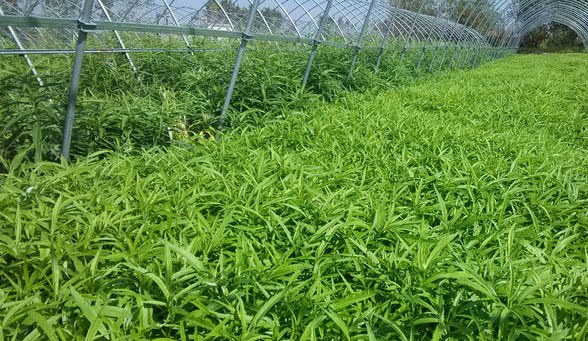
Xiangli No. 1 is a new Artemisia selengensis cultivar developed locally in Hubei, and it is also a high-yield, good cultivar suitable for local cultivation in Hubei. Below, the breeding process and key cultivation management points of Xiangli No. 1 are shared with everyone!
1 Breeding process
In the spring of 2011, 1 mutant plant was initially selected from the natural population of wild Artemisia selengensis in Chenhu Wetland and transplanted to the primary selection trial field for propagation.
In June 2011, the lignified stems from the late growth stage of the mutant plant were cut into 18 small sections of 10 cm according to "one leaf, one bud" and cuttings were inserted into the primary selection identification nursery. Using wild Artemisia selengensis from Chenhu Wetland and Yunnan Artemisia selengensis cultivars as controls, 4 superior individual plants were screened out (namely 1-1, 1-2, 1-4, 1-7).
In September 2011, the 4 primary selected individual plants were propagated by cuttings, and 38 plants were retained for seed and entered the secondary selection identification nursery. Using wild Artemisia selengensis from Chenhu Wetland and Yunnan Artemisia selengensis cultivars as controls, weak-growing individual plants within the mutant lines were eliminated.
From December 2011 to the spring of 2012, using wild Artemisia selengensis from Chenhu Wetland and Yunnan Artemisia selengensis cultivars as controls, superior plant 1-1-8 was cut into 10 small sections according to "one leaf, one bud" and entered the final selection identification nursery. Using wild Artemisia selengensis from Chenhu Wetland and Yunnan Artemisia selengensis cultivars as controls, superior plant 1-1-8-6 was ultimately screened out.
In June 2012, cutting propagation was carried out, and using Yunnan Artemisia selengensis and Nanjing Artemisia selengensis as controls, a plot variety comparison trial was conducted. The 1-1-8-6 clone performed consistently and had excellent comprehensive traits. A large number of plants were retained for regional trials, and it was initially named Xiangli No. 1.
2 Characteristics and traits
Xiangli No. 1 has strong growth vigor, palmate leaves with 3, 4 or 5 fully divided leaflets, green leaf color, and relatively small leaves (13.1 cm x 6.8 cm); the stems are green, the commercial stem length is 27.8 cm, the thickness is 0.72 cm, and the mass is 19.3 g; it is planted by cuttings and can be harvested 50 days after planting in spring and autumn, and 55-60 days after planting in winter and early spring; it has a delicate fragrance and a crisp, tender taste; it is high-yielding, with medium disease resistance and strong stress resistance.
Through multi-site and multi-season trial planting in Wuhan and other places in Hubei, the results showed that the yield reached 1,284.96 kg/667 sq m, increasing yield by 24.86% and 11.82% compared with Nanjing Artemisia selengensis and Yunnan Artemisia selengensis, respectively; harvest was 2 and 5 days earlier than Nanjing Artemisia selengensis and Yunnan Artemisia selengensis, respectively; tested by the Hubei Provincial Engineering Technology Research Center for Bean (Vegetable) Plants, fresh Artemisia selengensis contained 5.9 mg/g vitamin C, 168.01 μg/g soluble sugar, and 26.75 μg/g protein.
3 Cultivation key points
3.1 Crop rotation arrangement
For this cultivar, from cutting to harvest, it takes 45-50 days in summer and autumn, and 55-60 days in winter and spring, and 4-5 crops can be produced throughout the year.
First crop: during spring harvest, retain plants with excellent growth vigor in the field for seed; around July 15, take stems and cut them into 10 cm small sections for cuttings; harvest in late August to early September, leaving 1-2 cm at the base after harvest.
Second crop: in early September, sprouts grow on the first crop, and 1-2 cm at the stem base is left at harvest.
Third crop: sprouting begins in late October, and harvest is in late November.
Fourth crop: sprouting in early December, and harvest can be done from late January to mid-February of the following year.
Fifth crop: this crop sprouts and grows at the end of January in the field where the fourth crop has been harvested, and harvest is completed in early March. Apply organic fertilizer once before the start of each crop.
3.2 Planting
Before planting, do a good job of land preparation. Apply sufficient base fertilizer, plow deeply 25 cm, then rotary till once, open ditches and make beds. The bed surface should be level. The bed width can be determined according to the field plot, and the ditch width is 30-40 cm.
For planting by cuttings, the row spacing is 15 cm, the plant spacing is 10 cm, 11,000-12,000 plants/667 sq m, and water sufficiently to settle the roots.
3.3 Water and fertilizer management
Apply sufficient base fertilizer before land preparation: 100 kg organic compound fertilizer or 2,000 kg farmyard organic fertilizer per 667 sq m, and 50 kg enzyme bacteria biological organic fertilizer; after planting and sprouting, apply nitrogen fertilizer once and water; when stems grow to 15-20 cm, water and apply foliar fertilizer once.
3.4 Pest and disease control
In spring, summer and autumn, when temperatures are high, focus mainly on pest control, using vinegar spraying and hanging insect-control boards to control aphids and whiteflies; in winter, focus mainly on preventing downy mildew and gray mold, paying attention to ventilation and humidity reduction, and appropriately sparse planting.
3.5 Harvest
Harvest when stems are 20-30 cm long and the stems have not become lignified. In the hot summer and autumn seasons, according to market prices, harvest can be completed in 2 batches or 1 batch; in the cold winter and spring seasons, the harvest period can be extended and harvest can be done multiple times.
The above is all the content about the new Artemisia selengensis cultivar Xiangli No. 1. If you are interested in this cultivar, you can consider it in light of your own actual situation!