This is how to grow Echeveria glauca so it thrives and looks beautiful
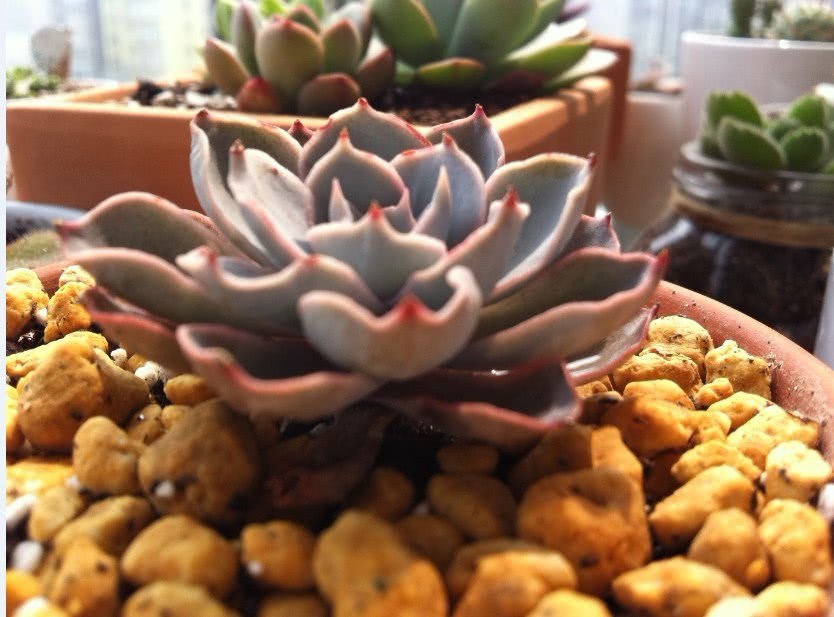
Echeveria glauca is a succulent plant of the genus Echeveria in the Crassulaceae family, also known as a succulent; it is suited to growing in places with ample sunlight, prefers a warm, dry and sunny environment, is drought-tolerant, not cold-tolerant, and slightly tolerant of semi-shade. The potting soil should be fertile and have good drainage. No fertiliser should be applied during the high-temperature dormant period in summer, while appropriate fertiliser may be applied during the growing season. The Echeveria glauca plant has a thick stem that slowly elongates over time to form a large old trunk. The leaves are densely arranged in a rosette, the plant diameter does not get too large, the leaves are inverted teardrop-shaped, the leaf margins are thin, with fairly pointed leaf tips, the leaves have slight wrinkles, the middle of the leaf is the same thickness throughout, there is a depression in the middle of the leaf extending to the base, and the whole leaf is slightly folded in half. The plant's leaf colour is white-green, the leaves have a slight white powder, and it is green all year round. Under weak light the leaves tend to stretch out and the plant shape is not compact enough. Echeveria glauca produces clustered inflorescences, with flowers in an inverted bell shape, pink in colour. Echeveria glauca and Echeveria elegans look somewhat similar at a glance; the difference lies in the leaves - the leaf tips of Echeveria elegans are round, while the leaf tips of Echeveria glauca are more pointed, making them very easy to tell apart.
The Echeveria glauca plant is not large and has a short stem that slowly elongates over time to form an old trunk. The leaves are densely arranged in a rosette, the plant diameter is not very large, and the leaves are relatively thin. The variegated Echeveria glauca has spoon-shaped leaves with smooth, unwrinkled leaf margins and leaf tips; the centre of the leaf is green, and both sides are light yellow or light white variegation. The leaves have a slight white powder; new leaves are lighter in colour and old leaves are darker. Under strong light and large day-night temperature differences or during low-temperature periods in winter, the leaves turn slightly pink; under weak light the leaf colour is light pink-blue and the variegation also turns slightly white. The leaf surface is covered with a slight white powder, and after the white powder falls off the old leaves they appear smooth. The variegated Echeveria glauca has a spike-shaped inflorescence, with flowers in an inverted bell shape, yellow-red in colour, and the flowering period is in spring.
Echeveria glauca prefers a warm, dry, sunny and well-ventilated environment, with no obvious dormant period. It is drought-tolerant, not cold-tolerant, slightly tolerant of semi-shade, and dislikes waterlogging. During high temperatures in summer the plant has a brief dormant period, growing slowly or completely stalling, and at this time direct sunlight should be prevented; spring, autumn and early summer are the plant's main growing seasons, when ample light can be given. Reduce watering during high-temperature periods; during the growing season water thoroughly only after the soil has dried out, keeping it appropriately dry; when the winter temperature is below 5°C, control watering. The potting soil should be fertile and have good drainage. No fertiliser should be applied during the high-temperature dormant period in summer, while appropriate fertiliser may be applied during the growing season.
It grows beside rocks at high altitudes, so it cannot tolerate waterlogging. It likes a warm, dry, sunny climate, and moderate shade is also acceptable (it cannot tolerate strong light); the optimal growing temperature is 20-30°C, and the lower the temperature the more vivid the flesh colour; it is not frost-tolerant. Sow from February to April; from sowing to flowering takes 17-20 weeks, and germination requires light. 35000 seeds/gram. The propagation methods for Echeveria glauca generally include leaf cuttings, stem cuttings and seed propagation; both of these propagation methods are used by quite a lot of people, and their advantage is that they root easily. Propagation uses beheading and offsets, and sowing is also possible. Beheading can be done all year round, and it is basically offset propagation.