Succulent plants' summer survival tips: learn these few tricks and they will grow beautifully
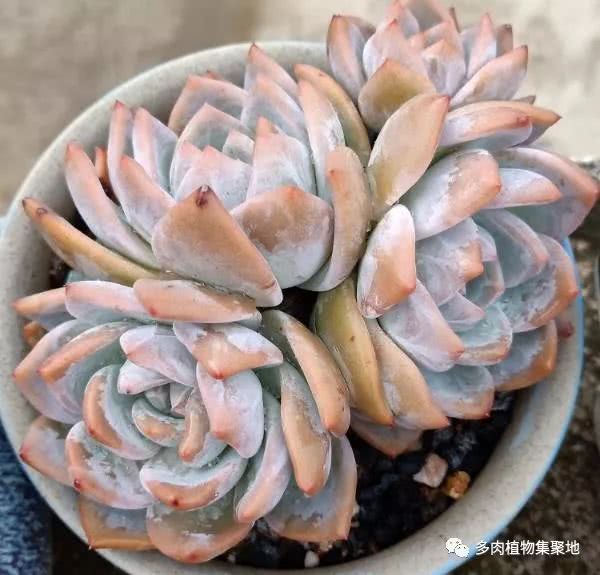
From the perspective of the growing environment of succulent plants, those growing in desert regions, such as those in the Cactaceae family, Aizoaceae family, and Crassula genus, generally have root systems that are relatively tolerant of high temperatures, so getting through summer is not too difficult, while most Echeveria that grow in mountain crevices are relatively unable to withstand summer. For succulents growing in the wild, as long as the roots desperately grow downward, the lower they go, the lower the temperature, while succulents planted in pots are in a rather awkward situation: the pot is only so small, the soil is only so much, and no matter how the roots grow, the temperature is still this high, even higher than the temperature suffered by the leaf surface.
For succulent plants in summer, ventilation is very important. At the same time, when mixing soil, you can choose a large proportion of gritty soil to strengthen air circulation inside the pot. Use open-mouth pots more; the temperature in narrow-mouth pots is estimated to be very high. Another benefit of gritty soil is that the average distance between particles increases, so the soil's thermal conductivity is relatively small, and it may heat up a bit more slowly. In addition, after watering, with the help of water, the contact area between gritty soil particles becomes larger, and the thermal conductivity will increase.
No matter what season it is, light is indispensable. Even in summer, succulents still need sunlight, but they cannot be exposed to too much sun. For shading, shade cloth is generally used, and the degree of light transmission depends on the specific need. Silver is better because it does not absorb heat, but it is very expensive. I generally start partial shading at around 28 degrees, and as the temperature continues to rise, I gradually lower the shade cloth. After the shade cloth blocks more light, the greenhouse will be relatively less ventilated, so if conditions permit, it is best to equip a fan to increase ventilation.
Crassulaceae plants open their stomata at night to absorb carbon dioxide. Within a certain range, the lower the temperature, the more carbon dioxide they absorb. During the day, they close their stomata and release carbon dioxide through decarboxylation for photosynthesis. The higher the temperature, the faster the decarboxylation. Therefore, a large temperature difference between day and night is beneficial to the growth of succulents. In summer at night, if the plants can have a relatively cool environment, it is very good for them, but the change from cold to hot cannot be too sudden.
In summer, due to water control and temperature, mealybugs are prone to outbreaks. Because after summer begins it is not suitable to water or apply medicine too much, I generally use medicines such as Huahuashen and carbendazim every other week before summer begins to prevent fungi and insects, and after summer begins, if watering, I can also continue to use them. After summer begins, patrol frequently the tender buds, the center of the leaves, the back side, the visible roots, and other positions, paying attention to abnormal transparent mucus, white powder, and so on. If mealybugs are not discovered in time, the succulent may be disfigured or die. Usually, it is best to clean up completely dried leaves. These layered dried leaves will become a refuge for insects in summer and will also make ventilation at the roots worse. Try not to clean up dead leaves and water at the same time, to prevent the wounds that may be left on the stem when cleaning dead leaves from coming into contact with water.
When watering, you can only gently pour a little at the corner of the pot; there is no need to water until water comes out of the bottom of the pot. A tiny amount of water is enough to keep the plant's roots from drying out too much and dying in midsummer. In midsummer, be sure not to soak the pot, because if you soak the pot, it will not dry out for several days. Below is a brief explanation of watering different genera of plants in summer. Cactus: most are in their growing period in summer and can be watered thoroughly after the soil dries out, with a few exceptions. Crassulaceae: most Crassulaceae plants are dormant, so provide shade and only give a tiny amount of water. In particular, for the Crassula genus in Crassulaceae, too much water will make them rot, and fellow enthusiasts must remember this. Aizoaceae: provide shade; many varieties are dormant and should not be given water, or only a tiny amount of water.
This is a gathering place for succulent plant enthusiasts, sharing succulent care tips. You are welcome to follow and exchange ideas.