The blue butterfly flower has elegant blooms, looking like a swarm of butterflies dancing when in full bloom
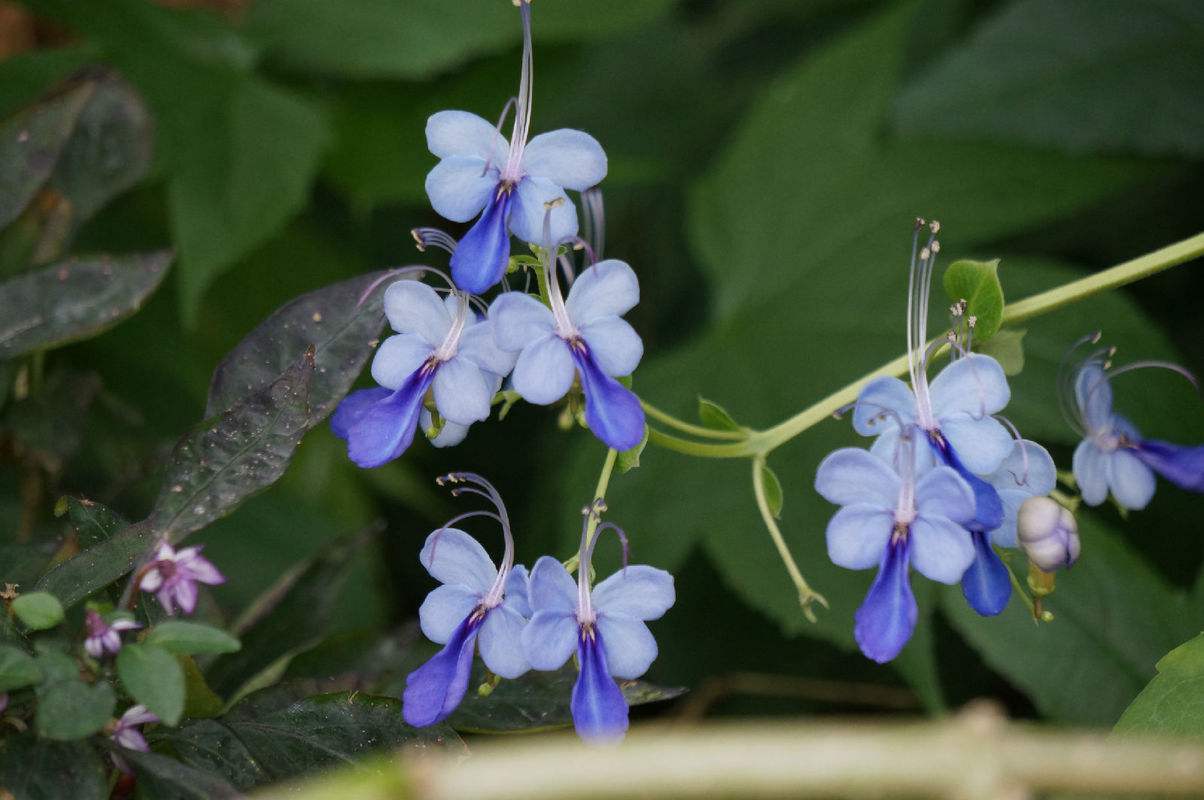
Blue butterfly is a herbaceous plant of the genus Iris, named for its blue-purple corolla. This plant prefers a warm and humid climate. It is cold-resistant and drought-tolerant, and is best grown in loose sandy loam. Propagated by division and sowing. It is distributed in Yunnan, Sichuan, Jiangsu, Zhejiang and other provinces.
Blue butterfly
Morphological characteristics:
Climbing herbaceous vine. Stems and branchlets slender, covered with deciduous appressed short pubescence. Leaves 2.5-5 cm long; stipules small, linear, 2-5 mm long; petioles 1.5-3 cm long; the upper side of the compound leaf rachis has fine grooved lines; leaflets 5-7, but usually 5, thin papery or nearly membranous, broadly elliptic or sometimes nearly ovate, 2.5-5 cm long, 1.5-3.5 cm wide, apex obtuse, slightly concave, often with a minute small mucro, base obtuse, sparsely covered on both sides with appressed short pubescence or sometimes hairless, turning green or greenish-brown when dry; stipels small, bristle-like; petiolules 1-2 mm long, and the rachis both covered with short pubescence. Flowers large, solitary and axillary; bracts 2, lanceolate; bracteoles large, membranous, nearly round, green, 5-8 mm in diameter, with obvious reticulate veins; calyx membranous, 1.5-2 cm long, with longitudinal veins, 5-lobed, lobes lanceolate, less than 1/2 the length of the calyx tube; apex with a mucro; corolla blue, pink or white, up to 5.5 cm long, standard broadly obovate, about 3 cm in diameter, with a white or orange-yellow faint halo in the center, gradually narrowed at the base, with a short claw, wings and keel much smaller than the standard, both with claws, wings obovate-oblong, keel elliptic; stamens diadelphous; ovary covered with short pubescence. Pod 5-11 cm long, about 1 cm wide, flat, with a long beak, containing 6-10 seeds; seeds oblong, about 6 mm long, about 4 mm wide, black, with an obvious strophiole. Flowering and fruiting period July-November.
Blue butterfly
Cultivation techniques:
The best cultivation soil is loam or sandy loam, and drainage must be good. It likes high temperatures, and the suitable growing temperature is about 23-32 degrees C. In winter it needs warmth and shelter from wind to overwinter. It adapts to environments from partial sun to full sun; strong sun will make the leaves somewhat yellow, but this does not affect growth or flowering. Low temperatures and cold waves in winter will cause a slight dormancy phenomenon with leaf drop. It blooms in spring and summer, with inflorescences extending from the branch tips, opening one after another, and the flowering period is quite long. After flowering, dwarfing pruning can be carried out to prevent it from growing taller and taller and gradually becoming sparse. Apply a slow-release fertilizer once in late winter and early spring, and one more application after flowering is enough.
Blue butterfly
Origin of the name:
When the blue butterfly flower is in full bloom it closely resembles a swarm of butterflies dancing, with elegant blooms, and it is named blue butterfly because it resembles a butterfly. The blue butterfly's beautiful purple flowers, like those of a butterfly, bloom only once every thousand years, and only exist in the Wu Hui forest! Wu Hui forest, as the name suggests, means there is no return once you go in, and it is extremely dangerous inside, so few people have ever seen the purple butterfly flower!