Brunfelsia's flower color changes dramatically, different yesterday, today and tomorrow
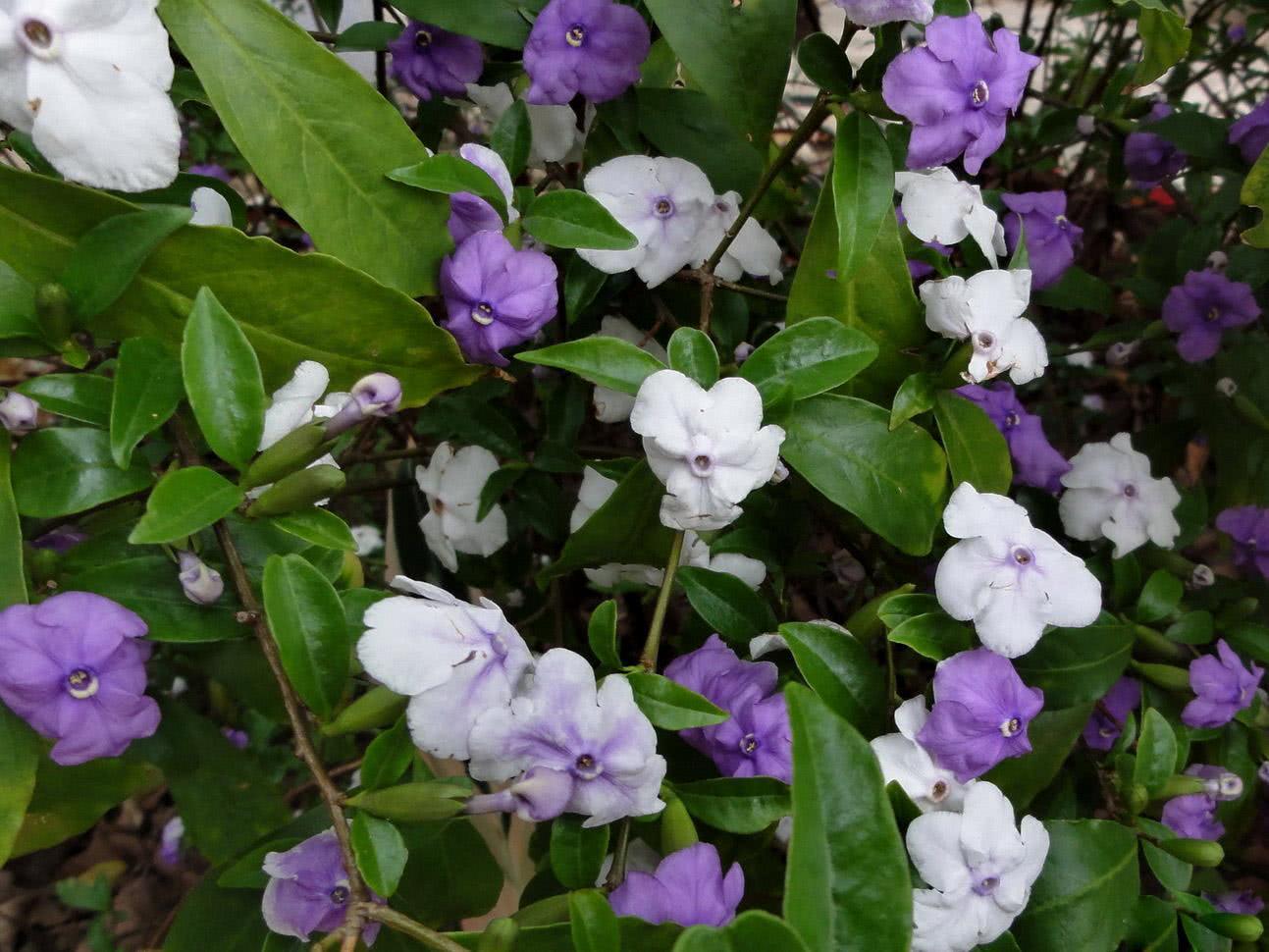
Brunfelsia belongs to the Solanaceae family, Brunfelsia genus, an evergreen dwarf shrub, and is an excellent potted flower for outdoor display in summer and indoor arrangement in winter in North China. Brunfelsia grows 50 to 100 cm tall, with alternate single leaves, and flowers mostly solitary, rarely several clustered together. The corolla is salverform with shallow lobes, the flowering period is from April to October, and a single flower blooms for about 5 days. The flower opens blue-purple at first, gradually turns lilac, and finally becomes white. Because the flowers open at different times, blue-purple and white flowers can be seen on the same plant at the same time, so it is also called two-color jasmine; its English name means "yesterday, today, tomorrow," which vividly depicts the special change in its flower color.
Brunfelsia
Morphological characteristics:
Perennial evergreen shrub, an excellent potted flower for outdoor display in summer and indoor arrangement in winter in North China. The plant is about 70-150 cm tall; after dwarfing in pots, the plant height can be reduced to 30 cm-60 cm. The stem bark is dark brown or grayish white, with strong branching ability, and the periderm splits longitudinally. Leaves are alternate, long lanceolate or elliptical, with acute tips, short petioles, and the leaf surface is grass green. Leaves are 5-7 cm long and 1.7-2.5 cm wide, papery, green on the upper surface, yellow-green on the underside, and the leaf margin is slightly wavy.
Flowers are solitary or several clustered, sometimes several forming a cyme. The corolla is salverform with shallow lobes. The corolla diameter is 4 cm-5 cm, the calyx is tubular, and the stamens and pistils sit on the small opening at the center of the corolla. Flowers are solitary or 2-3 clustered in the leaf axils, salverform, with a five-lobed corolla and obvious serrations on the petals. When the flower is in bud, it is mushroom-shaped and deep purple; when it first opens, it is blue-purple, then gradually becomes pale lilac, and finally turns white. A single flower can remain open for 3 to 5 days. The floral fragrance is rich, and the scent is also different from ordinary jasmine fragrance.
Brunfelsia
Growth habits:
Brunfelsia is native to the tropical regions of Central America and South America, and prefers warm, humid climatic conditions with ample light. Its cold tolerance is not strong, and the suitable growth temperature is 18-30°C, and it should not be lower than 10°C; it likes a semi-shaded, ventilated environment, and indoor cultivation should have at least 4 hours of light, and under sufficient sunlight it blooms profusely; it is tolerant of semi-shade and drought, but not waterlogging or poor soil. In East China and North China, it is grown as a greenhouse potted plant, and the substrate should be fertile, loose, and well-drained slightly acidic soil. In summer, alum fertilizer water should be supplemented regularly so that the leaves are dark green and glossy and the branches and flowers are abundant.
Brunfelsia
Distribution:
Jasmine is native to the Jiangnan region and western regions of China, as well as India and the Arabian area; its central production area is near the Persian Gulf, and it is now widely cultivated in subtropical regions. It is mainly distributed in Iran, Egypt, Turkey, Morocco, Algeria, Tunisia, as well as Spain, France, Italy and other Mediterranean coastal countries, and is cultivated in India and various Southeast Asian countries.
Ornamental value:
Brunfelsia has brilliant flower colors and is fragrant, suitable for planting in garden green spaces, and can also be placed in pots for viewing. Brunfelsia is highly ornamental, easy to grow and easy to propagate. Because of its different flowering stages, Brunfelsia presents two colors of flowers on one tree and also has the fragrance of jasmine, thus becoming an important potted ornamental flower. Brunfelsia has emerald green leaves, and its flowers are interlaced in purple, blue, and white, with a strong fragrance. People often use it to decorate and beautify courtyards, balconies, windowsills, corridors and other places, elegant and pleasant.