Growing orchids in summer: use this method and watering becomes second nature
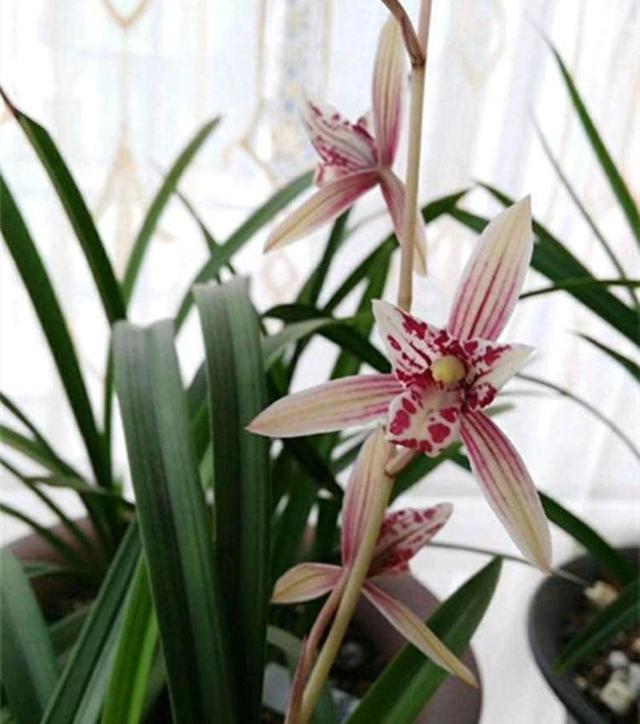
Summer is the peak period of orchid growth. Once water is lacking, the orchids will grow poorly, but if they stay wet without drying out for a long time, they are prone to disease, so watering must be both timely and at the right time. How well watering is managed directly affects how well the orchids grow. Today, I will share a method with everyone; once you have mastered it, you will have watering "down pat."
Many orchid growers know that when watering orchids, you should go by the potting medium, but the medium is inside the pot, invisible and impossible to touch, making the dryness and moisture level rather difficult to judge. Some growers also use the tube-insertion method, the stick-insertion method, the pot-weighing method, and so on, but these methods are all too cumbersome and inconvenient to carry out, and when there are many pots it becomes even harder to manage.
So, is there a simple and easy method? The answer is: yes, and this method is the "sample pot observation method." What is the "sample pot observation method"? That is, in the orchid garden, use the same kind of orchid pots and the same potting medium to plant 1~2 pots of ordinary orchids of basically the same size as "sample pots," and during routine observation you can push aside the surface soil of the "sample pots" as an auxiliary judgment.
Fellow growers, when the potting soil is slightly moist down to "one-tenth dry" (that is, the color has turned dry at 1/10 below the pot surface, equivalent to 1~1.5 cm in a shallow pot and 1.5-2 cm in a deep pot showing dryness), it is most suitable for orchid growth. In spring, when it reaches "two-tenths dry" (that is, the color has turned dry at 2/10 below the pot surface, equivalent to 2~2.5 cm in a shallow pot and 3~3.5 cm in a deep pot showing dryness), it is time to water.
In addition, when fertilizing orchids, if it is summer, growers are advised to use an organic liquid fertilizer specially made for orchids, diluted 500 times, to water the roots of the orchids. When watering, combine it with fertilizing for the best results, and the amount of liquid fertilizer used can be the same as the amount of water used.
Because summer spans the mold and rain season and also coincides with the time for "water withholding" on spring orchids (Cymbidium goeringii) to promote flowering, growers may let the potting soil dry slightly, and it is best to water when the potting soil reaches "three-tenths dry" (that is, the color has turned dry at 3/10 below the pot surface, equivalent to 3~3.5 cm in a shallow pot and 4.55 cm in a deep pot showing dryness).
Under normal circumstances, it is best not to exceed "four-tenths dry" (that is, the color has turned dry at 4/10 below the pot surface, equivalent to 4~4.5 cm in a shallow pot and 5.5~6.5 cm in a deep pot showing dryness) before watering. If the orchid's root system is short and the roots do not reach the middle of the pot, it is best to water a little earlier; if the root system is vigorous and extends below the middle of the pot, you can let it dry a little more before watering.
The watering interval varies with the size of the orchid pot and the potting medium, and with the environment and season, so you cannot mechanically apply someone else's watering interval. As long as you flexibly manage it according to the "sample pot observation method" introduced above, and keep some records according to different seasons and temperature conditions, you can work out a watering method suited to your own orchid-growing situation, and then you need not worry about failing to grow orchids well.