Detailed Explanation of the Technical Methods for Making Bonsai from Firethorn Seedlings
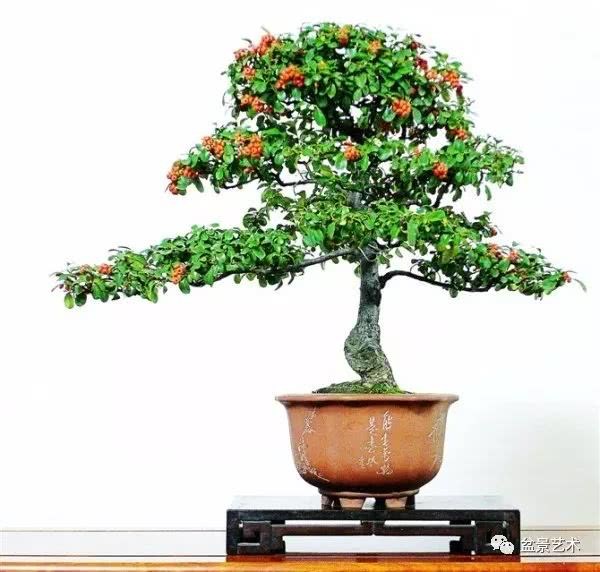
Firethorn (Pyracantha) is an evergreen shrub or small tree of the genus Pyracantha in the rose family (Rosaceae). It is a subtropical tree species, naturally distributed in the mountains and wilds of the southern provinces. Its branches are dense and its leaves small, and it has extremely strong resistance to stress. In May, white flowers cover the whole tree, like snow weighing down the branches; after flowering it sets fruit, which ripens from October to December, brilliant as red clouds, hanging on the branches for a long time and not withering through the winter. Firethorn is not only ornamental for its fruit, but also for its leaves, flowers and form; it can be appreciated in all four seasons, making it an excellent bonsai tree material.
When making firethorn bonsai in the north, most of the tree material must be purchased from the south, which is rather troublesome, and satisfactory tree material is hard to find. After several years of experimentation, the author used flowering and fruiting branches to root cuttings of small firethorn seedlings; the following year they can bloom and bear fruit, and when used to make bonsai, they can take shape and be appreciated in one or two years. The process of cultivating and making the bonsai is briefly described below:
1. Cutting time: Based on the author's practical observation, firethorn differentiates flower buds in July and August, and by September the flower bud differentiation process is basically complete. At this time, taking flowering and fruiting branches as cuttings will certainly produce flowers and fruit the following year. In September the weather gradually turns cool, while the soil temperature is still high. Cuttings taken at this time, with the medium kept moist, are not prone to rotting, which suits the firethorn's habit of liking warmth and moisture; they root quickly, and the survival rate is almost 100 percent.
2. Selection of cuttings: Choose robust branches bearing flower buds and cut them into 8-15 cm cuttings that can be shaped. Keep 2-3 pairs of leaves at the upper part and cut off all the remaining leaves. Cut the lower end of the cutting into a horseshoe shape to enlarge the rooting surface of the cutting. A heel cutting is even better; the heel part stores abundant nutrients, which benefits the rooting and sprouting of the firethorn cutting.
3. Choosing the pot and medium: The author used a medium made by mixing sawdust with screened fine coal cinder particles and fine sand; it is slightly acidic, and the cuttings root quickly with a high survival rate. For home cuttings the number of seedlings is small and they are easy to move, so pot cuttings can be used. Generally, a clay pot with a mouth diameter and height of 30-40 cm is more suitable. Line the bottom of the pot with a layer of coarse coal cinder to facilitate drainage and aeration. After filling with the medium, pour boiling water through it to sterilize it, then wait to insert the seedlings.
4. Cutting operation: The cuttings are best soaked in a rooting agent (the soaking time according to the instructions of the rooting agent). For home cuttings, if there is no rooting agent, willow branch infusion can be used instead. According to the author's experiments, using fresh willow branches cut into 8-10 cm lengths, bundled together and soaked in a glass container for 20-30 days, the infusion is then used to soak the cuttings for about 24 hours; the rooting effect is no worse than that of a rooting agent.
After the cuttings are soaked, insert them into the medium to 1/3 or 1/4 of their length, water thoroughly, and cover with plastic film, keeping the temperature inside the cover at 20-30 degrees C. In about 30 days they will root and sprout. The rooted cuttings soon enter winter; in winter the pot soil must not be kept too wet. If overwintering outdoors, place the pot in a warm, sunny spot and still cover it with plastic film; with the temperature inside the film above 0 degrees C, it can overwinter safely. If it is too cold, it can be overwintered indoors.
5. Potting, planting and care: After the firethorn cuttings have overwintered, by March, when the temperature warms up, those with a good tree form can be selected for transplanting into pots. To begin with, a small pot is suitable, and a clay pot is best. The growing medium should be made by mixing fine coal cinder, leaf mold and garden soil, with an appropriate addition of organic fertilizer powder, so that it grows vigorously. Apply organic fertilizer liquid about once every 10 days. In May and June it buds and blooms; strengthen the fertilizer and water care and management so that the branches thicken and lengthen. Protect the long branches as much as possible to facilitate wiring and shaping. In August and September it can be shaped into a bonsai.
6. Shaping and making: When starting to make a bonsai from firethorn cuttings, first select the material, trying to choose plants with a thick trunk and a good form, with low branches, wide internodes and rich variation. After selecting the tree material, first cut off whorled branches, opposite branches, overlapping branches and water sprouts, and cut it back into a skeletal prototype of the bonsai. The top of a firethorn cutting usually has one long branch; if there is no long branch, multiple branches can be cut off and a long branch then cultivated.
Firethorn branches are soft and slender with good flexibility, easy to wire and shape, and are suitable for cascade-style or weeping-branch-style bonsai. After preliminary wiring, pruning and shaping, it can be planted in a bonsai pot. Then, according to the basic form of the tree stock and following an artistic conception, carry out a second shaping, mainly by pruning, combining pruning with wiring. After another one or two years of continuous pruning, wiring and shaping, a bonsai of firethorn full of delightful interest will have taken shape.