Key Factors in the Occurrence of Major Fruit Borers in Apple and Control Measures
Key Factors in the Occurrence of Major Fruit Borers in Apple and Control Measures
Apple is China's largest fruit crop, with its cultivation area and production ranking first in the world. In the 1990s, the state implemented pollution-free agricultural production. In order to control fruit diseases and pests, reduce pesticide residues, and improve the external quality of fruit, the apple industry vigorously promoted fruit bagging technology. At present, the bagging rate of apples in Shandong has reached 75%[1], which has basically solved the problem of fruit-boring damage by fruit borers, and pesticide residues have generally been reduced. However, with rising labor costs and the aging and shortage of orchard management personnel, bagging has become an obstacle to large-scale, efficient, high-quality apple production, manifested as: 1) High production cost. Each fruit bag costs 0.20 yuan, and bagging a 666.7 sq m orchard requires an additional cost of more than 2000 yuan. 2) Reduced internal quality of apples. After bagging, light exposure decreases, the sugar content and firmness of the flesh are significantly reduced, and the peel is prone to water loss and shriveling during the shelf life[2]. 3) Severe damage from new diseases and pests. With continuous bagging of apples for many years, the fruit is prone to calcium deficiency, leading to increasingly severe damage from Comstock mealybug, black spot disease, and bitter pit, and an increased rate of inferior fruit. Therefore, some apple experts advocate bag removal cultivation to alleviate the contradiction of high input and low returns in apple production. After bag removal, apples will face new plant protection problems, the foremost of which is the damage and control of fruit borers. To understand the occurrence characteristics and scientific control techniques of fruit borers on apples under modern cultivation conditions, the author elaborates from the following 3 aspects.
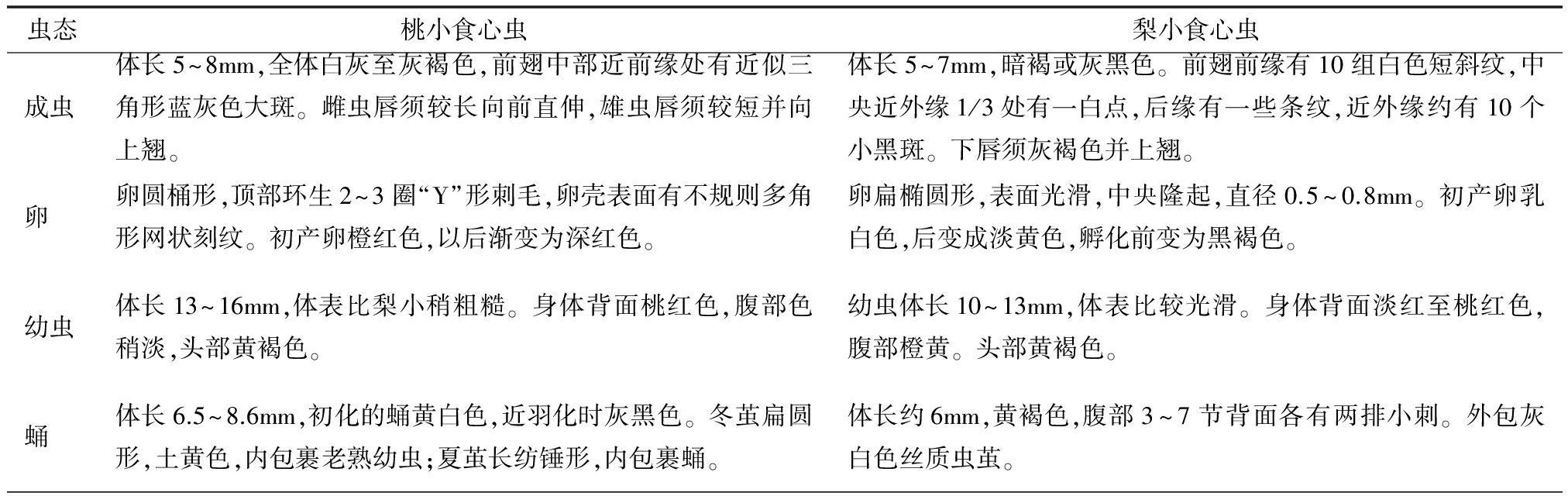
Table 1 Comparison of morphological characteristics between the peach fruit borer and the oriental fruit moth
1 Occurrence characteristics of major fruit borers in apple
At present, there are mainly 2 species of fruit borers causing damage to apples in Shandong Province, namely the peach fruit borer (also known as the peach fruit moth) and the oriental fruit moth (also known as the pear fruit moth), abbreviated as peach borer and pear borer respectively. Both can bore into fruit and cause damage, causing fruit rot and drop, and seriously affecting apple yield and quality. However, they differ greatly in body morphology and occurrence characteristics, and can be distinguished by comparison through Table 1 and Table 2.
Table 2 Comparison of occurrence characteristics between the peach fruit borer and the oriental fruit moth
2 Key factors affecting the occurrence of fruit borers
2.1 Biological environment
With the rapid development of urban and rural environmental greening, the planting of ornamental fruit trees is very common, such as crabapple, apricot, peach, pear, cherry, and plum, plus ornamental peach, flowering cherry, plum blossom, and purple-leaf plum in the same family as the above fruit trees. These are all suitable hosts for the peach fruit borer and the oriental fruit moth. Usually, pests on these trees are rarely controlled, and fruit borers are basically not controlled, causing the above fruit borers to cause damage and reproduce freely on these trees, and continuously move to nearby apple orchards.
In addition, in order to improve the fruit-setting rate of apples, most newly built large-scale orchards plant some crabapple trees to pollinate apples, but disease and pest control on crabapple trees is neglected, making crabapple trees a breeding ground and shelter for the two fruit borers and continuously providing insect sources for apples.
2.2 Temperature and humidity
Temperature and humidity are key factors affecting the growth, development, and reproduction of insects. With global climate warming, the annual average temperature has generally increased, and the ground temperature will increase accordingly. According to reports by Liu Xianzhao et al., during the 40 years from 1961 to 1999, the annual average temperature in the Yantai area increased by 0.6°C, with the largest increase in winter average temperature, rising from -1.5°C in the 1960s to 0.3°C in the 1990s[3]; Song Jiaying and Guo Lei analyzed temperature changes in Muping from 1971 to 2010 and found a climate tendency rate of 0.49°C/10 years[4]. According to the effects of temperature on the two fruit borers[5,6], after temperature rise, the mortality of overwintering larvae of fruit borers may decrease, the occurrence period of overwintering-generation adults may advance, the number of annual generations may increase accordingly, and it may even stimulate their reproduction [Qingqianliu]. Shen Changpeng et al. reported in 1993 that the peak occurrence of overwintering-generation adults of the peach fruit borer in apple orchards in Fushan District, Yantai City was from late June to early July[8]. In 2016, overwintering-generation adults in Fushan District and Laizhou City of Yantai City were first seen in mid-May, and the emergence peak appeared in mid-June. The occurrence period was significantly earlier than in 1990, indicating that it is related to climate warming.
Many documents have reported that the appearance time of overwintering-generation adults of the peach fruit borer is affected by humidity [Jishan Huayao]. With the development of China's water conservancy facilities and the improvement of irrigation conditions, existing apple orchards basically have irrigation conditions, and spring irrigation has become the norm. Spring orchard watering will inevitably be beneficial to the emergence, pupation, and adult eclosion of overwintering larvae of the peach fruit borer, and will also lead to an earlier occurrence period of overwintering-generation adults.
2.3 Grass-growing technology
Many experimental results show that growing grass in orchards can increase soil organic matter content, regulate soil pH, promote fruit tree root growth, and provide abundant food sources and good habitats for natural enemies[13-14]. However, artificial inter-row grass growing is not conducive to winter orchard cleaning and soil plowing, and is beneficial to the overwintering of the peach fruit borer and the oriental fruit moth under fallen leaves and weeds and in surface soil, increasing the overwintering insect source base and leading to severe occurrence the following year. Reasonable grass growing and strengthened field management are needed.
2.4 Drip irrigation technology
Usually, the peach fruit borer and the oriental fruit moth mostly concentrate in the soil within 50 cm of the tree trunk for overwintering. The implementation of drip irrigation technology in apple orchards provides a guarantee for timely irrigation and maintaining stable soil moisture around the roots. In orchards with drip irrigation facilities, the soil around the tree trunk in spring always maintains suitable humidity, providing favorable conditions for the emergence, pupation, and adult eclosion of the two fruit borers.
3 Integrated control techniques for fruit borers
Manual control. Promptly pick up fallen fruit in the field and put it into biogas pits in a concentrated manner to prevent the larvae of the two fruit borers from crawling from the fruit into the soil. Before the occurrence of overwintering-generation adults, cover the ground under the trees with plastic film to block adults from coming out and climbing the trees to lay eggs. Bag young apple fruitlets for protection to prevent the peach fruit borer and the oriental fruit moth from contacting apples. In addition, for the oriental fruit moth, scrape off old coarse bark and cracked bark on branches and trunks in winter and spring to eliminate overwintering larvae; during the growing season, promptly remove damaged new shoots and handle them in a concentrated manner; before overwintering larvae leave the fruit, tie grass bundles on main branches and trunks to attract larvae leaving the fruit, and remove and burn them in late autumn or early spring.
Natural grass growing. Under natural grass-growing conditions in orchards, the whole orchard can be turned over in autumn and early spring in combination with fertilization to destroy the overwintering sites of the two fruit borers, exposing them to the soil surface to be killed by sun or cold, reducing the insect source base the following year. At the same time, in spring, weeds can be removed and the ground cleaned at any time, facilitating the application of entomopathogenic nematodes and pesticides on the ground to control larvae and pupae in the soil.
Biological control. From May to September, when the larvae of the peach fruit borer inhabit the soil, an entomopathogenic nematode suspension can be sprayed on the soil under the tree canopy so that they parasitize peach borer larvae, also controlling the oriental fruit moth, white grubs, wireworms, and others in the soil. According to moth trapping forecasts, release Trichogramma in the field during the adult occurrence periods of the peach fruit borer and the oriental fruit moth respectively, so that they parasitize eggs. Generally, release bees once every 4 to 5 days for 3 to 4 consecutive releases.
Moth trapping control. In the early occurrence stage of adults of each generation, hang sex pheromone lures or mating disruption dispensers for the peach fruit borer and the oriental fruit moth in the field to trap and kill male adults or prevent males from finding females, thereby reducing mating and reproduction rates of the field population and gradually reducing the number of offspring of the two fruit borers. According to the chemotaxis of the oriental fruit moth, hanging sugar-vinegar liquid traps in the field can trap and kill female and male adults of the oriental fruit moth.
Chemical control. The key period for spraying pesticides on trees to control the peach fruit borer and the oriental fruit moth is the egg stage. Once larvae bore into fruit or new shoots, pesticides are difficult to effective. Before spraying, pest monitoring and forecasting must be done well. For predicting the adult occurrence period, the method of trapping male moths with sex pheromone lures is used. Starting in late April, hang sex pheromone lures for the peach fruit borer and the oriental fruit moth respectively in apple orchards to monitor the occurrence time and quantity of overwintering-generation adults of the two fruit borers. When overwintering-generation adults are trapped for 3 consecutive days in the field, spray pesticides on the trees, and spray a second time 10 days later, which can effectively control the first-generation eggs and newly hatched larvae. For the control of second-generation eggs, based on the moth trapping peak, generally spray on the second day of the peak. For the first spray, use 35% chlorantraniliprole water-dispersible granules at 8000-fold dilution plus 2.5% deltamethrin emulsifiable concentrate at 2000-fold dilution; for the second spray, use 1% emamectin benzoate emulsifiable concentrate at 2500-fold dilution plus 2.5% beta-cyhalothrin emulsifiable concentrate at 2500-fold dilution.