Tangli fruit (Pyrus betulifolia) is delicious whether eaten raw or cooked, and soaking it in sugar water or fruit wine gives it a distinctive flavor.
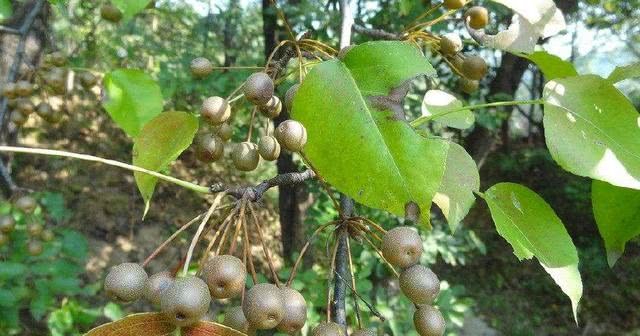
Tangli fruit
Tangli fruit, also known as Duli fruit, the branches of the Tangli tree often have thorns. It is a deciduous tree or large shrub, reaching up to 10 m tall.
The bark is grayish-black and cracks into small square plates; the branchlets are yellowish-brown to dark brown, densely covered with grayish-white down when young, later gradually turning purplish-brown; usually thorny.
Leaves simple, alternate; leaf blades rhombic-ovate to long-ovate, 5-8 cm long, 3-5 cm wide, apex acuminate, base broadly cuneate, rarely nearly rounded, margins with coarse sharp serrations, almost without awns, both surfaces hairless or only young leaves and petioles densely covered with grayish-white down; petiole 3-4.5 cm long, hairy; stipules membranous, linear-lanceolate, downy on both surfaces.
Umbellate racemes composed of 6-15 flowers; peduncle and pedicels densely downy; flowers bisexual, actinomorphic, 1.5-2 cm in diameter; sepals triangular-ovate, downy on both inner and outer surfaces; petals broadly ovate, apex rounded-obtuse, base with a short claw, white, slightly pink when first opening; stamens 20; styles 2-3, slightly hairy at the base.
Pome nearly spherical, 0.5-1.2 cm in diameter, calyx deciduous, apex not depressed, brown when ripe, surface with pale spots; fruiting pedicel 2-4 cm long, slightly downy at the base.
Flowering period April; fruiting period August-September. Tangli fruit has strong adaptability, prefers light, and is cold-tolerant, drought-tolerant and waterlogging-tolerant; it is widely distributed in China, and is cultivated in North China, East China, Northwest China, the middle and lower reaches of the Yangtze River, and southern Northeast China.
Morphological characteristics
Tree, up to 10 m tall, crown spreading, branches often thorny; branchlets densely covered with grayish-white down when young, biennial branches sparsely downy or nearly hairless, purplish-brown;
Winter buds ovate, apex acuminate, covered with grayish-white down.
Leaf blades rhombic-ovate to oblong-ovate, 4-8 cm long, 2.5-3.5 cm wide, apex acuminate, base broadly cuneate, rarely nearly rounded, margins with coarse sharp serrations, young leaves densely covered with grayish-white down on both surfaces, falling off as they mature, old leaves hairless and glossy above, slightly downy or nearly hairless below;
Petiole 2-3 cm long, covered with grayish-white down; stipules membranous, linear-lanceolate, about 2 mm long, downy on both surfaces, caducous.
Umbellate racemes with 10-15 flowers, peduncle and pedicels all covered with grayish-white down, pedicels 2-2.5 cm long; bracts membranous, linear, 5-8 mm long, slightly downy on both surfaces, caducous; flowers 1.5-2 cm in diameter;
Hypanthium densely covered with grayish-white down on the outside; sepals triangular-ovate, about 3 mm long, apex acute, entire, densely downy on both inner and outer surfaces; petals broadly ovate, 5-8 mm long, 3-4 mm wide, apex rounded-obtuse, base with a short claw.
White; stamens 20, anthers purple, about half as long as the petals; styles 2-3, slightly hairy at the base.
Fruit nearly spherical, 5-10 mm in diameter, 2-3 locular, brown, with pale spots, sepals deciduous, base with a downy fruiting pedicel. Flowering period April, fruiting period August-September.
Growing environment
Strong adaptability, prefers light, cold-tolerant, drought-tolerant, waterlogging-tolerant and barren-tolerant; it can grow vigorously in neutral soil and saline-alkali soil.
Distribution range
It is widely distributed in China, and is cultivated in North China, East China, Northwest China, the middle and lower reaches of the Yangtze River, and southern Northeast China.
Harvesting and processing
Bark is peeled in spring and sun-dried. Fruit is picked when ripe in autumn and used fresh. Leaves are collected in summer, sun-dried or used fresh. Branches are collected in all four seasons, sun-dried or used fresh.
Chemical composition
Leaves and seedlings contain epicatechin, arbutin, etc. The fruit contains polysaccharides; volatile oil: the main components are tricosane, pentacosane, 6,10,14-trimethyl-2-pentadecanone, tetracosane, dioctyl 1,2-benzenedicarboxylate, octacosane, etc. The main component of the flower volatile oil is heneicosane, etc. The leaves contain amino acids and inorganic elements such as copper, manganese and iron.
Fruit harvesting and processing
Harvesting period
At an altitude of 1,850 m, Tangli fruit ripens in late September, and yellow fruit should be harvested. In late September yellow fruit accounts for 24.5%, in early October yellow fruit accounts for 62.2%, and in mid-October yellow fruit accounts for 89.3%, which is the best harvesting period. In late October, most years have rain, and after rain the fruit softens and drops, so it is not suitable for harvesting.
Post-harvest fruit processing
There are the following 2 post-harvest fruit processing methods: (1) Indoor window-open heap rotting; (2) Open-field heap rotting (10-20 cm thick), covered with grass on top, watered once every 2-3 d to make it rot quickly. After more than 50% of the fruit has rotted, mash it with a wooden stick, place it on an iron net with holes smaller than the Tangli fruit, rinse while stirring, washing out the seeds and pulp, then use a plastic-frame wire net with holes slightly smaller than Tangli seeds to wash out the seeds. Sow the fresh seeds obtained directly on the seedbed. Experiments show that the indoor window-open heap rotting method after harvest makes seeds prone to mildew, while the open-field heap rotting method is better and the seeds will not rot.
Planting
Seedbed treatment
Sow in late October, water when sowing, break up clods finely, build ridge borders, ridge height 5-8 cm, ridge width 40 cm, bed surface width 1 m, the bed surface should be level, the bed ditch 30 cm deep and 30 cm wide. Because winters are dry, building ridges helps retain water, and after ditching and watering it drains easily. Two treatments were set up: (1) Sun-baking the seedbed soil, turning and digging the seedbed in late September; (2) No sun-baking of the seedbed soil, digging and preparing the soil and sowing on the spot in late October. The results show that sun-baking the seedbed soil gives good seedling emergence and no death. Without sun-baking the seedbed soil, seedling emergence is poor, and from early January of the following year the seedlings gradually die, with a seedling survival rate of only 33%.
Sowing
Cover the leveled bed surface with a layer of sand to prevent the seeds from being buried too deep, which is unfavorable for emergence. Mix the washed wet seeds with dry sand, then evenly broadcast them on the sand surface of the seedbed, with a density of 1-2 seeds/cm2 being suitable, then cover with river sand 0.3-0.5 cm thick, then cover with grass, water, spray with carbendazim 1,000 times solution + phoxim 800-1,000 times solution to prevent insects and disease, and finally cover with plastic film.
Seedling management
Seedlings emerge 15-20 d after sowing; remove the plastic film and rice straw, water, and build a 30-40 cm high arched shed. After the seedlings have 2 true leaves, water once every 2 weeks with clear manure water + urea 600 times solution; from December to February of the following year, spray insecticide once; in late January, leave ventilation openings at both ends of the arched shed to release heat and prevent high-temperature burning of the seedlings. The plastic film can be removed in the afternoon and put back on at 10 a.m.; after 2-3 d of hardening, remove the plastic film on January 30-31 to avoid burning the seedlings as the temperature rises.
Transplanting of seedlings
In late March, when the seedlings are 20-30 cm tall, they can be transplanted to the field at a row spacing of 10 cm x 3 cm. Level the land 10 d before planting, sun-bake the soil, and water thoroughly 1 d before planting so as to break up the clods and level the ground. After planting, because the temperature is high and the air is dry, the seedlings are prone to dying. To improve the seedling survival rate, different shading treatments on the bed surface and transplanting at different times were tested. Three shading treatments were set up on the bed surface: (1) No cover, watering once each morning and evening; (2) Shade net cover, watering once each morning and evening; (3) A 40 cm high arched shed, covered with plastic film, then covered with a shade net, watering 1-2 times per week. From May to July, broadcast urea 45-75 kg per hectare once a month, and water after application or apply urea when it rains, to prevent fertilizer burning of the seedlings; from May to July, water with clear manure water once a month. Two transplanting periods were set up: (1) Transplanting from late March to early May, surveyed in late December; (2) Transplanting from mid-May to mid-June, surveyed in late December. The results show that the seedling survival rates for no cover and shade net cover were 17.8% and 37.6% respectively; the seedling survival rate for the 40 cm high arched shed covered with plastic film, then covered with a shade net, watered 1-2 times per week, was as high as 99.3%. In addition, for transplanting from mid-May to mid-June, the seedling establishment rate (the percentage of plants with a stem diameter of 0.5 cm at 5 cm above and below the ground out of the total number of plants) was 68.9%; the seedling establishment rate for transplanting from late March to early May reached 97.1%.
Grafting
Four grafting periods were set up: (1) Grafting from December 28 to mid-February of the following year; (2) Grafting in late February; (3) Grafting in early March; (4) Grafting in mid-March. The percentage of plants with a height of 80 cm or more out of the total number of plants was 89.1%, 74.3%, 54.6% and 37.2% for each grafting period respectively, showing that December 28 to mid-February of the following year is the best grafting period.
Growth situation
During the growth period of Huangjin, Shuijing and Fengshui (mid-March to late June), seedling height can all reach more than 80 cm; during the growth period of Jinhua (mid-March to early June), the proportion of seedlings reaching more than 80 cm in height was 89.6%; during the growth period of Xuehua, Huanghua and Cangxi (mid-March to late May), the proportion of seedlings reaching more than 80 cm in height was 49.2%. 6 Summary The best period for harvesting Tangli fruit is mid-October. After harvesting, heap-rot it in the open field, wash out the seeds and sow them fresh, which is easier to manage than the traditional sand storage and will not mildew. Using plastic film to retain moisture for seedling raising can achieve the goal of early seedling raising and early emergence. For transplanting seedlings, using a 40 cm high arched shed, covered with plastic film, then covered with a shade net, and watering 1-2 times per week can improve the survival rate. The best grafting period is late December to mid-February of the following year.
Pest and disease control
After Tangli seedlings emerge, they are prone to damage by cutworms (soil silkworms), which bite off thicker plants; water the seedlings with methamidophos diluted in water, and at the same time, manual catching can also be used to kill adult insects. If aphids harm Tangli seedlings, spray with dimethoate diluted in water for control. If powdery mildew occurs during the Tangli seedling stage, spray with dinocap and carbendazim diluted in water for control.
Main value
Medicinal value: aids digestion and stops dysentery, treats diarrhea. Soaking in sugar water or in fruit wine, or eating raw or cooked, gives yet another flavor.