Cultivation Techniques for Beautybush: Propagation and Pest and Disease Control of a Rare Flowering Shrub
Propagation Methods and Pest and Disease Control Cultivation Techniques for the Rare Flowering Shrub Beautybush
1 Biological Characteristics
1.1 Morphological Characteristics
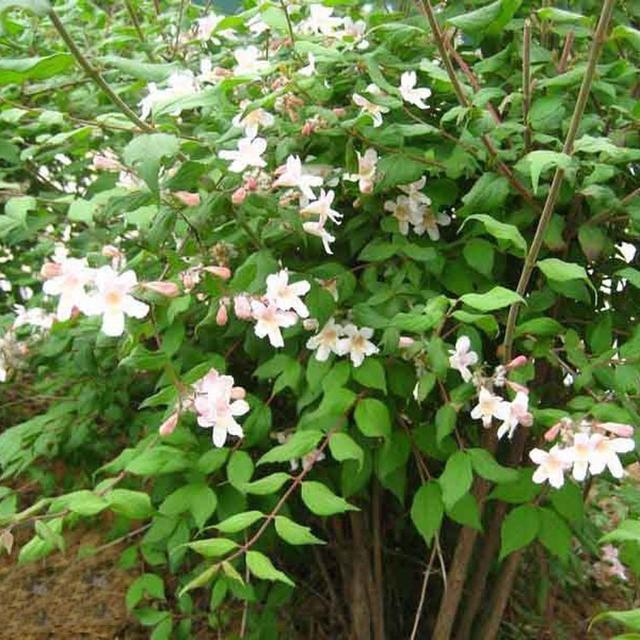
Beautybush (Kolkwitzia amabilis), a shrub or small tree, can reach a height of up to 3 m; young branches are reddish-brown, and the bark of old branches peels off in thin flakes; leaves are simple, opposite, with short petioles, ovate-oblong, 3-8 cm long and 1.5-5 cm wide, with a nearly rounded base and sparsely shallow-toothed or nearly entire margins; cymes are borne at the tips of lateral branches, the corolla is bell-shaped with 5 lobes at the apex, pinkish-white to pink; the fruit stalk and pericarp are densely covered with bristle-like stiff hairs, resembling a hedgehog, hence the unusual shape and the name; flowering period is April to May; fruiting period is August to September.
1.2 Growth Habits
Beautybush is a xerophytic to mesophytic plant with cold and drought tolerance. It is a light-demanding tree species, tolerant of semi-shade, but grows weak and spindly under shaded conditions and cannot flower normally. It can grow normally on thin-soiled, dry sunny slopes, but in places with excessively high relative humidity and excessive rainfall, it grows poorly, its roots are prone to rot, and it is susceptible to pests and diseases. The fruit of beautybush has bristles, which can be carried by wild animals for long-distance dispersal, expanding its distribution range; however, because its seed coat is hard, there are many empty and shriveled seeds, and the fruit bristles often hook onto other plants and cannot fall to the ground, and even when they do fall, the seeds cannot germinate normally due to dry soil or excessive moisture. Therefore, naturally regenerated seedlings of beautybush are generally very few, and they are usually root-sucker seedlings, which limits the expansion and development of its population.
1.3 Distribution
Beautybush is a warm temperate zone species, generally growing on barren slopes, forest edges, roadsides, ditches, or in thickets at an altitude of 350-1,500 m. The distribution area generally has a semi-humid, semi-arid climate with dry and cold winters and springs and hot and rainy summers and autumns. Beautybush can tolerate a minimum temperature of -21°C, and the annual precipitation in its distribution area is 500-1,100 mm, mostly concentrated in July to August [3]. In Anhui Province, it is mainly distributed in Jinzhai and Huoshan in the Dabie Mountain area, but in recent years it has also been found in Laoshang of Guichi and the southern mountainous areas of Dongzhi County. According to field surveys, it is generally scattered in thickets along roadsides and ditches in valleys in mountainous areas.
2 Seedling Propagation
2.1 Seed Propagation
2.1.1 Seed Collection
Generally from late September to mid-October, seeds should be collected promptly after they have completely turned yellow. Beautybush seeds have a high rate of empty and shriveled seeds, with a thousand-grain weight of 0.31 g, a plump seed rate of about 10%, and a germination rate of around 10%, so an appropriate amount of extra seeds should be collected according to the scale of seedling propagation.
2.1.2 Sowing Methods
(1) Direct sowing method: that is, sowing directly in the nursery bed after seed collection, which can reduce the workload of seed treatment. However, in order to improve the seed germination rate, simple treatments such as seed cleaning are generally carried out.
(2) Greenhouse sowing method: gently rub the collected seeds to break them up, take out the seeds, wash them clean, dry them in the shade, and soak them in 45°C warm water for 3 h (because beautybush seeds have a certain physiological dormancy, and the inhibitory substances causing physiological dormancy exist in the endosperm; storage in wet sand or treatment with gibberellin can effectively break their physiological dormancy). After removing them, spray once with a 100 mg/L gibberellin solution, then store in wet sand for 30 d, and sow in a simple greenhouse after the seeds begin to germinate. Beautybush seeds are very small, so the seedbed should be finely prepared and the bed surface should be leveled. In order to sow evenly, the seeds can be evenly mixed with fine sand and broadcast on the seedbed, then thinly covered with a layer of burnt soil about 0.5 cm thick, and a small arched frame covered with plastic film should be set up over the seedbed, which can not only increase the ground temperature but also maintain a relatively high humidity; generally 15 d after sowing, they will germinate and emerge, and after the seedlings emerge completely, the plastic arch frame can be removed. Because they are cultivated in a greenhouse, fertilizer and water management must be meticulous. When the seedlings grow to 4-5 cm, thinning can be carried out; if the seedlings are unevenly distributed, transplanting can be combined with thinning, and after transplanting they must be watered, using a fine-holed watering can to sprinkle water. In order to accelerate the growth of the seedlings, some fertilizer can be applied after thinning, and the fertilization principle is small amounts applied frequently [4].
(3) Spring sowing method: after the fruits are harvested in autumn, first spread them out to dry in the sun for 1-2 d, then thresh and clean the seeds, place them in hemp sacks and store them dry in a dry, ventilated place. Before sowing in March of the following year, soak them in 45°C warm water for 24 h, remove them and dry them slightly, treat them with ABT No. 1 rooting powder at 50 mg/L for 40 h, remove them and dry them, and after 24 h mix the seeds with fine sand and sow, covering thinly with a layer of fine soil. Set up a small arched frame over the seedbed, and then lay shade netting over it. Generally, seedlings emerge after 20 d, and all seedlings emerge after 30-35 d. Remove the film on rainy days or in the evening, and continue shading with the shade netting; when the seedlings grow to 3-5 cm tall, the shade netting can be removed and management carried out by conventional methods.
Generally, the seedling height can reach 30-50 cm in the same year, and after 2 years of cultivation, when the seedling height reaches more than 120 cm, they can be lifted from the nursery and planted out.
2.2 Cutting Propagation
Because the seed quality of beautybush is relatively poor and seedling emergence is uneven, it is difficult to produce high-quality superior seedlings, so in production, softwood cuttings are generally used to produce high-quality strong seedlings; hardwood cuttings have a low survival rate and are generally not used in production. The seedbed for cutting propagation should preferably be sandy loam.
2.2.1 Cutting Collection
Cuttings should be taken within 20-30 d after the flowering period; when the branch diameter reaches more than 0.3 cm and the middle and lower sections of the branches begin to lignify, the branches can be collected and cut into cuttings 10-15 cm long, retaining 2-3 pairs of leaves at the upper part. If the upper two pairs of leaves on the cutting are too large, they can be appropriately trimmed smaller, or only the upper two pairs of large leaves can be retained while all the middle and lower leaves of the cutting are removed; the lower cut of the cutting should be made at an angle about 0.2 cm below the node. In order to prevent the cuttings from losing water and wilting, which would affect the survival rate, during the processes of collecting branches, cutting cuttings, and inserting cuttings, an assembly-line operation can be adopted, collecting branches while cutting cuttings while inserting them; throughout this process, the branches must always be kept shaded and moist. The cutting period can continue until early to mid-October, so throughout the entire growing season, cuttings can be taken and inserted multiple times to cultivate a larger number of seedlings.
2.2.2 Cutting Insertion and Management
Soak the lower cut of the prepared cuttings in 500 mg/L ABT No. 1 rooting powder for 10 s, then insert them neatly into the seedbed at a density of 10 cm × 25 cm, with an insertion depth of 3-5 cm. After insertion, water thoroughly with a fine-holed watering can, set up a small arched frame over the seedbed, and lay shade netting over the arch frame. The seedbed should be kept moist; generally after 20 d the cuttings begin to root, and the two ends of the arch frame can be opened for ventilation and hardening; after another 10 d, remove the arch frame; fertilizer can be appropriately applied twice, and the frequency of watering reduced. After the Beginning of Autumn, the shade netting can be removed, and some phosphorus and potassium fertilizers can be sprayed on the leaves to promote lignification of the seedlings. For cuttings inserted after the Autumn Equinox, because the temperature drops and can no longer meet the requirements for softwood rooting, heating measures must be taken, and a plastic greenhouse should be set up over the seedbed for insulation. When the temperature inside the greenhouse gradually rises above 20°C in spring, the cuttings continue to callus and root; by late March or early April, the root system of the cuttings is basically well developed and the leaf buds have begun to sprout, so they should be transplanted in a timely manner. The plant and row spacing for transplanting into the field is 50 cm × 80 cm; when transplanting, the root system should be kept intact, dipped in mud slurry, and the branches heavily pruned to reduce leaf transpiration; at the same time, shade netting should be set up over the seedbed for shading for about 7 d, so that the transplanted seedlings can recover as quickly as possible. The seedlings should grow in the field environment for at least 1-2 years, and when each plant has more than 5-10 branches, a crown width of 80-120 cm, and a plant height of 120-150 cm, they can be lifted from the nursery and planted out.
2.3 Root Division Propagation
Root division propagation is generally used when propagating a small number of seedlings, mainly because there are too few root-sucker seedlings in the wild state. Root division propagation can be carried out in both spring and autumn; before spring sprouting or after autumn leaf fall, dig up the sucker shoots around the roots of beautybush and divide and plant them with roots; or dig up the entire mother plant and split it into several clumps, each with 2-3 stems and some roots, preferably with a small amount of native soil for planting, and strengthen water and fertilizer management, so they will easily survive. If divided in autumn, they can be heeled in until spring planting, which makes survival even easier [Jishan Huayao].
3 Pest and Disease Control
Beautybush has relatively few pests and diseases; generally in May to June and in autumn there is occasional aphid damage, which can be sprayed with a 2,000-fold solution of 10% imidacloprid. Brown spot disease is also a common disease of beautybush, and can be prevented and controlled by spraying with a solution of 50% carbendazim plus 70% chlorothalonil at 1:1:500, and spraying once more after about 15 d.