A Detailed Guide to Growing Marguerite Daisies in Pots at Home
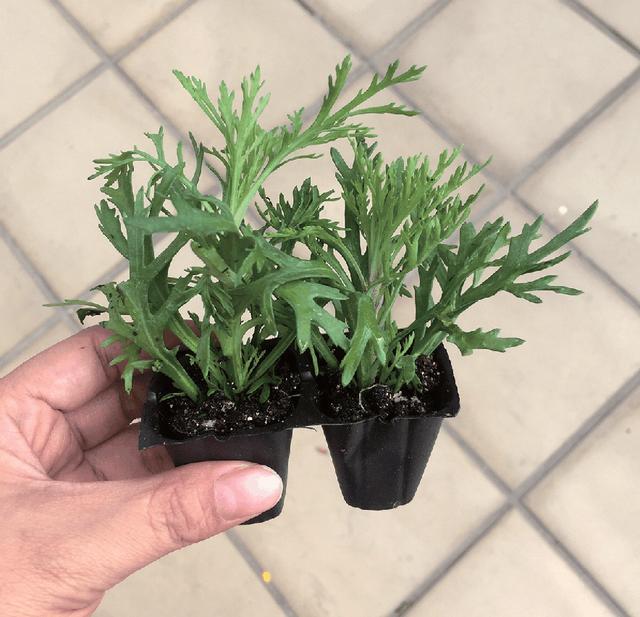
Growing Marguerite daisies in pots at home
To put it simply: soil, pots, fertilizer and pinching techniques.
Soil and pots:The seedlings you just bought are all small plug seedlings (Fig. 1). I use a nutrient soil mixed from farm chicken manure fertilizer + coconut coir brick + fired soil + perlite to pot up the small seedlings temporarily. If fellow flower growers do not have these, you can buy ready-mixed nutrient soil online. This kind of soil is loose, airy and fertile, especially suitable for the growth of small seedlings. The pot I use for temporary potting is a 12 cm two-tone pot. Two-tone pots come in many diameters, and any of about 10 cm will do. (Fig. 2).
Fig. 1
Fig. 2
Two-tone potIt is a very handy pot for temporary potting. When it is time to take the plant out, just turn it upside down and the whole root ball comes out without damaging the roots at all. A special reminder to fellow flower growers about the concept of temporary potting. Small seedlings go in small pots, large seedlings go in large pots. Why plant small seedlings in small pots and large seedlings in large pots? When the seedling is small, its root system is naturally weak. Grown in a small pot, the pot holds only a little soil. With little soil, only a little water is needed. In this way, the wet-dry cycle in the potting soil can be very fast. What is a wet-dry cycle? It means the potting soil dries quickly and also gets wet quickly. In order to absorb more water, the roots will strive to grow. When the roots grow well, the seedling grows well. But when you plant a small seedling in a large pot, because there is more soil and more water, the wet-dry cycle in the whole pot is not so fast. The weak roots are often soaking in water, causing root rot. Once the roots rot, the seedling is gone. If you grow the root system of the small seedling well, you need not worry that the seedling will not grow big later on.
Fertilizer:If you want the flowers to grow well, the necessary fertilizer is indispensable. In the early temporary potting stage, because nutrient soil is used, relatively little fertilizer is applied. Small seedlings also cannot tolerate much fertilizer. After the seedlings have settled in, at about 20 days, I start fertilizing. Fertilizers suitable for the growth of small seedlings include Biwang or Huaduoduo No. 1. Fertilize once a week, with a ratio of 1 gram of fertilizer to 1500 ml of water, about the amount of 3 bottles of 500 ml mineral water. Very soon, the roots of the small seedlings grow out of the original temporary potting pot, and at this point they can be moved to a larger pot, or directly planted in their final position. For the final planting pot, you can choose a pot of 20 cm or more. I first moved them to an 18 cm two-tone pot, and then finally planted them in a 27 cm pot, because I wanted them to bloom bigger. (Fig. 3)
Fig. 3
After final planting, I fertilized more frequently. Still Biwang and Huaduoduo, 2 times a week, with the ratio changed from 1:1500 to 1:1000. In the later stage, when preparing to let them bloom, I began to switch to Bikaihua or Huaduoduo No. 2. The ratio is also 1:1000, 2 times a week.
Pinching techniques: if you want Marguerite daisies to become a blooming machine, you must master the pinching technique. My pinching technique comes down to one formula: keep six, remove two, leaving four. On a branch, once it has grown 6 leaves, you can pinch off 2 leaves. The purpose of keeping the remaining four leaves is to make new shoots grow from the side buds, so the plant grows more flowering branches. Without pinching, it is often just one solitary stem, and the amount of bloom is not great. Without pinching, all the plant's nutrients are supplied straight upward, which is called apical dominance. Through pinching, this dominance is broken, so the nutrients are distributed to the remaining leaves, prompting them to grow axillary buds.
Let us make a comparison using the following two pictures: Fig. 4 is a straight, upright Marguerite daisy that has already grown 5 pairs of leaves. Each pair of leaves shows nothing special. In Fig. 5, I pinched off one pair of leaves, leaving 8 leaves. Because it is a small seedling, I have not yet pinched it down to only 4 leaves. After pinching, from the originally flat leaf axils of the 4 pairs of leaves, dense small buds grew out. After the axillary buds grow out, once they grow to 6 leaves, we can pinch according to the keep six, remove two, leaving four method, constantly encouraging it to grow more branches. If you want to pinch it into a ball shape, when pinching you must reach every direction properly, so that it forms a curve and keeps a consistent growth trend; in this way, as time passes, the ball gradually takes shape. (Fig. 6) With fertilizer, water and pinching techniques, plus ensuring sufficient light, once all these are in place, we can just sit back and wait to enjoy the flowers. (Fig. 7)
Fig. 4
Fig. 5
Fig. 6
Fig. 7