Detailed Explanation of Summer Pruning Methods and Technical Points for Peach Trees
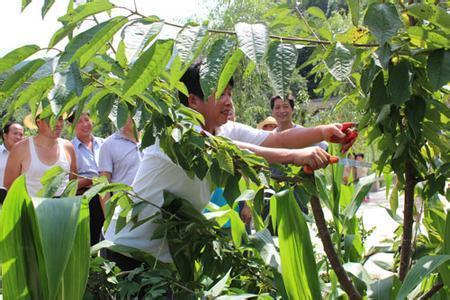
How to prune peach trees in summer?
Among the various fruit trees, peach trees are a species with many branches and large branch growth. Summer pruning of young vigorous trees can accelerate canopy formation and promote early high yields. The time for flower bud differentiation in peach trees is mainly in July to August. During this period, a large number of water sprouts are produced, causing branch groups to cluster and block wind and light from each other. If pruning is not carried out in time, it will affect flower bud differentiation, causing the tree to grow only branches and leaves without bearing fruit the following year [1,2]. Summer pruning can promote the normal growth of scaffold branches at all levels, rapidly form the canopy, and can balance tree vigor, control excessive growth, save nutrients, achieve the goals of early fruiting and early high yield, and prevent the fruiting zone from moving outward.
1 Growth Patterns of Peach Trees
Peach trees grow quickly and can produce 2 to 4 secondary shoots per year, and they flower easily, fruit early, and reach high yield early. Generally, they can bear fruit in 3 years and enter full fruiting period in 5 years. Except for young
trees, the vast majority of branches belong to the fruiting branch category. Peach trees originated in areas of our country with higher altitude, long sunshine duration, and high light intensity. Through long-term phylogenetic development, they have formed certain patterns, so their pruning characteristics differ from other fruit trees.
1.1 Light-loving, weak apical dominance
In naturally growing peach trees, the central leader is weak, and as the tree ages, the fruiting zone moves outward and yield declines. Good light is essential for normal growth and development, so open-center tree forms are mostly used in production. Peach tree canopies are relatively small, generally 3 m in tree height and 3 to 4 m in canopy spread, making them easy to manage.
1.2 High bud germination rate, strong branching ability
Peach trees have a very high germination rate, with only 2 to 3 latent buds, and these have short lifespans, so the lower parts of perennial branches easily become bare and are difficult to renew. Branching ability is very strong. The extension leader of the main branch of a young tree can generally grow more than ten long branches and can sprout secondary and tertiary shoots, so peach trees form canopies quickly and fruit early, but this can also easily cause canopy shading, so appropriate thinning of branches and attention to pruning are necessary.
1.3 Weak apical dominance, many branches, large taper
The apical dominance of peach trees is less pronounced than that of apples. After heading back a vigorous branch, the new shoots that sprout at the top grow relatively large, but multiple new shoots can also sprout below, which is beneficial for cultivating fruiting branch groups. However, when cultivating scaffold branches, the many lower branches significantly weaken the thickening growth of the terminal extension leader, resulting in a large taper, so the vigor of competing branches below must be controlled to ensure vigorous growth of the extension leader. In addition, when the main branch angle is large, water sprouts often sprout on the upper side, severely weakening the growth of upper branches and blocking more light, so they must be removed or controlled in time to avoid trees growing on trees.
1.4 Tolerant of pruning but poor wound healing
Removing large branches generally does not weaken the growth vigor of the upper part as obviously as with apple trees, but wound healing is poor, so during pruning, strive for small and smooth wounds, and never leave stubs. Large wounds should be promptly coated with protectants to promote rapid healing and prevent gummosis or infection by other diseases.
2 Main Methods of Summer Pruning
Summer pruning includes bud removal and sprout elimination, pinching, branch bending, and branch spreading.
2.1 Twisting shoots
Twisting shoots can control excessive growth and improve light conditions by twisting new shoots so that the tips droop. All overly vigorous new shoots on the extension branches of main branches, vigorous shoots emerging from the upper part of the canopy, and strong shoots sprouting beside the cut after winter heading back should be twisted. Twisting is generally carried out when new shoots grow to about 30 cm and have not yet lignified, and the twisting point should be controlled at 15 cm from the base.
2.2 Pinching
For overly strong vigorous upright shoots, when they grow to 18 to 20 cm, first pinch them to control apical dominance, and later when the new shoots emerging from the pinching point grow to 30 cm, twist them. For new shoots emerging from empty areas in the middle and lower parts of the canopy, pinch them when they reach 20 cm to promote lateral branch growth. Pinching water sprouts can produce several secondary shoots, and the secondary shoots can also become fruiting branches, commonly used for cultivating fruiting branch groups.
2.3 Branch pruning
For overly vigorous water sprouts on the upper and outer parts of the canopy, the method of removing the strong and keeping the weak should be adopted for control. At the same time, excessively dense branches and useless branches should also be pruned out to improve light conditions in the canopy and promote flower bud differentiation and fruit growth.
2.4 Branch spreading
For some young vigorous trees, branch spreading can moderate tree vigor, cultivate an ideal tree form, and promote early canopy formation and fruiting. The branch spreading angle is generally controlled at about 80 degrees, but branches should not be spread to a horizontal position. When spreading branches, be careful not to split large branches, which causes gummosis and poor healing. It is best to pad with soft materials when spreading to prevent bark injury.
3 Key Pruning Points for Peach Trees in Summer for Different Purposes
3.1 Pruning techniques for balancing tree vigor
During training and pruning, uneven vigor among scaffold branches is often encountered, preventing full use of space and resulting in low per-tree yield. At this time, various methods are used to suppress the strong and support the weak to achieve balanced growth. During pruning, generally prune vigorous branches heavily and weak branches lightly, keep weak buds on vigorous branches and strong buds on weak branches, leave more fruit on vigorous branches and less fruit on weak branches, open the angle of vigorous branches and raise the angle of weak branches, and use propping, pulling, and weighting techniques combined with fertilization to gradually balance tree vigor.
3.2 Pruning techniques for promoting fruiting in vigorous trees
For this type of tree, in addition to controlling with fertilizer and water management and using chemical agents, reasonable pruning should also be carried out. First, open the light path, remove some scaffold branches and large shading branches, especially water sprouts on the upper side, and spread the main branch angles. Where there is light, there are flowers. At this time, also pay attention to summer bending and pinching of vigorous branches. Winter pruning can also be changed to early spring to weaken vigor. In this way, tree vigor can be moderated in 1 to 2 years, plump flower buds can be formed, and yield can be stabilized.
3.3 Pruning of fruiting branches
The number of fruiting branches is related to variety, tree vigor, and tree age. Generally, after winter pruning, the spacing between fruiting branch tips is maintained at 10 to 20 cm. Varieties of the northern variety group mainly fruit on short fruiting branches, so they can be appropriately denser; varieties of the southern variety group mainly fruit on medium and long fruiting branches, so they can be appropriately sparser [3].
The length of fruiting branches to be retained depends on branch length, position, and the fruit-setting rate of the variety. Generally, long fruiting branches are pruned to retain 5 to 8 nodes of flower buds. When too dense, remove upright branches and keep flat or slanting branches. Note that branch distribution should not be "even-topped"; stagger lengths. Also note to leavebranches. Medium fruiting branches generally retain 3 to 5 nodes of flower buds, with the bud at the cut left as a leaf bud. Short fruiting branches and bouquet fruiting branches are generally only thinned, not headed back. Water sprout-type fruiting branches have a low fruit-setting rate and vigorous growth; after heading back, they can produce several good fruiting branches, often combined with summer pruning to cultivate into fruiting branch groups.
4 Cultivation of Fruiting Branch Groups
Fruiting branch groups are fruiting units directly attached to scaffold branches and composed of several fruiting branches, and they are also the main part of the tree's fruit yield. Branch groups come in 3 types: large, medium, and small. Large branch groups have relatively strong growth vigor, long lifespan, and good fruit quality. The cultivation method is as follows: generally, relatively vigorous branches are pruned to retain 5 to 10 nodes; in the second year, retain 2 to 3 healthy branches at the lower part and head them back again, removing the rest; in the third year, retain 3 to 5 buds and head back, which can cultivate a large fruiting branch group. Large fruiting branch groups are generally distributed on the slanting sides of scaffold branches, while medium and small branch groups are distributed on the upper side and in the spaces of large branch groups. The cultivation methods for medium and small branch groups are similar to those for large branch groups, only controlled smaller [4].
When pruning fruiting branch groups, attention should be paid to the vigor and density of fruiting branches. Consideration should be given both to the current year's fruiting and to preparing fruiting branches for the next year. Vigorous branches can appropriately retain more fruit, while weak branches should be heavily pruned and renewed to ensure branch group stability. If a branch group shows decline, it should be promptly retracted and renewed within the group; heavily prune vegetative branches, retain morebranches at the lower part, bear less fruit, and gradually recover. If some branch groups have become senescent, they can be removed and replaced by cultivating new branches nearby, or other branch groups can be extended into this space. If a branch group grows too vigorously, promptly remove vigorous and upright branches and retain moderate, healthy fruiting branches.
In branch group pruning, there are two ways to cultivatebranches: one is called double-branch renewal, which involves selecting two adjacent fruiting branches at the base of the mother branch; the upper branch is pruned as a fruiting branch to bear fruit, while the lower branch is heavily cut back to only two basal buds, producing two new shoots that form the fruiting branches for the second year. In winter, remove the upper branch that has already fruited, and the two new lower branches are still treated by the previous year's method: the upper branch bears fruit and the lower branch is cut back to two buds. In this way, each year one bears fruit and one produces shoots. The other is called single-branch renewal, which involves appropriately heavy pruning of healthy medium and long fruiting branches so that they can both bear 2 to 3 fruits and produce relatively strong new shoots. In winter, remove the upper small branches, and the lower healthy new shoots are similarly heavily pruned. Repeat this to maintain fruiting.