Detailed Explanation of Key Golden Pear Cultivation Techniques in Dengzhou City
Dengzhou City Golden Pear Cultivation Techniques
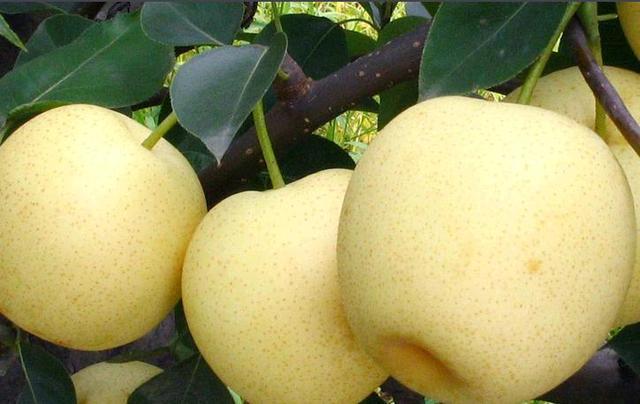
The golden pear is a fruit greatly loved by consumers, with golden-yellow skin, excellent quality and flavor, and good storability. Pear fruit has the effects of promoting saliva production, moistening dryness, clearing heat, and resolving phlegm. The golden pear originates from South Korea and is a new mid-to-late ripening pear variety. The golden pear has thin skin, white and tender flesh, a fragrant and beautiful taste, a sweet and aromatic flavor, and an excellent taste. Generally speaking, the golden pear's ripening period is in mid-September, with a growth period of about 145d. Golden pear seedlings grow very vigorously; after fruiting, growth slows down, with weak branching ability, strong flower formation ability, high fruit-setting rate, and good yielding ability. Golden pear seedlings can bear fruit after 2 years of transplanting. With the continuous increase in market demand, the income from golden pears keeps rising, and their cultivation is increasingly favored by fruit growers.]
As is well known, increasing the yield and quality of golden pears can increase economic income, and only by carrying out scientific cultivation management according to the growth characteristics of golden pears and the planting environment can the yield of golden pears be increased and fruit quality improved.
1 Orchard site selection
The golden pear has a wide range of adaptability and is not strict about planting soil. However, in order to achieve high yield and quality of golden pears, suitable orchard sites should be selected for cultivation. The soil for building the orchard should preferably be sandy loam and sandy soil, requiring deep, fertile soil with good drainage, and orchards should as far as possible not be built on plots with heavy clay soil.
2 Planting techniques
2.1 Orchard establishment and field planting
2.1.1 Land preparation
For golden pear cultivation, sandy loam land with relatively good water source conditions should be selected as far as possible. The soil is required to have high organic matter content, a deep soil layer, and good air permeability. Before planting, the land should be deeply plowed; this not only loosens and activates the soil but can also kill overwintering insect eggs in the soil, reducing the occurrence of golden pear tree pests the following year. Dig the planting trenches well, with a trench width of 0.8~1m and a depth of 60~80cm. The trench-digging method is to place topsoil and subsoil separately on each side. When planting seedlings, mix the topsoil with various fertilizers and fill it into the bottom layer; after the seedlings are planted, backfill with the subsoil.
2.1.2 Field planting
Complete planting from mid-February to before March 12. When establishing the orchard, select vigorous one-year-old seedlings with well-developed root systems, straight and thick trunks, plump and strong terminal buds, evenly distributed lateral buds, a root crown of more than 0.8cm, a seedling height of more than 80cm, and no pest or disease damage. Use north-south row planting, with a plant-row spacing of 2m x 4m, planting 83 plants per 667 sq m; or a plant-row spacing of 3m x 4m, planting 55 plants per 667 sq m, with a trunk height of 70cm.
2.2 Water and fertilizer management
Generally speaking, golden pear cultivation is based mainly on farmyard manure, crop straw, and other base fertilizers, supplemented by quick-acting chemical fertilizers as topdressing. The best time to apply base fertilizer is after fruit harvest, and one irrigation should be given after applying base fertilizer. Topdressing is mainly quick-acting chemical fertilizer, divided into pre-sprouting and pre-flowering fertilizer, fruit-promoting fertilizer, and flower bud differentiation fertilizer. For pre-sprouting and pre-flowering fertilizer, at this time new roots grow in large numbers, and the current year's sprouting, leaf unfolding, flowering, and fruit setting require large amounts of nitrogen, so fertilization is mainly nitrogen fertilizer. For fruit-promoting fertilizer, mainly nitrogen-phosphorus-potassium compound fertilizer, the best topdressing time is early June; at this time the fruit is expanding and flower buds are differentiating, and applying sufficient compound fertilizer helps increase fruit size, raise yield, and achieve good flower bud differentiation. During the flower bud differentiation period, boron fertilizer and phosphorus fertilizer of high purity and good quick solubility need to be applied as topdressing, and should be used in orchards with vigorous tree vigor, medium-to-upper tree vigor, relatively few fruits set, sufficient fertilizer and water, autumn shoots already mature before mid-October, and numerous and thick autumn shoots. During the process of flower bud differentiation, it is necessary to reasonably analyze the orchard's tree vigor and fruit load, and take care not to use methods such as root cutting or spraying paclobutrazol to forcibly control shoots and promote flowering.
2.3 Artificial pollination
Using mixed pollen to spot-pollinate the central flowers that open on the same day in each inflorescence can achieve very good pollination results. During the flower bud separation stage, flowers should be thinned, removing excess inflorescences and some useless flower buds, with inflorescences thinned at a spacing of 20~25cm, and in every two inflorescences 1 central flower bud and 1 side flower bud should be retained.
When the golden pear is in full bloom, at the stigma and the nectar-secreting area of the flower, use tools such as a brush or pencil to dip an appropriate amount of pollen and then directly apply it to the stigma; attention should be paid to the amount of force, as too much force may damage the stigma, while too little force makes it difficult for the pollen to adhere; spot-pollinate 2~3 times. Because the golden pear's pistil is relatively well developed while the stamens are relatively degenerated and produce little pollen, during planting two other kinds of trees can be appropriately planted as pollinator trees, with a ratio to golden pear trees of 1:4 (pollinator trees:golden pears); generally white pear series and sand pear series trees can be used, as they have large amounts of pollen and give better pollination results.
2.4 Pruning and training
The golden pear forms flowers easily, fruits mainly on short branches, and has the characteristic of fruiting on axillary flower buds; with scientific management it easily bears fruit early and yields well. The main purpose of pruning is to rapidly expand the canopy and increase yield, and the main task is to cultivate skeletal branches and reasonably transform and utilize auxiliary branches.
2.4.1 Selection and cultivation of skeletal branches
Skeletal branches are the 3 main branches at the base and the central leader branch. The first and second main branches at the base should preferably be selected in the southern half or a southerly direction, the third main branch in the north or a northerly direction, and the central leader branch near the direction of extension of the trunk. Within 1~3 years after planting, repeatedly cut back the selected skeletal branches year after year to promote more and better branching and form a firm framework. In addition to winter heading back of skeletal branches, during the growing season timely heavy pinching should also be carried out on skeletal branches whose current-year growth reaches more than 60cm, to promote lateral branches, which plays an important role in expanding the canopy as quickly as possible. When heading back main branches, in addition to retaining the outer bud as the extension branch, methods such as pulling, propping, and weighting should also be adopted to open the angle so that the rows close in as quickly as possible. The central leader branch is well positioned and generally grows vigorously; to increase branch number, the method of frequent summer pinching is generally adopted. When the central trunk height reaches more than 2m, heavy heading back should be carried out to promote 3~4 stronger branches. During winter pruning, select 2~3 well-positioned branches for medium heading back and cultivate them into 3 large fruiting branch groups.
2.4.2 Rational utilization of auxiliary branches
For newly fruiting trees, in addition to selecting and arranging several skeletal branches, a large number of branches are auxiliary branches. The functions of auxiliary branches: first, they produce many medium and short branches and form flower buds as early as possible; such auxiliary branches are left unpruned to form flowers, and after fruiting for several years they are removed; second, they occupy a large position and space and have the effect of filling space and balancing tree vigor; such auxiliary branches should be carefully pruned to promote early fruiting and be transformed year by year into large and medium fruiting branch groups; third, they assist the growth of main branches. However, as tree age increases, auxiliary branches will affect the growth of main branches and should be retracted as soon as possible or removed immediately.
2.5 Fertilization management
Before transplanting the trees, apply compound fertilizer in the pits; when expanding the tree basin in autumn, then apply farmyard manure at 50kg/plant. Open a trench at 50cm from the root crown of the tree, not too large, apply the farmyard manure into the pit, and backfill. Then build the water-storage ridge well and irrigate. During the golden pear growing season, especially in early spring and the fruit expansion period, apply topdressing at 0.5kg/plant. In the late growth stage of the golden pear (August~September), spray 0.2% potassium dihydrogen phosphate 3 times. While fertilizing, observe the degree of soil dryness, and the general irrigation rate is 3~5 times/year. Irrigation should be stopped about two weeks before harvest.
2.6 Flower and fruit management
Use bees for pollination, with the number of pollinating bees controlled at 1 box of wall bees per 3000 sq m. When the golden pear begins to set fruit, fruit thinning is also needed. Fruit thinning should be completed within 10~15d before fruit set, retaining only one fruit per inflorescence, with a fruit-to-leaf ratio of 1:50. The spacing between two fruits should be about 25cm, and all axillary flowers and poorly developed bud fruits should be removed. To thin out poorly formed young fruits, carry out the first bagging (using small bags), with a bagging amount of 30~40 per plant; one-time bagging can be carried out 3 weeks after flowering, and the time should not be too late, so as not to affect fruit expansion. For one-time bagging, double-layer fruit bags can be used, or young fruits can be bagged in plastic bags. When young fruits grow to a diameter of 2~3cm, carry out the second bagging (using large bags); the second bagging can be done 10~15d after flower drop. Disinfection and sterilization are needed before bagging. About 7d before harvesting the golden pear, tear the bag open from the bottom.
2.7 Pest and disease control
In the golden pear planting process, doing a good job in pest and disease control is also a key link; it can not only ensure tree growth but also guarantee fruit yield and quality. Common diseases include pear ring rot and yellow mealworm, which mainly harm leaves, new shoots, flowers, fruits, and other parts. After pear trees drop their flowers, spray a mixed solution of 1500mL of 1:200 Bordeaux mixture and 15% triadimefon solvent; to control pear ring rot, 10d after flower drop, use 750mL of 80% M-45 wettable powder 80-fold solution, spraying once a week; to control yellow mealworm, before fruit bagging, spray insecticide, using 1050mL of 90% methomyl 1500-fold solution, or 1000mL of 15% imidacloprid 3000-fold solution, etc., diluted. In the golden pear planting process, common pests include pear stink bug and pear psylla. Pear stink bug damage occurs when, at budding, they disperse on branches and suck sap, and after leaf unfolding they suck at leaf stalks and fruit stalks, causing leaf drop and fruit drop in severe cases. In production, adults and nymphs should be captured and killed. Taking advantage of the clustering characteristics of adults and nymphs, manually capture adults and nymphs around midday in mid-to-late May to eliminate overwintering larvae. Pear psylla uses adults and nymphs to pierce and suck sap from tender green parts; in spring they mostly concentrate on new shoots and leaf stalks to cause damage, and in summer they mostly concentrate on leaf surfaces to feed and cause damage. The main control method is to eliminate overwintering adults: carefully clear field weeds, dead branches, and fallen leaves in early spring, scrape off old cracked bark and burn it centrally; during the emergence period of overwintering adults, spray 500mL of high-efficiency cypermethrin 1200-fold diluted solution or 0.5kg of 2.5% deltamethrin 2000-fold diluted solution evenly on leaf surfaces, which can achieve very good results.