Appreciation of Beautiful Form Pictures of Viewing Stone Bonsai
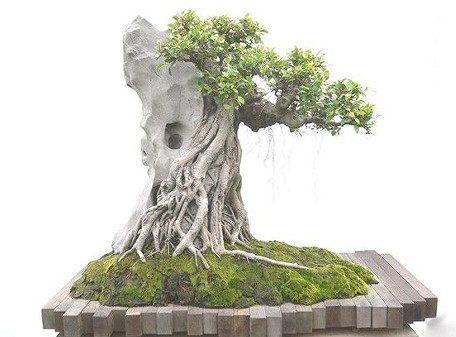
Viewing stone bonsai Generally speaking, there are three basic forms of beauty: natural beauty, social beauty, and artistic beauty. Natural beauty is the beauty possessed by natural things; social beauty is the beauty in social life; processing natural beauty and social beauty to become a unified expression is artistic beauty. Preserving, processing, transforming, or imitating natural beauty and reproducing it in bonsai for people to enjoy is bonsai beauty.
Specifically, natural beauty also includes the natural beauty of bonsai trees, the natural beauty of water features, the natural beauty of mountain scenery, the natural beauty of habitats, the natural beauty of bonsai pots, the natural beauty of display stands, and the natural beauty of animals (including figures). The artistic beauty of bonsai includes beauty of form, beauty of artistic conception (poetic and pictorial charm), and beauty of subtlety.
(1) Natural beauty of bonsai. The beauty of natural scenery within a bonsai is the natural beauty of bonsai.
A. Natural beauty of bonsai trees. The roots, trunks, branches, leaves, flowers, and fruits of trees all have their own posture, form, color, and charm. In addition, flowers and fruits also have their fragrance. These natural attributes of trees constitute the material foundation of natural beauty. People often use phrases such as graceful posture, exposed roots and claws, peculiar dead peaks, a riot of flowers, fragrant flowers assaulting the senses, and heavy with fruit to describe them, all of which show that the aesthetic feeling they give people is profound. B. Natural beauty of mountain scenery. The natural shapes, undulations, textures (various cun textures), colors, and materials of mountain peaks or mountain stones can also arouse people's aesthetic feeling. For example, the mountain scenery of Guilin, the mountain scenery of the Three Gorges of the Yangtze River, and the mountain scenery of Yunnan Stone Forest expressed in bonsai can all give people a sense of natural beauty. C. Natural beauty of water features. The shimmering waves and reflections of water, the bright mountains and beautiful waters, and the sound of water, "springs and stones rippling like a zither," are all full of natural beauty. D. Natural beauty of pots. Although pots are products of artificial manufacture, they still retain a coordinated, simple natural beauty.
E. Natural beauty of display stands. Regular-shaped wooden stands have the natural beauty of wood (grain, material, color, charm), while natural tree stands possess even more of a simple, hazy, naive, and condensed charm.
F. Natural beauty of animals. Apart from artistic beauty, figures and animal accessories still retain their natural beauty.
Natural beauty lies not only in the natural aesthetic feeling of natural objects, but also in the fact that it is the result of human subjective emotion and ideological consciousness acting on natural things. Natural beauty should also be the objectification of humanity's essential powers. The so-called objectification of humanity's essential powers essentially speaks of the relationship between humans and nature. That is, humanity's essential powers are embodied in natural objects, and natural objects embody humanity's essential powers. This kind of object that embodies humanity's essential powers is what Marx called "humanized nature." "Humanized nature" is a product of the development of human society and the historical result of a fundamental change in the relationship between humans and nature. When people praise the color, fragrance, posture, and charm of plum blossoms, they are in fact praising humanity itself, praising the essential powers unfolded on the objectively existing object of the plum blossom: wisdom, talent, thought, character, emotion, and vigorous vitality. In other words, natural beauty is the organic unity between the essence of natural beauty and social essence.
(2) The artistic beauty of bonsai
Artistic beauty is the concentration, generalization, and reflection of social beauty and natural beauty. Although it is not as broad and rich as social beauty and natural beauty, because it has undergone a series of processes of discarding the coarse and selecting the fine, discarding the false and retaining the true, proceeding from the surface to the interior, and from one to another, it removes the scattered, ugly, rough, and accidental shortcomings of social beauty, and removes the shortcomings of natural beauty being insufficiently pure (the unity of beauty and ugliness) and insufficiently standard. Therefore, it is purer, more concentrated, and more typical than social beauty and natural beauty, and thus richer in aesthetic feeling.
① Beauty of form. Beauty of form is the formal beauty embodied by the natural scenery in bonsai through artificial shaping. Beauty of form is divided into the graceful type and the magnificent type.
A. Graceful. Also called elegant beauty (Zhu Guangqian) or soft beauty, it gives people a feeling of gentleness and pleasure. For example, the beautiful "Emei, the most beautiful under heaven" expressed in bonsai, Guilin's landscape, the small and exquisite Shanghai miniature bonsai, as well as the clear and elegant Su style and the charming and graceful Chuan style, are all very graceful. According to differences in form, gracefulness can be further divided into tranquil beauty, rhythmic beauty, and color beauty. In bonsai, silent nights, secluded valley streams, quiet forests, and the sea give people a relaxed and joyful aesthetic feeling. For example, the work "Cicadas Chirp, the Forest Seems Still" fully embodies this kind of tranquil beauty; it gives people a tranquil aesthetic feeling through hearing and imagination. Rhythmic beauty: in bonsai, swirling clouds and mist, flying waterfalls, rippling lake waves, and dancing willow postures all have a kind of rhythmic beauty. For example, the Three Spring Willow bonsai of Henan, with its graceful and delicate soft branches drifting in the wind, reflects the flow of wind and the rhythm of spring through the dancing of the branches. Another example is the work "Phoenix Dance," which is mainly static, with movement setting off stillness, giving people rich associations. Color beauty: the brilliantly colored flowers, lush green branches and leaves, and golden morning glow expressed in bonsai can all give people a sense of elegant beauty.
B. Magnificent. The aged pines and green cypresses in stump scenery, and the lofty mountains, ridges, cliffs, and steep walls in landscape bonsai all give people a sense of masculine beauty, giving the viewer a feeling of fierceness and excitement.
② Beauty of artistic conception. Bonsai artistic conception refers to a kind of artistic realm formed by the fusion of the natural and life scenes depicted in a bonsai work with the thoughts and feelings contained within. This realm has both form and spirit, endless philosophical appeal, and a blending of feeling and scene, enabling the viewer, through association, to be emotionally and intellectually moved. Whether the artistic conception is profound or shallow is the key to the success or failure of a bonsai work. A bonsai work with beauty of artistic conception is thought-provoking and never tiresome to look at, because the bonsai creator has already melted their emotions into the scene during the creative process. Therefore, when the viewer enters this realm of beautiful emotion, they can achieve intellectual resonance with the bonsai creator.
The highest realm of bonsai art is poetic and pictorial charm. Poetic and pictorial charm is built on the foundation of pictorial scene and living scene, and the two permeate each other. In bonsai creation, what is most difficult to express is poetic and pictorial charm.
A. Pictorial charm. This refers to bonsai having a painting-like artistic conception; the work looks like a vivid, three-dimensional Chinese painting. Pan Zhonglian's work "Liu Songnian's Brushwork"<轩昂》等画意就非常浓厚。浓厚的画意来自于作者深厚的中国画功底,或者可以说它是作者绘画功底在盆景中的反映。
B. Poetic emotion. This refers to bonsai having a profound artistic conception like poetry. It achieves the artistic realm of poetry within "scene," "scene" within poetry, expressing emotion through scenery, and blending feeling and scene.
C. Subtlety. The beauty of Chinese bonsai is not like Western beauty; the beauty it expresses is a subtle Eastern beauty, not a beauty that is completely revealed at a glance. This subtlety is expressed not only in form, but also in connotation, technique, and title.
Statement: The pictures come from the internet, and the article was written by me. It may not be reproduced without permission. Please give your support.