How bizarre can succulents be? There is no most bizarre, only more bizarre
The plants in the succulent world really do come in every shape imaginable. You may have seen bizarre ones, but never ones this bizarre. As the saying goes, there is no most bizarre, only more bizarre. Perhaps you have already seen some of the strangest succulents, but the ones below are not to be missed!
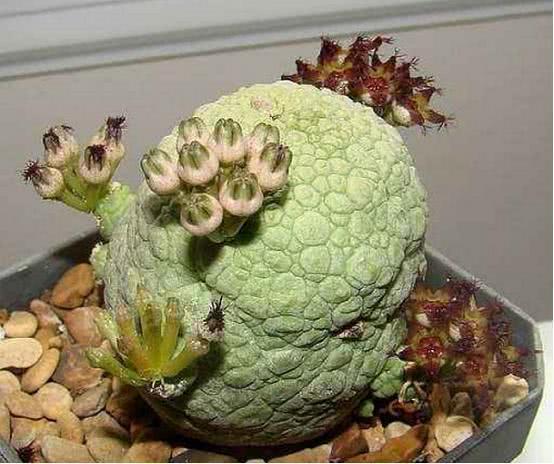
1. Pseudolithos migiurtinus (Pseudolithos) In my eyes the number one bizarre plant. This thing does not look like a living thing from Earth at all; it really gives off the feel of an alien species. Its shape is just a big lump of irregular green stuff, with all kinds of bumps and hollows on the surface. Grown in shade, its surface is green; with sufficient sunlight, the surface turns reddish. The flowers are deep red, and it relies on the rotting smell given off by the flowers to attract insects for pollination.
2. Conophytum calculus (jade stone, dove's egg) Conophytum calculus is spherical, about the size of a dove's egg, and the sphere has a mouth-shaped slit. When it blooms, the flower stalk grows out from the mouth-shaped slit. Each plant produces only one flower. The flower is orange-red, opens in the afternoon (it can only fully open with sufficient sunlight), closes at night, and can stay open for several days. It needs shading during intense sun exposure.
3. Lithops (living stones) Lithops is one of the types of living stones, known as the butt flower that looks most like a butt. It generally consists of two opposite block-like leaves with a gap in the middle. When it blooms, the flower stalk grows out from the gap. Normal aging brings about a kind of "shedding" phenomenon, in which the outer layer of skin peels off until it shrivels. During the shedding period and the summer dormancy period, water must be strictly controlled, otherwise it is very prone to rot.
4. Notocactus (Parodia) Notocactus is a type of cactus. Its shape is just round balls stacked together irregularly. With sufficient sunlight, the small balls turn orange-red. It blooms in spring, with pink flowers. Water once a week in spring, autumn and winter, and twice in summer. It can only grow well and bloom when placed in a spot with sufficient sunlight.
Image source: Xici Hutong 5. Haworthia (Yuzao) It looks like an aloe that has grown a little strangely. The two leaves are opposite, growing almost flat against the ground and horizontally sideways, so the soil should be kept from waterlogging, and when watering, do not pour water on the leaves, otherwise the leaves rot extremely easily. It is best kept in a semi-shaded, ventilated spot. You can observe the plumpness and color of the leaves: if the leaves are plump, there is sufficient water; if the leaves turn yellow, it means there is too much water or poor ventilation.