The flower is a horn and the fruit is a pouch: have you ever seen this strange plant?
In June, Aristolochia debilis is in full bloom, and both its flowers and fruits are quite interesting.
[Aristolochia debilis] Aristolochiaceae >> Aristolochia
Aristolochia debilis is widely distributed. According to the Flora of China, it is found in all southern provinces and regions as well as the central region. But I have never seen Aristolochia debilis in the wild; all the ones I have seen are other species with heart-shaped leaves (possibly Aristolochia tubiflora). However, in botanical gardens and medicinal plant nurseries at universities across the country, Aristolochia debilis is always cultivated.
On Dragon Boat Festival, I saw blooming Aristolochia debilis in the herb garden of a university in Hangzhou. This is a vine with strong climbing ability, and it had covered the trellis in the herb garden, which is taller than a person, completely.
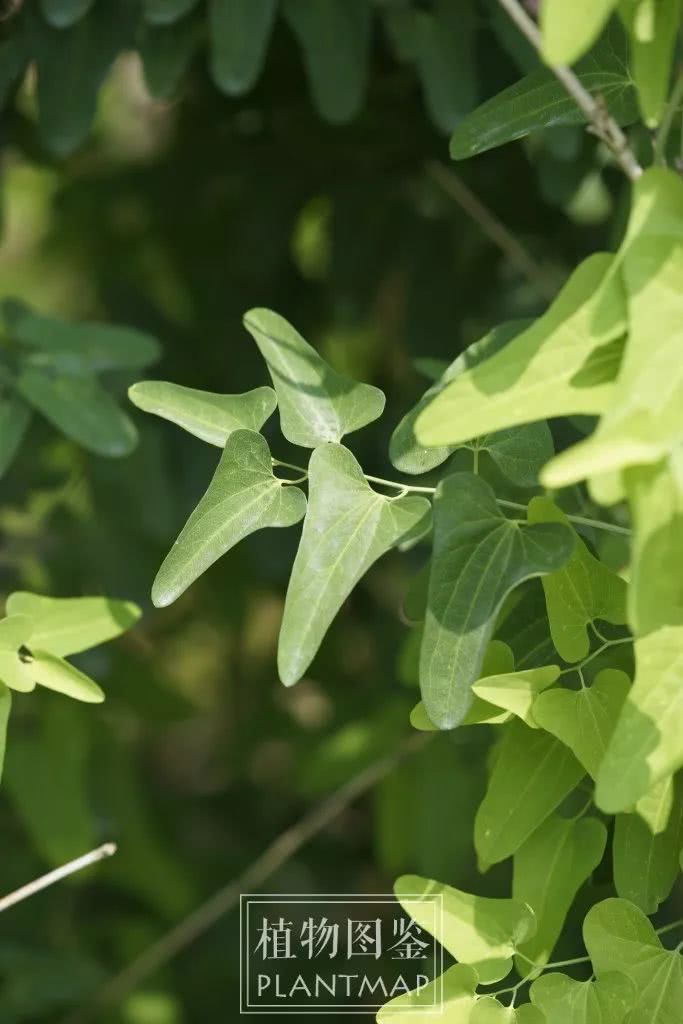
The first thing that caught my attention was the dense foliage of Aristolochia debilis. The leaf shape is roughly heart-shaped, but the lower half of the heart shape looks as if someone had pinched it to a point, turning it into an elongated shape.
The leaves are alternate on the vine, and in the leaf axils grow strange-shaped flowers one after another. This is probably one of the strangest flowers in the plant kingdom. Its perianth forms a tubular structure, with the base of the floral tube swelling into a small spherical pouch, and the head expanding into a trumpet shape, with a twisted structure on one side of the trumpet opening. It looks just like a bizarre horn.
The opening of the floral tube is dark purple, and the inner side is densely covered with short white hairs. The lower part of the floral tube is yellow-green. So where are its stamens and pistils? Inside that small spherical pouch. If you dissect the flower, you can find that they grow like this.
With a flower of this shape, and slippery short white hairs growing on the inner wall, isn't it deliberately making things difficult for pollinating insects? The Aristolochia flower is such a control freak: only after the pollen matures do the short hairs on the inner wall of the floral tube shrivel, and only then can the insect be freed. After pollination is complete, the twist at the trumpet opening of the floral tube becomes even more severe, until the opening of the floral tube closes completely.
The strangeness of Aristolochia goes far beyond this. Searching further south and abroad, the various Aristolochia species are each more peculiar than the last, simply a riot of demons. By comparison, Aristolochia debilis is quite understated.
[1]By Daderot
[2 ] By Dick Culbert from Gibsons
There are also Aristolochia species in the north, such as Aristolochia contorta, whose flower color is even more understated than that of Aristolochia debilis.
Back in Hangzhou, I found that on the trellis, some impatient Aristolochia debilis flowers had already produced young fruits. After the fruit ripens, it splits open into six valves, truly becoming a "pouch."
Aristolochia debilis has always been an important Chinese herbal medicine, with alternative names such as Qingmuxiang and Tianxianteng, which sound simply like immortal medicine. But in last year's aristolochic acid carcinogenicity incident at the end of the year, Aristolochia and traditional Chinese medicine were once again pushed to the forefront, triggering widespread discussion and reflection.
No matter how academia views Aristolochia, it is enough for us to know that it is toxic. If you see it in the wild, don't just grab a handful and eat it as a wild vegetable...
[1]By Daderot [CC0], from Wikimedia Commons
[2]By Dick Culbert from Gibsons, B.C., Canada (Aristolochia chilensis) [CC BY 2.0 (https://creativecommons.org/licenses/by/2.0)], via Wikimedia Commons
[3]zh.wikipedia.org/wiki/File:Aristolochia_labiata.jpg#filelinks
Author: Jiang Mouren
Images: Jiang Mouren
This work is licensed under the (CC BY-NC-ND 4.0) license agreement
Please retain the above statement when reposting