Detailed Explanation of Key Techniques for Tomato Cultivation in Solar Greenhouses
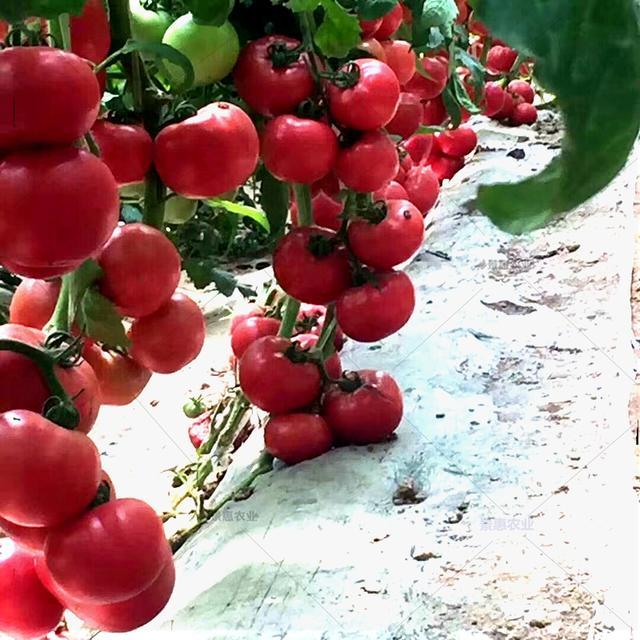
Key Techniques for Tomato Cultivation in Solar Greenhouses
1 Variety Selection
Choose mid-to-late maturing varieties with good tolerance to low temperatures and weak light, disease resistance, and good fruit shape and color. The main cultivated varieties include Baoguan, Jinpeng No. 1, Jinpeng No. 5, Shengnü cherry tomato, etc.
2 Raising Strong Seedlings
Generally sown from mid-August to early September; sowing too late or too early will be affected by the early spring crop or autumn delayed crop, impacting prices. Soak seeds for 3 to 4 h, disinfect with 1% potassium permanganate for 10 to 15 min, rinse clean with water, then germinate. After most seeds have sprouted, sow on the seedling bed, then cover with 1 cm of bed soil. During seedling raising, strengthen light exposure, avoid direct strong light, and shade when temperature exceeds 30°C. Seedlings can be transplanted when they have 4 to 6 true leaves.
3 Timely Transplanting
Tomato has a well-developed root system; deep plow 20 to 25 cm, apply 5,000 to 6,000 kg of organic fertilizer per mu. In mid-to-late September, open furrows for wide and narrow row transplanting: narrow row spacing 60 cm, wide row spacing 80 cm, plant spacing 30 to 35 cm, planting 3,000 to 3,500 plants per mu. After transplanting, form ridges, cover with plastic film, and water once under the film.
4 Field Management
4.1 Temperature management. Regulate temperature by uncovering and covering agricultural film and mulching materials, and adjusting vent size and ventilation duration. Daytime temperature around 25°C, not exceeding 30°C; nighttime temperature above 10°C, preferably 14°C to 17°C. When the minimum temperature inside the greenhouse stabilizes above 15°C, open all vents to increase light exposure.
4.2 Fertilizer and Water Management
4.2.1 Irrigation, intertillage, and seedling hardening. After tomato seedlings recover, water for seedling recovery; intertill promptly after 3 to 4 d. For mid-to-late maturing varieties, harden seedlings after recovery and intertillage; immediately after seedling hardening ends, water to promote fruit development and apply compound fertilizer with the water.
4.2.2 Topdressing. Generally starting after seedling recovery, mainly using urea and nitrogen, phosphorus, potassium compound fertilizers, combined with foliar spraying. Apply topdressing in 4 applications: after seedling recovery, apply 10 kg per mu; when the first truss fruit begins to swell, apply 20 to 25 kg per mu; when the first truss fruit is about to be harvested, apply 10 to 15 kg per mu; during the full fruiting stage, spray 0.3% monopotassium phosphate or 0.2% urea on the leaves.
4.3 Flower and Fruit Preservation. (1) Strengthen cultivation management: raise strong seedlings, apply sufficient basal fertilizer, proper seedling hardening, rational topdressing and watering, and active pest and disease control help reduce flower and fruit drop. (2) Timely use plant growth regulators: treat with 4-CPA (fruit-setting hormone) and 2,4-D. Spray flowers with 4-CPA at a concentration of 25 to 40 mg/L; apply 2,4-D at 15 to 20 mg/L to coat the fruit stalk.
4.4 Plant Training. The tomato stem is semi-lignified and semi-trailing with weak support. When plants reach 30 cm, insert bamboo poles or hang strings 15 cm from the roots to support the plants, and tie the stems multiple times as the plants grow. Use double-stem training: besides the main stem, select and keep a side branch below the first truss as a fruiting branch, growing alongside the main stem, each keeping 3 to 4 trusses of fruit. Remove side branches promptly, and remove lower old leaves and diseased leaves in a timely manner in later stages to facilitate ventilation and light penetration.
5 Pest and Disease Control
5.1 Viral disease. Spray 20% Virus A wettable powder at 500 times dilution, or potassium permanganate at 800 times dilution, once every 8 to 10 d, spraying 3 to 4 times consecutively.
5.2 Septoria leaf spot. Use 75% chlorothalonil wettable powder at 600 times dilution, or 70% thiophanate-methyl wettable powder at 1,000 times dilution, alternating for control, spraying once every 7 to 10 d, 2 to 3 times consecutively.
5.3 Whitefly. Use 10% imidacloprid wettable powder at 1,000 to 1,500 times dilution, or 50% phoxim emulsifiable concentrate at 1,000 to 2,000 times dilution for spray control.