Cultivation Techniques and Management Methods for the Four-Season National Day Chrysanthemum
Cultivation Techniques for the Four-Season National Day Chrysanthemum
Morphological Characteristics and Key Cultural Points
1. Morphological Characteristics
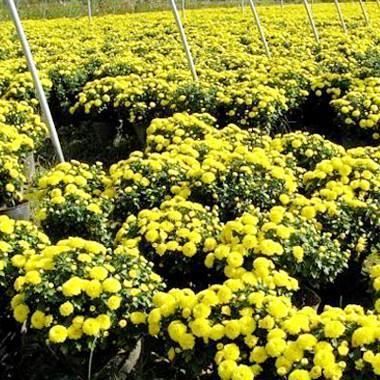
The dwarf four-season chrysanthemum originated in Europe, and the varieties currently available in China were introduced from the Netherlands. Flower colors include yellow, red, pink, purple, and white with a red center. In this trial, this variety was selected from introduced four-season chrysanthemums through artificial breeding and natural hybridization. Its flowers and plant form closely resemble those of the National Day chrysanthemum, except that the National Day chrysanthemum blooms only once at National Day and requires pinching for dwarfing before the growing period, whereas this variety does not require dwarfing or pinching, and its plant form is full and compact. Its flowering period runs from April 25 to December 20, lasting about 300 d, hence the name four-season National Day chrysanthemum. The four-season National Day chrysanthemum has yellow, brilliant flowers, a profusion of blooms, and a long flowering period; it branches profusely, has thick sturdy stems, and a compact, low plant form that is not prone to lodging; the leaves are deep green and relatively small, with cauline leaves ovate or oblong-ovate, pinnately lobed, the terminal lobe large, all lobe margins shallowly lobed, all leaves with glands and sparse soft hairs on the upper surface and grayish green with more hairs on the lower surface; it has the characteristics of a short forcing cultivation time, strong resistance, a long flowering period, and wide adaptability.
2 Key Cultural Points
The four-season National Day chrysanthemum is not limited by light and does not require short-day treatment; it flowers naturally year-round in the open air. It likes light and warmth, its flowers are not afraid of sun exposure, and it also has shade tolerance. It tolerates heat in summer and cold in winter, and can grow and flower normally at 10 to 35°C. After the seedlings are large, bury and apply decomposed poultry and livestock manure, residue cake fertilizer, or multi-element nitrogen-phosphorus-potassium chemical fertilizer away from the roots, in small amounts and multiple times; do not use too much fertilizer too frequently. Normally, water only when the seedling soil is dry, and each watering should just soak through; do not use too much water too frequently, as it fears waterlogging, and excessive water easily causes excessive vegetative growth. In the hottest summer weather, watering in the early morning or evening is best. It has strong reproductive capacity; in spring, summer, and autumn, rooted seedlings can be divided from the roots at any time, and each plant can naturally produce 20 to 30 root seedlings, with some producing more than 50. In summer and autumn, propagation by layering branches produces seedlings relatively quickly; from layering to flowering takes about 20 d or so. It can also be propagated in summer and autumn by stem cuttings; from cutting to flowering takes about 50 d or so. Propagation can also use the basal shoot division method and the new shoot cutting method; basal shoot division can be carried out at any time when the temperature is above 5°C. New shoot cuttings can be done in the rainy season or autumn, with the basic requirements being moisture retention and shading.
Based on its trait characteristics and key cultural points, it can be seen that the four-season National Day chrysanthemum is the preferred plant for large-area green vegetation, plant landscaping, flower beds, courtyard decoration, potted flowers, or cut flowers supplied to the market year-round.