Application of Integrated Water, Fertilizer and Pesticide Technology in Central-Leader Peach Tree Cultivation
Application of Integrated Water, Fertilizer and Pesticide Technology in Central-Leader Peach Trees
Source of the project: Hunan Provincial Key Research and Development Program (2016NK2049).
Integrated water, fertilizer and pesticide technology is a new agricultural technique that combines drip irrigation, fertilization and pesticide spraying into one. According to 2015 statistics, the peach planting area in Hunan Province was about 18,900 hm2, with an output of 108,000 t, ranking third in Hunan's fruit industry, after citrus and pear. With the adjustment of the rural industrial structure and support for industrial poverty alleviation, the peach planting area in Hunan Province has shown a trend of continuous expansion. Central-leader peach production is a labor-intensive industry. Given the shortage of labor and continuously rising production costs, orchard mechanization is the only way to reduce production costs. At present, water and fertilizer management in peach orchards in Hunan Province generally adopts the management model of hole application of fertilizer followed by watering; the utilization rates of fertilizer and water are not high, and it is labor-intensive with relatively high production costs. Compared with traditional fertilizer and water management measures such as border irrigation, integrated water and fertilizer technology can reduce water infiltration and evaporation and improve water use efficiency. It achieves balanced fertilization and concentrated fertilization, reduces fertilizer volatilization and loss, as well as losses caused by excess nutrients, and has advantages such as simple fertilization, timely fertilizer supply, easy absorption by crops and improved fertilizer use efficiency.
1 Materials and Methods
1.1 Experimental Site
The experiment was conducted in the Southern Peach Demonstration Orchard at the Fruit and Vegetable Base of the Chenzhou City Institute of Agricultural Sciences. The latitude is 25.6906, the longitude is 112.8569, the altitude is 338 m, the annual average temperature is 18°C, and the annual average rainfall is 1,490 mm. ... The soil of the experimental orchard is mainly mountain yellow soil.
1.2 Experimental Materials and Methods
The test material was Jinxiu yellow peach. On January 3, 2016, with a plant-row spacing of 1.5 m×4 m, ridge cultivation was adopted, with a ridge height of 35 cm and a ridge width of 2.5 m. A 2 m wide black ground cloth was laid on the ridge surface, and 2 drip irrigation pipes were placed under the ground cloth with a spacing of 40 cm. The outer diameter of the drip irrigation pipe was 16 mm, the wall thickness was 0.4 mm, the emitter spacing was 15 cm, and the maximum laying length was 50 m. Natural grass was allowed to grow outside the ground cloth and between rows to regulate the moisture and temperature of the peach orchard.
1.3 Water and Fertilizer Drip Irrigation System
Integrated drip irrigation water and fertilizer technology uses a pressurized irrigation system to mix soluble solid fertilizer or liquid fertilizer into a fertilizer solution together with irrigation water, and supplies water through a controllable pipeline system, so that the irrigation water with dissolved fertilizer forms droplets and evenly, regularly and quantitatively moistens the crop root development zone, keeping the soil in the main root zone loose and at a suitable moisture state. At the same time, according to the fertilizer requirements of different crops, soil environmental conditions and water requirements at different growth stages, a whole-growth-period demand design is made, and water and nutrients are directly supplied to crops regularly, quantitatively and in proportion. This technology consists of 4 parts: water source, head hub, water transmission and distribution pipelines, and emitters.
1.3.1 Drip Fertigation System One 120 m3 water storage tank was designed. The drip irrigation facility consists of 4 parts: water pump, filter, water transmission and distribution pipelines, and drip emitters. For the head, a combined centrifugal and mesh filter, a Venturi fertilizer injector and a fertilizer tank were selected. The field pipe network was composed of Ф63 mm PE pipes, with one block every 40 m, and each water and fertilizer supply was carried out separately by block.
1.3.2 Fertilization Time and Fertilization Amount Urea 140 g, applied in 2 splits; nitro-sulfur-based ternary compound fertilizer 850 g, applied in 7 splits; organic fertilizer 9 kg (organic matter ≥ 45%, NPK content ≥ 5%), applied once as base fertilizer at planting. Fertilization method: first dissolve the fertilizer in the fertilizer tank, first drip irrigate with clean water for 15 min, and after the main water pipe and drip irrigation pipes are filled with clean water, begin fertilizer irrigation. Through the Venturi fertilizer injector, the fertilizer is automatically supplied evenly to each fruit tree. After fertilizer irrigation is completed, drip irrigate with clean water for 30 min to clean out the residual fertilizer in the drip irrigation pipes so as to avoid pipeline blockage. The concentration of fertilizer in drip irrigation was controlled at 5‰, and the drip irrigation water amount each time was controlled at 40 m3/hm2.
1.4 Pesticide Spraying System
It consists of an electric sprayer, a pesticide tank, a centrifugal filter, a pesticide delivery pipe, valves and spray pipes. PPR Ф20 pesticide delivery pipes were laid in the field, and every 4 pipes shared 1 control valve. When spraying, it is only necessary to connect the Ф5×8 spray pipe and the spraying gun to the control valve for normal spraying.
1.5 Spraying Time and Spraying Amount
(1) Before the flowers show red, spray 3-5 Baume lime sulfur mixture; (2) at the large bell-shaped flower stage, control aphids and spray paclobutrazol to promote fruit set; (3) ... 1 week after flowering, control aphids once; (4) when new shoots are 10-15 cm, spray 180-...300 times paclobutrazol to control shoots; (5) after physiological fruit drop, control fruit borers once; (6) spray once before bagging, mainly to control fruit borers and brown rot, etc.; ...(7) in early to mid-May, when new shoots grow to 40-50 cm, control shoots according to tree age and tree vigor, and at the same time spray insecticides and fungicides to control fruit borers, red spiders, brown rot, scab, etc.; (8) spray once 20 d before harvest to control fruit borers, red spiders and shot hole disease; (9) after fruit harvest, control shoots according to tree vigor and control shot hole disease and leaf spot disease once; (10) in September-October, carry out emergency control according to the pests and diseases occurring at that time.
2 Results and Analysis
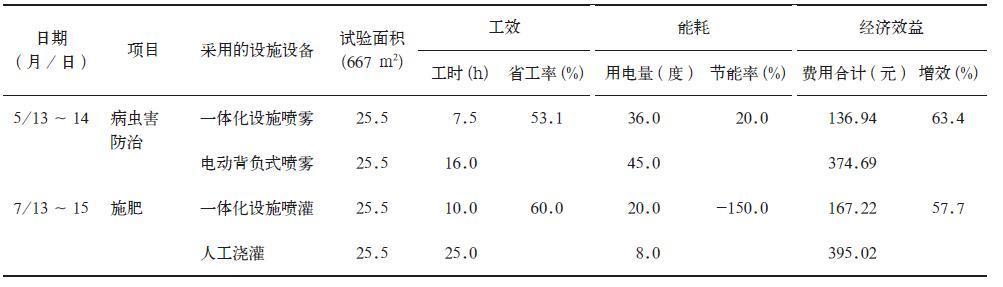
Pest and disease control was carried out on May 13-14, using different facilities and equipment for spraying, and a comparative effect experiment was conducted. The experimental area was ...3.4 hm2. The experimental results of the integrated spraying system and the knapsack electric spraying method are shown in the attached table. Compared with the electric knapsack type, the integrated spraying system saved 53.1% labor, saved 20% energy and increased efficiency by 63.4% in work efficiency, energy consumption and economic benefit respectively. The average labor and power cost per time was 5.37 yuan/667 m2, ... saving 9.32 yuan per 667 m2 in labor and electricity costs compared with the original method.
Fertilization was carried out on July 13-15, using different facilities and equipment for irrigation, and a comparative effect experiment was conducted. The experimental area was 3.4 hm2. The experimental results of the integrated irrigation and fertilization system and the manual irrigation method are shown in the attached table. Compared with manual irrigation, the integrated irrigation system saved 60.0% labor, saved -150.0% energy and increased efficiency by 57.7% in work efficiency, energy consumption and economic benefit respectively. The average labor and power cost per time was 6.56 yuan/667 m2, saving 9.11 yuan per 667 m2 in labor and electricity costs compared with the original method.
The integrated water, fertilizer and pesticide system integrates the 3 major functions of irrigation, fertilization and pesticide spraying into one, achieving the goals of high efficiency, energy saving and labor saving.
Attached Table Statistical Analysis of Operating Costs of the Integrated Water, Fertilizer and Pesticide System
3 Discussion
Aiming at the problem of high labor intensity in peach orchard production management, this project designed and built integrated water and fertilizer and integrated pesticide spraying system facilities. The application effect was excellent. Compared with conventional methods, the integrated spraying system saved 53.1% labor, saved 20% energy and increased efficiency by 63.4% in work efficiency, energy consumption and economic benefit respectively compared with the electric knapsack type, and the fertilization effect was also excellent. In particular, it can free workers from heavy physical labor and significantly improve labor productivity, which is basically consistent with the experimental results of others.
Integrated water and fertilizer technology can enhance soil microbial activity. Compared with conventional border irrigation and fertilization technology, drip fertigation can increase soil temperature by 2.7°C, which is conducive to enhancing soil microbial activity, promoting crop nutrient absorption and improving soil physical properties. Drip fertigation overcomes soil compaction caused by irrigation, reduces soil bulk density, increases porosity, reduces soil nutrient leaching and reduces groundwater pollution. Integrated drip irrigation water and fertilizer technology can promote increased crop yield and improved product quality. When crop yields are similar or the same, integrated water and fertilizer technology saves 40%-50% of chemical fertilizer compared with traditional fertilization technology.