After succulent leaf cuttings have rooted and sprouted, these 5 care points cannot be ignored
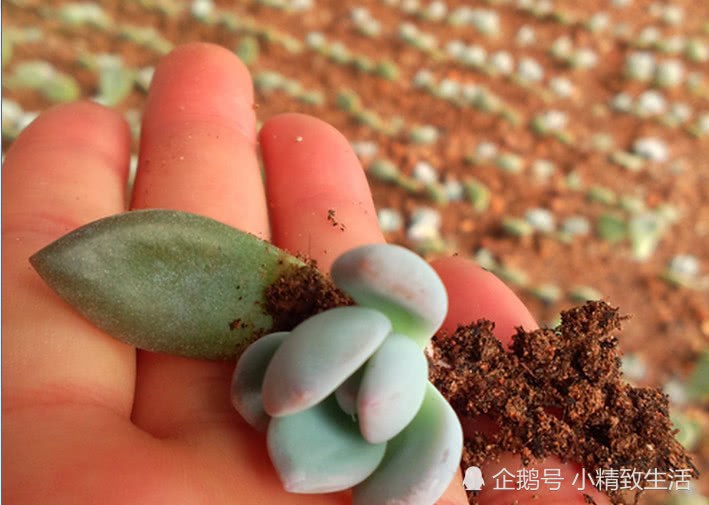
"Give me a few leaves, and I will give you back a succulent garden." Leaf cuttings are an important way to propagate succulents. Watching leaf after leaf slowly take root, sprout and grow into individual succulent plants, you cannot help but marvel at the wonder of nature.
However, some friends who are new to the hobby find that when they try leaf cuttings, even though the leaves have rooted or sprouted, they still end up dying in the end. Why is that? To be honest, getting leaves to root and sprout is not difficult. As long as you place leaves with a growth point in a ventilated, dry and shady environment, they will still root and sprout even if they do not touch the potting soil. The care during the transition period from rooting and sprouting to the young plant completely separating from the mother leaf and growing normally is what matters most. Below, Xiao Jingzhi Life will explore with you the care of leaf-cutting seedlings during the transition period:
1. During the transition period, the potting soil for the seedlings should be as loose as possible to facilitate root growth of the seedlings. The potting soil can be a mix of peat + coconut coir + vermiculite + coarse sand. Peat has a remarkable effect on rooting, and coarse sand helps make the root system thick and strong. With only peat and no coarse sand, the root system will be very slender, but the more coarse sand there is, the harder it is to root. The specific soil mixing ratio needs to be adjusted according to actual conditions.
2. The potting soil for leaf cuttings can be moist, but it must be ventilated. Because leaf-cutting seedlings are very fragile, although they still have the supply from the mother leaf, at this time they must work hard to root into the potting soil in order to cope with the situation later when the mother leaf slowly withers. So at this time, moist potting soil is beneficial to the growth of the seedling root system. However, because the mother leaf is in direct contact with the potting soil, long-term moisture can easily cause the mother leaf to turn to mush, so good ventilation is essential. Good ventilation can quickly dry the surface layer of the potting soil, while the inner layer of the potting soil is still moist at this time. Dry on the surface and moist inside is exactly the potting soil environment that leaf-cutting seedlings like best.
3. Seedlings in the transition period should not be exposed to full sun directly. Just place them in a ventilated environment with scattered light for quiet care. As the seedlings slowly grow, you can gradually and appropriately increase the duration and intensity of light step by step, until they can fully receive full sun.
4. If the mother leaf turns black or the back is wrinkled and very ugly, this may be a sign that it is about to turn to mush. At this time, if it has already sprouted and there are seedlings, you can gently use a toothpick to separate the seedlings and roots, then throw away the mother leaf and let the seedlings grow on their own. If the mother leaf has not yet rooted or sprouted, throw it away decisively to avoid infecting other leaf-cutting succulents.
5. Succulents at the seedling stage can be tried in mixed plantings of different varieties. Mixed-planted small succulents may be plumper than those planted alone, and their growth rate may also be faster. There may be a factor of mutual competition in this.
The above was compiled and published by Xiao Jingzhi Life. We hope it is helpful to you.