Banana supply-demand imbalance: Council of Agriculture spends 1 billion to build cold chain and pilot income insurance
In response to recent media reports of banana and pineapple market collapses, Council of Agriculture Deputy Minister Chen Chi-chung held another press conference today (the 19th), saying, "There is a difference from the actual situation." The price of green bananas at production areas has now rebounded to 9 to 13 yuan; pineapples have also set the best export volume in six years. He stressed that there is no issue of exports being blocked due to cross-strait factors, and that "inaccurate reports will affect farmers' income."
Pineapple exports hit a six-year high; banana prices stabilize with production-area prices at 9 to 13 yuan
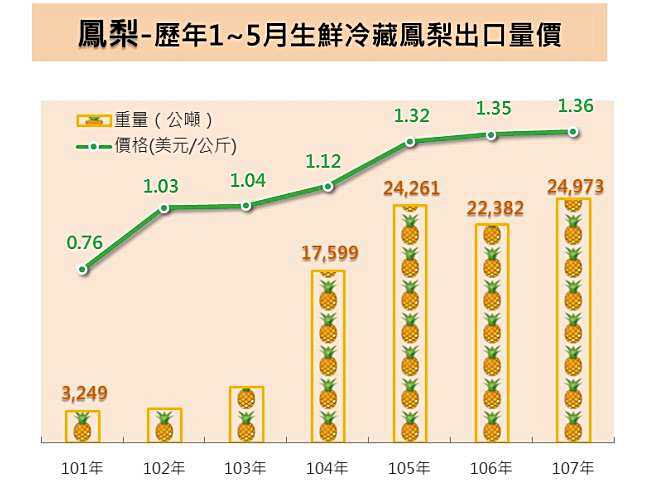
Since last month, there have been continuous reports of price collapses for bananas and pineapples, and the Council of Agriculture has held multiple press conferences and rolled out various measures in hopes of stabilizing prices. For pineapples, according to statistics, as of the end of May this year, export volume reached 31,947 metric tons, an increase of 16% compared with 27,439 metric tons in the same period last year, and the export price was 1.36 US dollars per kilogram.
On bananas, Chen explained that a previous press conference had already announced plans to handle 11,000 metric tons of bananas, and nearly 5,000 metric tons have been handled so far. According to wholesale prices at the Taipei Fruit and Vegetable Market, banana prices have stabilized at 18.4 yuan per kilogram, and green bananas at production areas have also rebounded to 9 to 13 yuan per kilogram. "If another 5,000 metric tons are handled later, prices will certainly rise further."
At present, pineapple and banana prices have stabilized, but some media outlets keep emphasizing price collapses and blocked exports. Chen stressed, "There is no such thing." Such incorrect information will lead traders to use the same incorrect information to mislead farmers when purchasing, causing farmers' income to suffer.
Developing banana processed products and piloting banana income insurance
In addition, agricultural product processing is also a major issue. Chen explained that generally 60% of agricultural products are consumed directly and 40% are used as processed products. Only when the processing ratio increases will there be an outlet when crops are in abundant harvest, "but at present the processing ratio for bananas does not exceed 5%." Southeast Asian countries grow bananas in large quantities and have developed many processed products, such as banana ice cream, banana biscuits, dried bananas, and breakfast banana slices. The Council of Agriculture will also actively carry out research and development in the future so that a higher proportion of bananas can be used for processing.
Chen said that some banana farmers buy healthy seedlings to plant, but some banana farmers use suckers, which cost less but are of poorer quality, and poor quality will affect prices. "Some farmers just hope a typhoon will come so they can receive disaster relief." For this reason, the Council of Agriculture will adjust the amount of natural disaster relief; if combined with planting registration, a higher subsidy can be obtained; if ratoon cultivation is used, the subsidy will be lower.
Chen further pointed out that there are also plans for banana income insurance combined with planting registration, to be piloted in various townships, towns and cities. If farmers participate in income insurance, the Council of Agriculture guarantees a certain income.
Adjusting the tariff quota system to reduce the impact on the domestic market
As for long-term measures, Chen explained that the tariff quota system will be adjusted. In the future, it may be possible to allocate part of the quota to related processed products rather than directly importing the crop itself, and the import period for agricultural product tariff quotas will also be adjusted to reduce the impact on the domestic market.
In the future, public-private cooperation will also be strengthened to provide policy tools. Chen explained that the price of red beans this year is 20% lower than last year, and farmers do not have equipment to refrigerate or store inventory. In the future, through farmers' associations and farmers' groups willing to cooperate, purchases will be made from farmers and help will be provided to find suitable cold storage space, so farmers do not need to sell immediately and prices will not be pushed down.
The Council of Agriculture said that through complete production-and-marketing management and guidance measures from the production end to the market end, production-area prices of agricultural products will be kept above cost, further increasing farmers' income.